
Tohoku Gakuin's "Founding Principles"
The three founders of Tohoku Gakuin, Masayoshi Oshikawa, W.E. Hoy, and D.B. Schneider, stated that the founding spirit of Tohoku Gakuin lies in education that "emphasizes individual dignity and the perfection of character" based on the faith of "evangelical Christianity" of the Reformation.
This education aims to cultivate reverence for God as shown in the Bible and a spirit of love for one's neighbor, following the example of Jesus Christ, and to nurture individuals who will contribute to cultural development and welfare.
The three founders who laid the foundation for Tohoku Gakuin
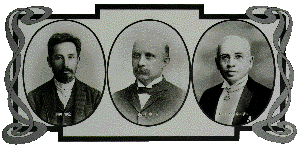
The first director: Masayoshi Oshikawa
(1850–1928)
Born as the third son of the Hashimoto family, samurai of the Matsuyama domain, he was adopted into the Oshikawa family. He was exposed to Christianity at an English school in Yokohama and was baptized by Barrath in 1872 (Meiji 5). He organized the Japan Christian Church, the first Protestant church in Japan. In 1886 (Meiji 19), he co-founded the Sendai Theological Seminary with Hoy. Five years later (1891 (Meiji 24)), it was renamed Tohoku Gakuin. The following year, he became the first principal, resigning in 1901 (Meiji 34). He remained involved with Tohoku Gakuin as an advisor for the rest of his life.
First Vice Director: W.E. Hoy
(1858–1927)
An American and German Reformed Church missionary. A graduate of Lancaster Theological Seminary in the United States. He came to Japan in 1885. The following year, together with Oshikawa and others, he founded Sendai Theological Seminary and Miyagi Girls' School (Miyagi Gakuin). In 1892, he became Vice President of Tohoku Gakuin. In 1899, he resigned from the school and began missionary work in Hunan Province, China.
Second Director: D.B. Schneider
(1857–1938)
An American and German Reformed Church missionary. A graduate of Lancaster Theological Seminary in the United States. He came to Japan in 1887 (Meiji 20). The following year, he was assigned to Sendai and assisted Oshikawa and Hoy as a professor at the newly established Sendai Theological Seminary. In 1901 (Meiji 34), he became the second president. During his 35-year tenure, he developed Tohoku Gakuin from a private school into a well-established Christian educational institution with a middle school, high school, and theology departments. He is considered the restorer of Tohoku Gakuin.