
















140th Anniversary
Tohoku Gakuin University's origins date back to 1886, when the private school "Sendai Theological Seminary" was established. Since then, it has developed into one of Tohoku's leading private higher education institutions, responding to the demands of the times. Today, it enjoys a high reputation as a university boasting comprehensive specialized education and an excellent research system.
In 2026, the year of our 140th anniversary, our university is moving forward with a new direction to create a university that offers new appeal. In 2023, we opened Itsutsubashi Campus and established four new faculties and five new departments. We will realize a next-generation educational space, including groundbreaking school buildings that support students' proactive learning.
The three founders who laid the foundation for Tohoku Gakuin
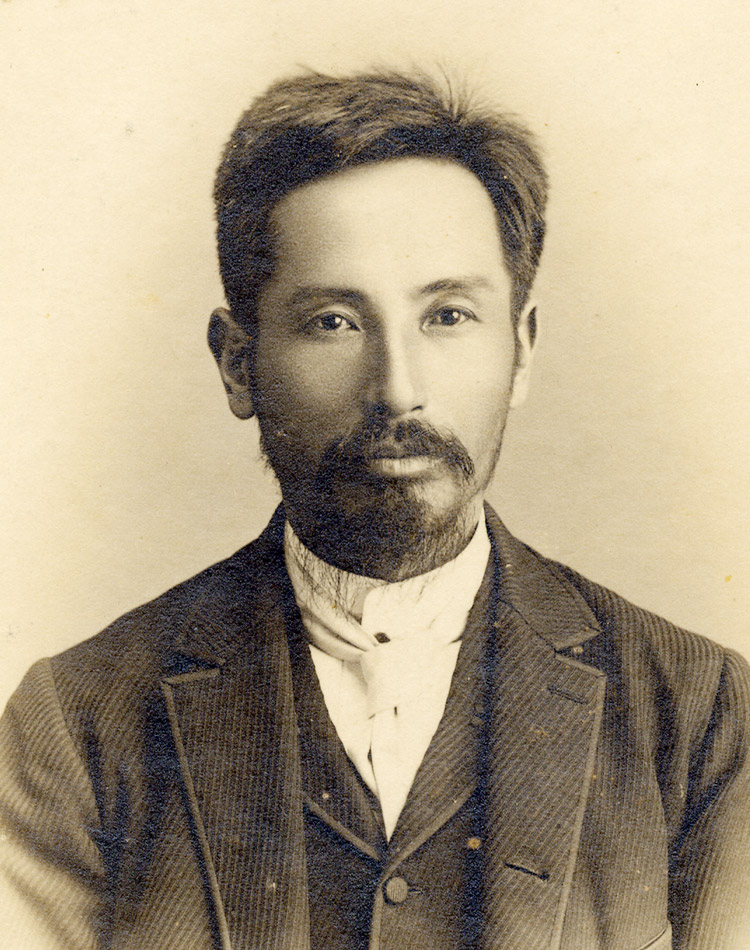
First director (1850-1928)
Masayoshi Oshikawa
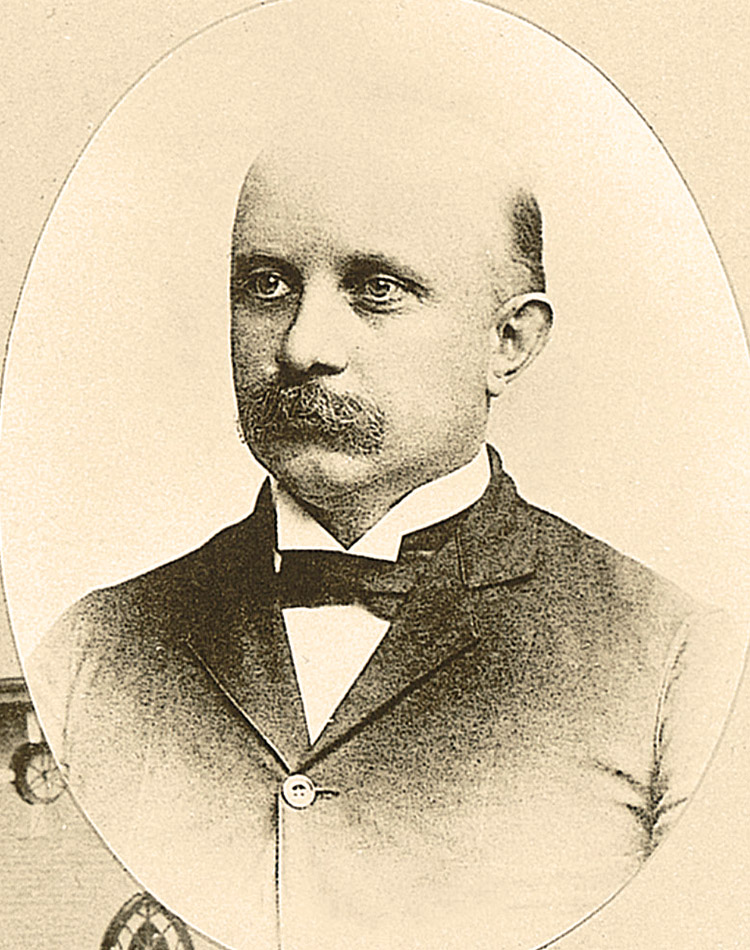
First Vice-Director (1858-1927)
W.E. Hoy
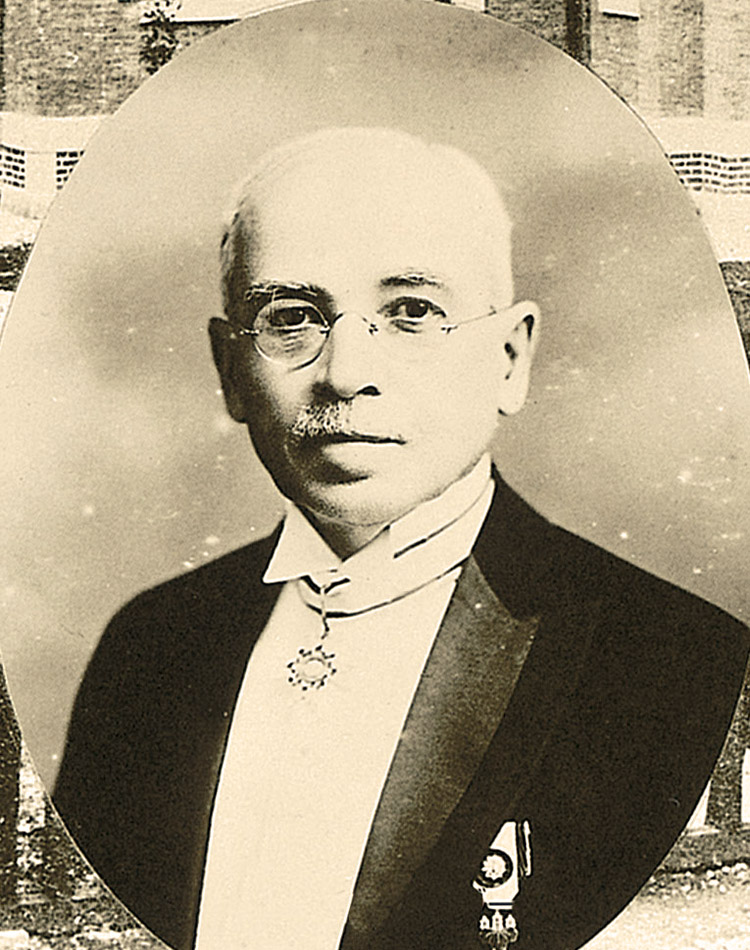
Second director (1857-1938)
D.B. Schneider
The history of Tohoku Gakuin University dates back to the establishment of the private school "Sendai Theological Seminary" in 1886. In the 1880s, Masayoshi Oshikawa was based in Sendai and engaged in Christian missionary work. Eventually, Oshikawa met W.E. Hoy, a missionary who had come to Japan from America, and together they established "Sendai Theological Seminary." The following year, missionary D.B. Schneider joined them. They established the founding principles of the university as an education based on Christian faith, emphasizing "respect for the individual and the perfection of character," and aiming to cultivate individuals who would contribute to cultural development and welfare.
Tohoku's largest private comprehensive university
After the establishment of the private school "Sendai Theological Seminary," the predecessor of Tohoku Gakuin University, in 1886, it was renamed Tohoku Gakuin in 1891. Since its establishment as a new university in 1949, it has gone through many historical changes and today, as the largest private comprehensive university in Tohoku, rooted in and contributing to the local community, it is cultivating individuals who can pioneer a new era.
Two campuses
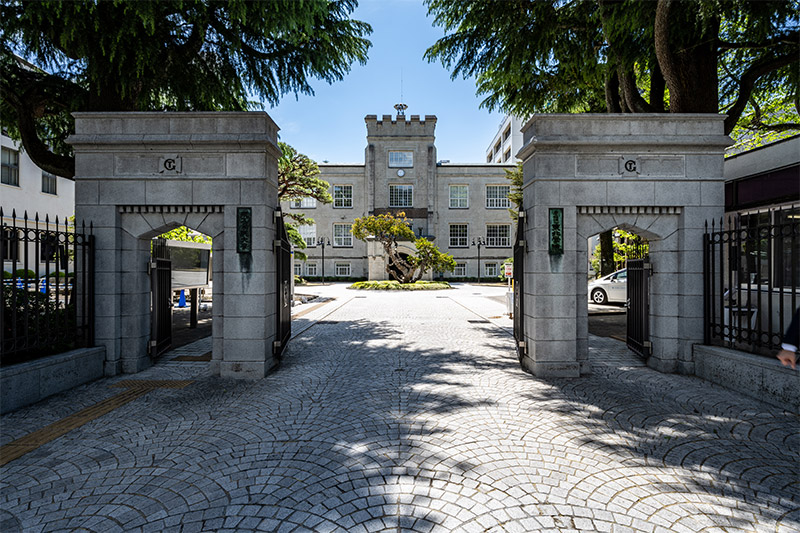
Tsuchitoi Campus
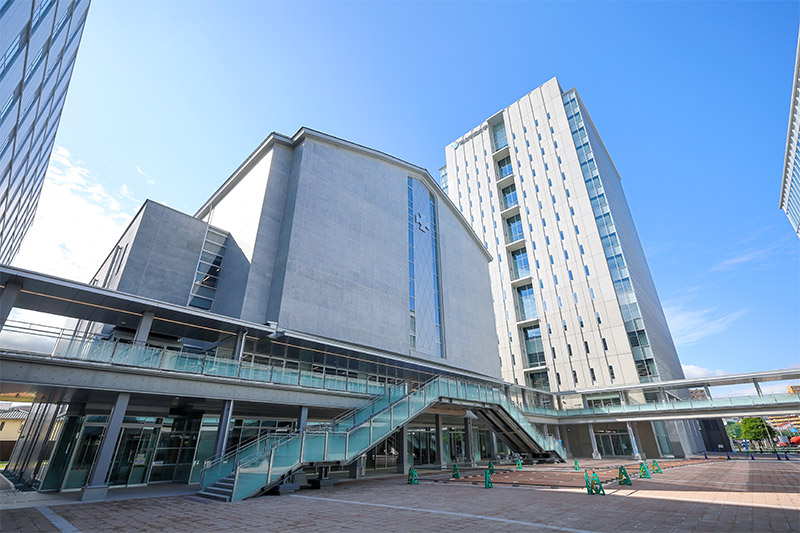
Itsutsubashi Campus
*The athletic facilities and some extracurricular activity facilities at the Izumi Campus are available for use.
University where many students study
Tohoku Gakuin University has 11,528 students (11,395 undergraduate students and 133 Graduate Schools) as of May 1, 2024.
Number of full-time faculty members
Tohoku Gakuin University has 308 experienced full-time faculty members who are dedicated to providing diverse learning opportunities tailored to each student's interests and concerns. (As of May 1, 2024)
A comprehensive university where you can study a wide range of subjects.
Tohoku Gakuin University is home to the Center for Liberal Arts Education, which is the core of liberal arts education, as well as Faculty of Letters (Department of English, Department of General Humanities, Department of History, Department of Education), Faculty of Economics (Department of Economics), Faculty of Business Administration (Department of Business Administration), Faculty of Law (Department of Law), and Faculty of Engineering (Department of Mechanical Engineering and Intelligent Systems Department of Electrical and Electronic Engineering, Department of Civil and Environmental Engineering), Faculty of Regional Studies (Department of Regional Community Studies, Department of Policy Design), Faculty of Informatics (Department of Data Science), Faculty of Human Sciences (Department of Psychology and Behavioral Sciences), Faculty of International Studies (Department of International Studies), 9 faculties and 15 departments, Graduate School of Letters (English Language and Literature major, European Cultural History major, It is the largest private comprehensive university in Tohoku, with six graduate schools and 12 majors: Asian Cultural History, Graduate School of Economics (Economics, Economic Data Science), Graduate School of Business Administration (Business Administration), Graduate School of Law (Law), Graduate School of Engineering (Mechanical Engineering, Electrical Engineering, Electronic Engineering, Environmental Construction Engineering), and Graduate School of Human Informatics (Human Informatics).
Promoting diverse research
Grants-in-Aid for Scientific Research are subsidies provided by the Ministry of Education, Culture, Sports, Science and Technology to support academic research at universities and other institutions. These grants cover a wide range of fields, from humanities and social sciences to natural sciences, and provide funding for original and pioneering research aimed at significantly advancing academic research.
Tohoku Gakuin University's Grants-in-Aid for Scientific Research for the 2023 academic year totaled 86 projects and 121.81 million yen (including 25 new projects totaling 60.32 million yen), with a diverse range of research projects across various faculties being selected. (As of March 29, 2024)
*By entering "Tohoku Gakuin" in the free word search field on the external website "Grant-in-Aid for Scientific Research Database," you can view research summaries and other information about our faculty members.
Universities with which we have overseas partnerships – learning extends beyond the campus.
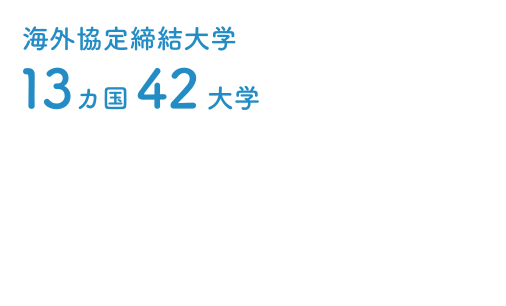
Tohoku Gakuin University provides students with opportunities to directly experience different cultures and cultivate a global perspective and proactive communication skills. Currently, the university has international educational exchange agreements with 42 universities in 13 countries, and academic exchanges and student exchanges are conducted with these universities.
In particular, Ursinus College and Franklin & Marshall College in the United States are partner institutions that share the same founding roots as our university, and we have a long history of mutual exchange between faculty and students.
In addition, we have agreements with universities in the United Kingdom, Serbia, Germany, France, Bulgaria, China, Taiwan, South Korea, Thailand, Vietnam, Australia, and Canada, and we are engaged in global international exchange activities.
A library boasting one of the largest collections of books among universities in the Tohoku region.
With a collection of approximately 1.24 million books and 17,000 magazine titles, it is one of the leading university libraries in the Tohoku region.
For more details, please visit the library's website below.
*The number of books in our collection is as of fiscal year 2024.
130 student clubs are currently active.
At Tohoku Gakuin University, approximately 130 organizations are active, including the General Executive Committee, clubs, research groups, and student societies. Students also interact with other universities and external organizations, expanding their social circles.
In addition, the website "TG MIND," which supports extracurricular activities, introduces students' competition records, activity reports, and schedules, conveying the "heart and spirit of Tohoku Gakuin University."
5 historical buildings
Tsuchitoi Campus of Tohoku Gakuin University has four nationally registered tangible cultural properties: the Tohoku Gakuin University Main Building (formerly the Department of Specialized Courses building), the Rahäuser Memorial Tohoku Gakuin Chapel, the Tohoku Gakuin University Graduate Schools Building (formerly the Schneider Memorial Tohoku Gakuin Library), and the Tohoku Gakuin University Main Gate. In addition, the DeForest Hall is registered as a nationally important cultural property as the "Former Tohoku Gakuin Missionary Residence."
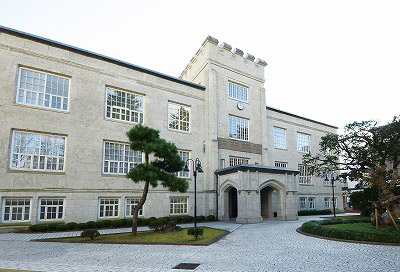
Tohoku Gakuin University Main Building (Former Specialized Department Building)
- Construction year: July 1926 (Taisho 15)
- Designer: J.H. Morgan
- Number of floors: 3
- Contractor: Torazo Nitta (Construction Supervisor: F.B. Nicodemus)
- Total floor area: 1,904 m²
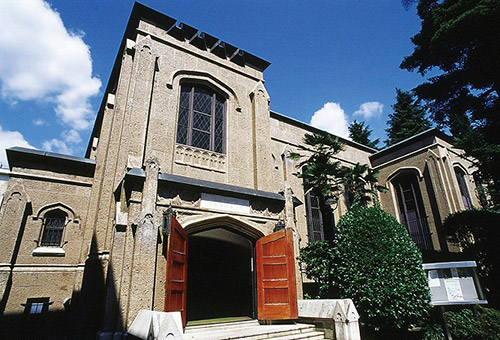
Rahäuser Memorial Tohoku Gakuin Chapel
- Year of construction: March 1932 (Showa 7)
- Designer: J.H. Morgan
- Number of floors: 2 above ground, 1 below ground
- Contractor/Ishiigumi
- Total floor area: 1,529 m²
- Capacity: 900 people
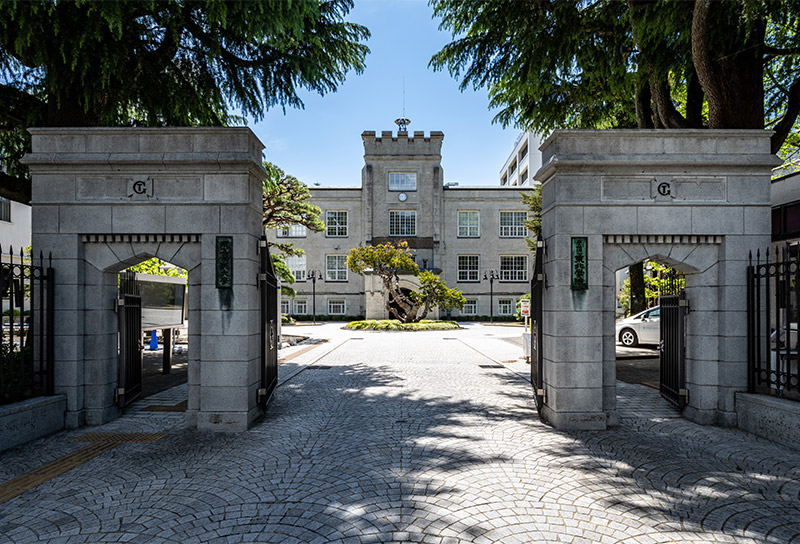
Main Gate of Tohoku Gakuin University
- Year of construction: 1926 (Taisho 15)
- Designer: J.H. Morgan
- Builder/Torazo Nita
- Total floor area / Main gate frontage 4.2m, side gate frontage 2.0m
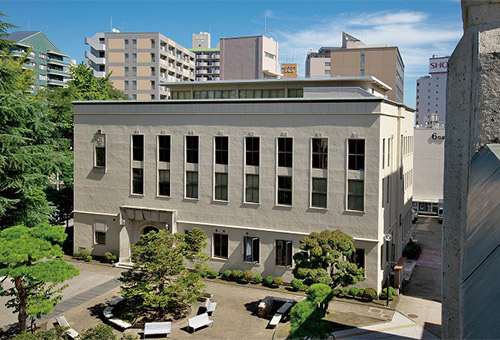
Tohoku Gakuin University Graduate Schools Building (formerly the Schneider Memorial Tohoku Gakuin Library)
- Year of construction: 1953 (Showa 28) (Renovated and expanded in 1963 and 1966)
- Designer: Yamashita Juro Architects & Engineers Co., Ltd., Sendai Branch (currently Yamashita Design Co., Ltd., Tohoku Branch)
- Number of floors: 6 floors above ground
- Construction Company: Ohki Construction Co., Ltd.
- Total floor area: 2,447 m² (including the 6th floor extension)
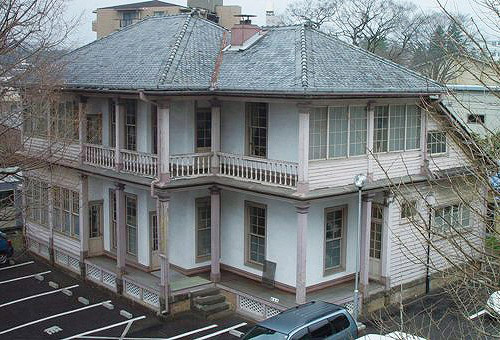
Tohoku Gakuin Former Missionary Residence (DeForest Hall)
- Year of construction: Around 1887 (Meiji 20)
- Designer/Technician, Miyagi Prefectural Civil Engineering Division: Noboru Ueda
- Construction contractor/unknown
- Number of floors / 2nd floor
- Total floor area: 391 m²
Social collaboration activities
Tohoku Gakuin University has concluded 28 agreements (*) with local companies and government agencies, contributing to the development of the local community and human resource development. (*Includes memoranda of understanding and agreements; as of April 2024)
Specific initiatives
- "Summer Vacation Children's English Campus" based on collaboration with the Sendai City Board of Education
- Collaboration with Miyako City, Iwate Prefecture: "Miyako Newton School"
- Collaborative project with Tagajo City: "Engineering-related awareness activities (for junior high school students)"
- Joint course with Miyagi Okami Association and the Sendai Tourism Convention Association: "The Management of Hospitality"
- Collaboration with FM Sendai Co., Ltd. on "RADIO COLLEGE," and support for various events.
etc.
Initiatives for regional revitalization
Tohoku Gakuin University is implementing two main initiatives as a university that contributes to the local community.
Miyagi-Sendai Regional Human Resource Development Collaborative Project Platform
Our university was selected for the "Development of Highly Skilled Regional Human Resources through the Miyagi-Sendai Collaborative Education Infrastructure" project, which we submitted as the applicant university, as part of the 2015 "Regional Revitalization Promotion Project by Universities as Regional Knowledge Hubs (COC+)".
This initiative is a joint effort between 12 universities and technical colleges in Miyagi Prefecture (our university, Miyagi University of Education, Tohoku Institute of Technology, Ishinomaki Senshu University, Shokei Gakuin University, Sendai University, Sendai Shirayuri Women's University, Tohoku Seikatsu Bunka University, Miyagi Gakuin Women's University, Seiwa Gakuen Junior College, Tohoku Seikatsu Bunka University Junior College Division, and Sendai National College of Technology), Miyagi Prefecture, and Sendai City, aiming to cultivate and retain human resources who can contribute to the region and to revitalize the local economy.
In 2020, building upon the collaborative system cultivated through the "COC+" project, we established the "Miyagi-Sendai Regional Human Resource Development Collaborative Project Platform" to further promote various projects aimed at regional revitalization.
Specific initiatives
- Miyagi Municipalities Discovery Program
- Miyagi Company Discovery Program
- Miyagi IT Discovery Program
- Miyagi's Work Experience Program
Building sustainable local communities through various courses and programs.
As an institution of higher education, our university contributes to the creation of a sustainable local community by conducting courses and other activities related to local communities for a wide range of citizens.
Specific initiatives
- Community Social Worker (CSW) Skills Development Program
- Community Social Worker (CSW) Public Study Group
- Active Community Academy (Kesennuma City - Commissioned Research Project)
Alumni spread throughout the country
The Tohoku Gakuin Alumni Association was established in 1903. It is comprised of graduates who have completed studies at Tohoku Gakuin (Junior High School, Senior High School, Tsutsujigaoka Senior High School, University, and Graduate Schools), and its purpose is to "promote fellowship and mutual learning among members based on the founding spirit of the school, and to contribute to the development of our alma mater." Today, there are over 200,000 alumni both in Japan and abroad.
A nationwide network
There are 86 alumni association branches throughout Japan, including all 47 prefectures and North America, organized by alumni who live or work in the same area, contributing to the development of their alma mater. Each branch holds an annual general meeting and social gathering to foster camaraderie and strengthen bonds among alumni. In addition, there are 123 TG associations organized by occupation.
Having a family of alumni throughout Japan and around the world provides a great sense of reassurance and strengthens the bond between the university and society.
Number of CEOs
Tohoku Gakuin University ranks 35th nationwide in the "University Rankings for Company Presidents," having produced 1,680 company presidents. (From "University Rankings 2024," Asahi Shimbun Publications) Furthermore, it is said that the vast majority of company presidents in Miyagi Prefecture are graduates of Tohoku Gakuin University.
Tohoku Gakuin University has an environment that fosters "employability" and "social skills," and its graduates acquire these skills and confidently navigate society.
The skills that graduates who have thrived in the business world and become known as "top business people" become apparent from those who gained their "strengths" at Tohoku Gakuin University.
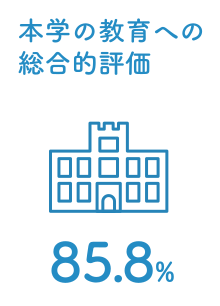
Comprehensive evaluation of our university's education
Based on the "2025 Graduation Attitude Survey." This report analyzes responses from graduates in March 2025, compiling data on those who answered "very good" or "somewhat good."
Comprehensive evaluation of graduates by their employers.
From the "2025 Graduates' Career Path Survey on Learning Outcomes." This data compiles responses of "Very Satisfied" and "Satisfied."
Number of students studying abroad
This number represents the number of students who participated in short-term study abroad programs during long holidays or exchange programs lasting six months or one year. In exchange programs, credits earned at the host institution may be recognized as credits at this university.
Number of companies offering job research seminars
In 2023, a career research seminar for third-year students was held online. Approximately 250 leading companies participated over five days.
Employment rate
Our school's Career Support Office provides various forms of support to help students build better careers.
*Based on the results of a survey conducted among 2023 graduates who were seeking employment.