
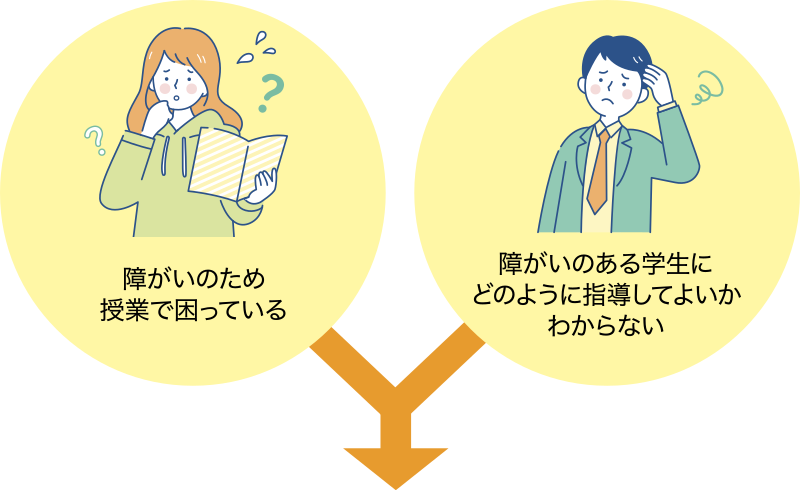
Please feel free to contact the Student Support Office.
We will provide support and assistance to students with disabilities by accepting consultations regarding anxieties and difficulties they may be experiencing in the classroom, and coordinating the provision of reasonable accommodations.
Regarding academic support and reasonable accommodations
Reasonable accommodation refers to making environmental adjustments to ensure that students with disabilities or illnesses have equal learning opportunities with other students. To create an environment where everyone can learn while respecting one another, we hope that even those without disabilities will watch the video and deepen their understanding of reasonable accommodation.
Please watch below.
*Viewing requires logging in to a Google account at "~g.tohoku-gakuin.ac.jp".
To those who wish to receive support
This program is for students with disabilities, including visual impairments, hearing impairments, speech impairments, physical disabilities, chronic illnesses, developmental disabilities, mental disabilities, and other disabilities. If you have any concerns or difficulties attending classes due to your disability, please feel free to contact the Student Support Office.
For detailed information on the support process, please see the support process page.
Student Support Office Guide (PDF)
User Guide
- Opening hours:
Monday to Friday, 9:00 AM to 5:00 PM (excluding worship service times)
We accept appointments for consultations by visiting our office, calling us, or using our online consultation booking form.
Reservation form
*Reservations can be made here.
To all faculty and staff members
For students with disabilities to have a fulfilling student life, just like students without disabilities, the understanding and cooperation of all faculty and staff are essential.
The Student Support Office accepts consultations from students with disabilities regarding any difficulties or anxieties they may have in their studies, and coordinates support systems in cooperation with faculty and staff.
To the instructors
If a student receiving support requests accommodations in their classes, the Student Support Office will distribute a "Request for Reasonable Accommodation" form to the instructors of the courses the student is taking. Once you receive the form, we would appreciate it if you could accommodate the request to the extent possible.
If you have any questions regarding the contents of the document or the guidance provided to the student support staff, please feel free to contact the Student Support Office. Also, please handle the document with care.
FAQ
Reasonable accommodation refers to removing social barriers to the extent that they do not impose an undue burden on students with disabilities, in accordance with their needs. The Student Support Office takes into account the characteristics of each disability and individual circumstances, and works in cooperation with various organizations inside and outside the university to coordinate and support the provision of reasonable accommodation.
The support provided varies for each student with a disability, but we strive to tailor the support to each individual student as much as possible through interviews. We also distribute a request for reasonable accommodations to instructors and relevant administrative departments, providing support primarily through information sharing. For detailed information on the support process, please refer to the support flow chart.
The Student Counseling Center accepts consultations regarding relationship problems, physical and mental health issues, and other concerns, regardless of whether or not you have a disability. If you feel anxious about attending classes or require support due to a disability, please contact the Student Support Center.
The specific accommodations will be determined based on the student's experiences and difficulties in their studies.
However, relaxing graduation requirements or credit requirements, or fundamentally changing the purpose of lectures, would be unfair to other students and therefore not considered reasonable accommodation. Also, depending on financial and human resource constraints, we may not be able to provide certain accommodations. We will discuss and decide on the accommodations you require during an interview, so please feel free to contact us.
At this university, we cannot treat absences as attendance due to reasonable accommodations, as this would constitute a relaxation of the requirements for obtaining credits.
It takes time to gather necessary information, hold meetings to decide on the accommodations, and prepare the document before a request for reasonable accommodation is issued. Therefore, if you wish to receive support, we recommend that you apply well in advance. If you are going to a medical institution far away or have not yet visited a medical institution, it may take several months to more than half a year depending on the hospital's appointment schedule.
The Student Support Office coordinates support based on the student's request for assistance. If a student expresses a need for assistance regarding their classes, we would appreciate it if professors could introduce them to the Student Support Office. For any other questions regarding support for students with disabilities, we also offer consultations with our specialist staff.
Support services tailored to each type of disability
The Student Support Office coordinates efforts to ensure that each student with a disability receives the same educational opportunities as students without disabilities.
The following are examples of support based on the characteristics of each disability and the support that has been provided to date.
Regardless of whether it's stated here or not, actual support will be arranged through individual consultations.
Points to note when receiving support
- Support from the Student Support Office does not guarantee that you will earn academic credits.
- We will not provide any support that would reduce the difficulty of the educational content.
- Please consult with your parents/guardians beforehand regarding receiving support.
- We do not provide assistance with commuting from home to the university or with daily life at the university.
- Taking into account the extent of the impact on operations, the feasibility of implementation, the level of cost burden, the scale of the project, the financial situation, etc., if it is determined that the project would place an excessive burden on the university or would significantly disrupt the balance with other students, the applicant's request may not be granted.
- It takes time from application to the start of support. Please contact us as soon as possible.
Visual impairment
- example)
-
- Regarding access to textual information
-
- Avoid demonstrative pronouns like "that" and "this," and provide specific explanations.
- Permission to photograph the whiteboard and record lectures.
- Advance provision of lecture materials in electronic format.
- Magnifying glasses, PCs, tablets, etc. are permitted.
- Provide enlarged copies of the documents.
- Environmental and transportation-related matters
-
- Orientation sessions will be held on campus (including walking practice).
- Securing a seat (depending on factors such as lighting conditions or the use of assistive devices, it may be advisable to secure a seat).
- Braille signage and additional installation of tactile paving blocks.
Hearing impairment
- example)
-
- Consideration for seating arrangements, and careful attention to speaking style (speaking slowly and clearly).
- Provide visual materials.
- A simple electronic whiteboard for written communication has been installed.
- Use of speech recognition and text conversion apps.
lameness
- example)
-
- Installation of a table specifically for wheelchair users.
- Permission to record lectures and take photos of the whiteboard is granted.
- Parking on campus is permitted (prior application is required).
- Assisting with on-campus movement practice.
- Considerations for the placement of tactile paving (tactile paving can sometimes obstruct the movement of students with physical disabilities).
- [Reference] Campus Barrier-Free Map
-
- Tsuchitoi Campus (PDF: 399KB)
- Itsutsubashi Campus (PDF: 237KB)
Developmental disability
- example)
-
- In addition to verbal explanations, visual explanations are also used (e.g., writing on a blackboard, distributing materials, using diagrams).
- I will explain the important points multiple times.
- Recording lectures and taking photographs of the whiteboard are permitted.
- We will contact students in advance about classes using methods that are easily accessible to them.
- Avoid beating around the bush. Give specific instructions and communicate slowly and carefully.
- Students will be reminded to be quiet during class.
- Leaving the room midway through the session is permitted.
- Distribute written notices (things to be done) such as assignment deadlines on a piece of paper.
- Clearly define the rules of the discussion.
- We will provide careful supervision.
Mental illness
- example)
-
- We will provide careful supervision.
- Avoid appointing anyone to leadership roles whenever possible.
- Taking photographs of the whiteboard and recording lectures are permitted.
- During the exam, taking the test in a separate room and having the time extended will be permitted.
- Taking medication and leaving the room during the session are permitted.
- Information accessibility during absences (distribution of materials, communication of important information).
- Consideration for handling absences, tardiness, and early departures.
sickly/weak
- example)
-
- To prepare for responding to seizures and other emergencies, we will develop and share an emergency response manual.
- We will make changes and adjustments to accommodate disabilities, without altering the fundamental essence or purpose of the lessons.
- We will take into consideration the use of classrooms and assigned seating.
- Leaving the room midway through the session is permitted.
- Information accessibility during absences (distribution of materials, communication of important information).
- Consideration for handling absences, tardiness, and early departures.
Barrier-free map
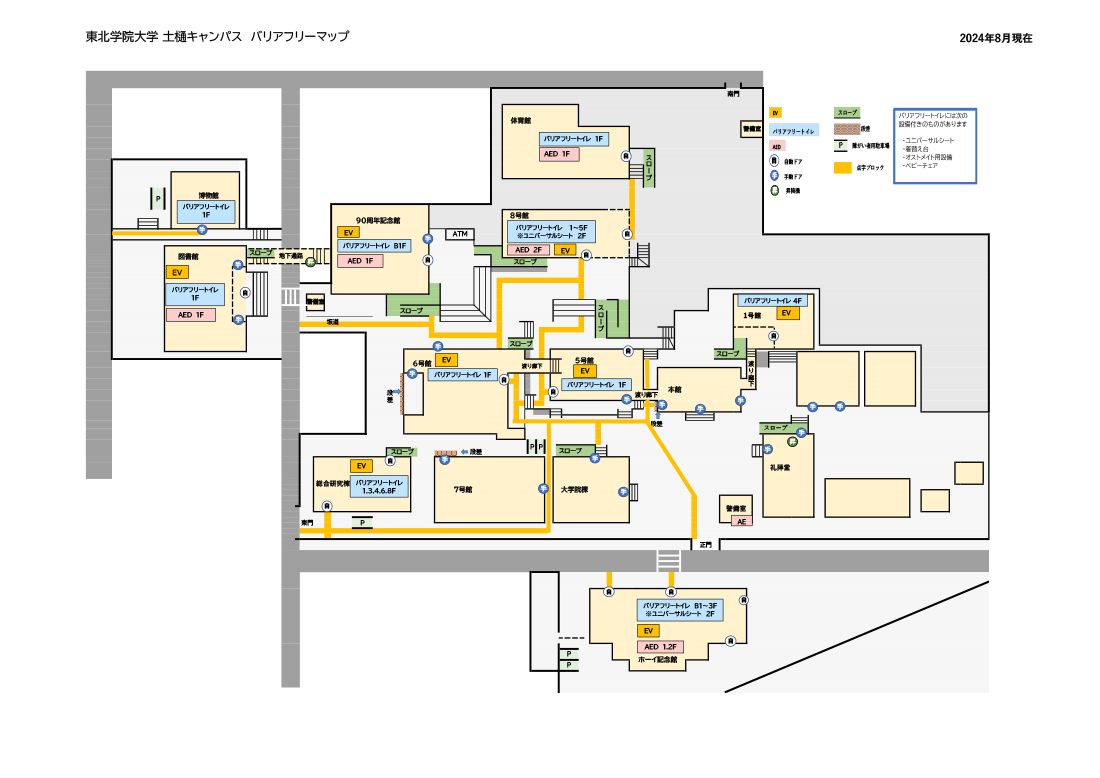
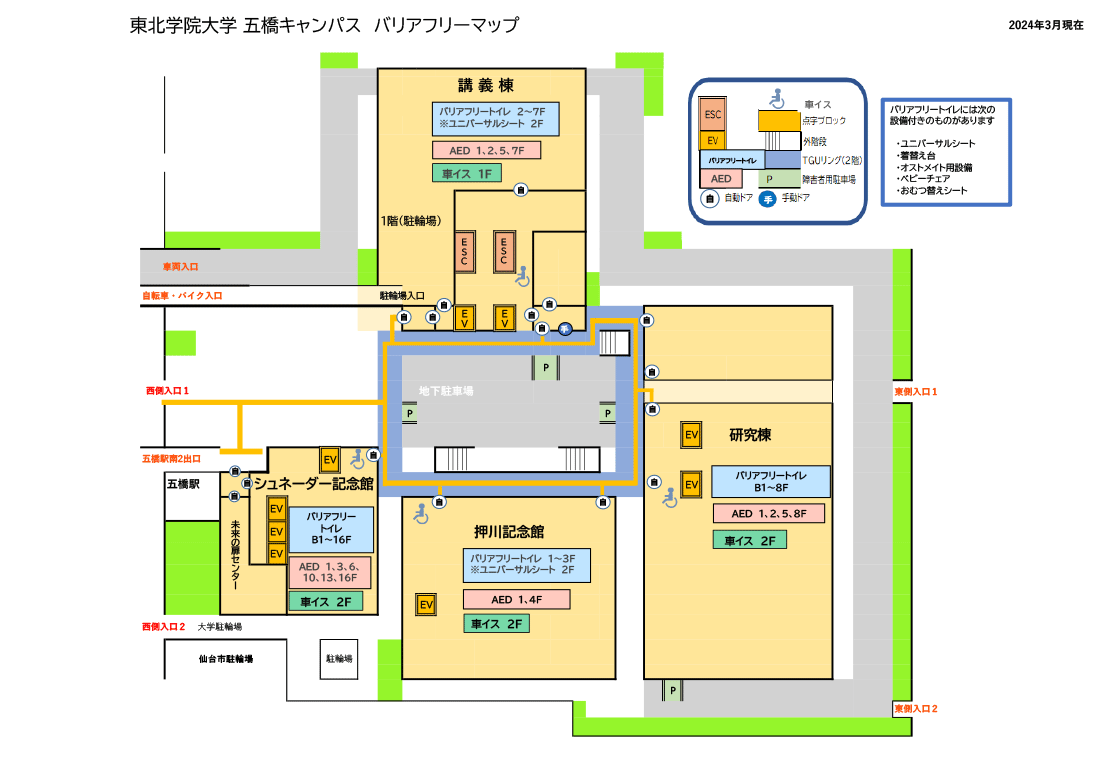
contact address
| Tsuchitoi Campus Student Support Office | Building 8, 3rd floor | TEL. 022-264-6410 |
| Itsutsubashi Campus Student Support Office | Lecture building, 2nd floor | TEL. 022-354-8230 |