Main Collections and Research
Research on folklore materials (history of daily life and culture)
Our university's Folklore Seminar has focused on research related to folklore and religion, while also collecting and studying folklore materials from the Tohoku region. We currently possess approximately 1,000 folklore items from various parts of Tohoku, primarily focusing on ritual objects rooted in folk beliefs and everyday tools used for clothing, food, shelter, and livelihoods.
Using these materials, we change the exhibits several times a year as part of our folklore practical training class.
Collection of folk art from the Tohoku region
What is folklore?
Folklore studies is the study of the historical development of people's lifestyles and cultures. Its subjects are diverse, encompassing family, clothing, food, shelter, beliefs, and livelihoods, and it involves folklore research using on-site observation and interviews. The true appeal of folklore lies in interpreting the realities of daily life, regional characteristics, and the characteristics of different eras through fieldwork—seeing, hearing, and experiencing things firsthand.
Tanabata horse
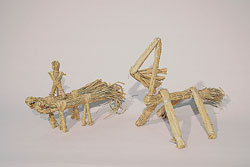
The custom of offering Tanabata horses, widely seen in eastern Japan, involves placing male and female horses made of straw or dwarf grass on the roofs or entrances of houses and stables on Tanabata. All of the Tanabata horses on display are from Miyagi Prefecture. In Miyagi, Tanabata is celebrated around August 7th, a month later than the traditional date according to the lunar calendar, and the Tanabata horses are offered as part of the Obon festival.
It is said that gods known as Tanabata-sama, Tagami-sama, Shōrō-sama, and Obon-sama come to homes riding Tanabata horses.
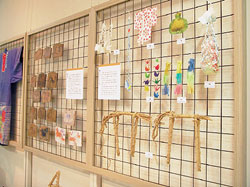
The Sendai Tanabata Festival, famous throughout Japan, is held annually from August 6th to 8th, primarily in several shopping districts throughout the city. During this time, many homes, not just businesses but also private residences, can be seen celebrating Tanabata. Handmade bamboo decorations are hung from bamboo poles and displayed from the eaves of houses, and a distinctive feature of these bamboo decorations is that there are seven specific types of decorations known as "seven ornaments."
The term "seven decorations" often refers to strips of paper, kimonos, origami cranes, drawstring bags, fishing nets, streamers, and wastebaskets, but these can sometimes be replaced with other items such as Tanabata incense sticks or papier-mâché lanterns. Even today, Tanabata decorations with these seven ornaments can be commonly seen in shopping streets and private homes.
Oshirasama
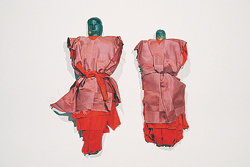
Oshirasama is worshipped as the god of silkworms, agriculture, and horses, and is widely distributed in the Tohoku region. Often, a divine image, such as a human face, a horse, or a male deity wearing an eboshi (a type of hat), is carved onto a scroll made of mulberry wood or bamboo, and then covered with cloth. The way the cloth is worn can be broadly divided into two types: the "wrapped head" type, where the cloth covers the head from above, and the "pierced head" type, where the head emerges through a slit.
In households that worship Oshirasama, once a year on a festival day, a shrine maiden is invited to perform a ritual called "Oshirasama Asobase."
At this stage, one piece of cloth is added on top of the other, so the approximate age of the Oshirasama can be estimated from the number of garments.
While Oshirasama are often enshrined in household altars or alcoves, the Oshirasama at our museum was not enshrined in a home. Originally, it was used as a ritual object by folk religious figures known as Ogamisama or Itako, and later it was enshrined at Daijoji Temple in Usuginu, Ichinoseki City, Iwate Prefecture.
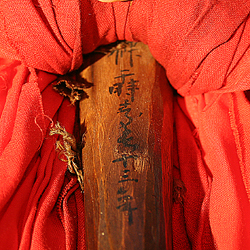
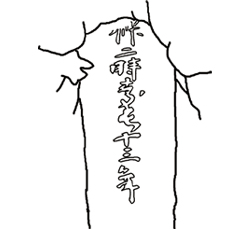
Daijoji Temple, once the head temple of the Yamato sect and revered by Ogamisama, houses a large number of Oshirasama statues that no longer have anyone to worship them, totaling 200 statues. Since Daijoji Temple does not add cloth to the statues every year, it is difficult to determine when these Oshirasama were made based on the number of cloths. However, when the robes of the Oshirasama in our museum are lifted, an inscription dated Keicho 13 (1608) can be seen on the divine image.
Ema (votive tablet)
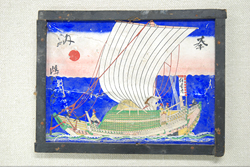
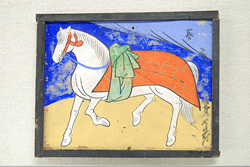
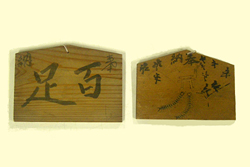
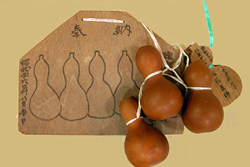
It is still common practice to dedicate votive tablets (ema) to temples and shrines when making a wish or as a token of gratitude for a wish being granted. In the case of large votive tablets, it is sometimes customary to have them painted by an artist before dedicating them.
Originally, live horses were offered as sacred horses, but this practice gradually became simplified to offering horse statues made of wood, paper, or clay, or paintings of horses on wooden boards. A variety of distinctive paintings, other than those of horses, also began to appear. Especially during the Edo period, the custom of offering ema (votive tablets) with practical wishes such as family safety and business prosperity spread among the common people.
For example, the centipede votive tablet on display is a motif for votive tablets because centipedes, with their many legs, are believed to symbolize good fortune and wealth, symbolizing the wish for "having many legs."
The exhibition also features votive tablets collected from Aomori, Iwate, Miyagi, and Fukushima prefectures, including votive tablets depicting ships donated by shipowners praying for safe voyages, and votive tablets depicting gourds, based on the legend that the main deity drifted ashore riding on a gourd.