
Main Collections and Research
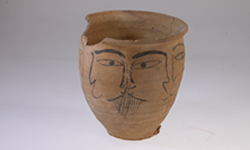
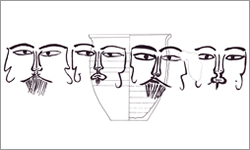
Symbolic exhibit: "Ink-painted human face pottery"
It appears to have been unearthed around 1961 near Ichikawa Bridge in Tagajo City during large-scale renovation work on the Sunaoshi River. While many earthenware vessels depicting human faces in ink have been discovered throughout Japan, the depiction in this piece is the most refined and excellent, making it nationally famous.
Otsukamori Tumulus | Japan's northernmost early burial mound
This burial mound is located at the northernmost limit of the Kofun culture in Wa (ancient Japan) during the 4th century. Investigations continued for five years, revealing the structure of the mound and the full extent of the burial facilities. The excavated pottery and grave goods are valuable resources for understanding the characteristics of the northern edge of the Yamato Kingdom. Among them, the lacquered quiver is particularly noteworthy, as it is one of the few known examples.
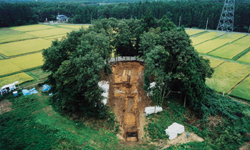
Panoramic view of the Otsukamori Kofun (ancient burial mound)
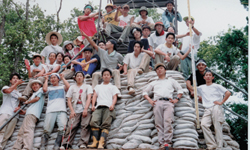
Scenes from the excavation of the Otsukamori Tumulus
Kanshouchi Kofun | Early Kofun period tomb in southern Tohoku region
This is the only tumulus in Fukushima Prefecture from the early Kofun period where peripheral burial (a method of burying outside the main burial chamber, such as a stone chamber) has been observed. The exhibition displays the burial jar used in the tomb and introduces the research findings, including the rituals of peripheral burial and the connections with other regions that can be seen from them.
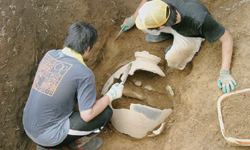
Excavation scene of the Kanshonai burial mound
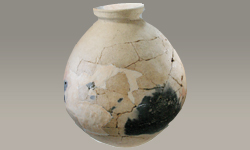
Jar coffin excavated from Kanjonai Kofun
Stone monument collected from the seabed of Ojima Island, Matsushima Town | Beliefs of medieval people |
The construction of stone memorial towers (itabi) in the medieval period was a part of Buddhist culture that spread mainly among samurai groups in the Kanto region. Numerous itabi that had fallen to the seabed were discovered on Ojima Island in Matsushima Town, known as one of Japan's three most scenic spots. Our university is conducting collection and research of these towers in collaboration with Matsushima Town and Zuiganji Temple.
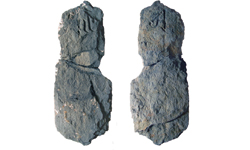
Stone monument collected from the seabed of Oshima Island
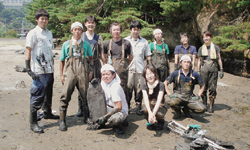
Scenes from the stone monument collection survey.
Sakaizawa Documents | A collection of documents belonging to the chief retainer of the Ichinoseki Domain
This collection of documents is a legacy of the Sakaizawa family, who served the Tamura family of the Ichinoseki Domain, a branch domain of the Sendai Domain, during the early modern period, and whose members held important positions such as chief retainer for generations. In addition to ledgers and notes, the collection includes household records concerning daily life and ceremonial occasions, as well as documents on scholarship and martial arts, making it a valuable resource for understanding the public and private lives of high-ranking samurai during the early modern period.
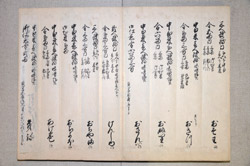
Kanrokucho
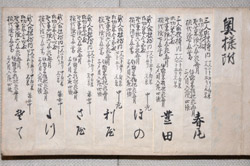
Ichinoseki Domain Samurai Register
Materials on folk beliefs in Tohoku | The wishes of ordinary people
This exhibition showcases folklore materials collected and preserved by the university's Folklore Seminar. In particular, it displays materials related to popular beliefs in the Tohoku region, such as "Oshirasama" bearing an inscription from the Keicho era, "Tanabata Horse," and Kokeshi dolls.
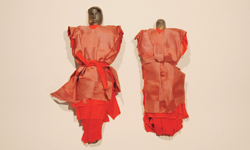
Oshirasama
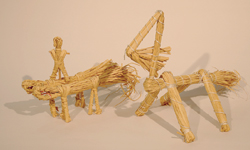
tanabata horse