Main Collections and Research
Research on the Otsukamori Tumulus (Kami Town, Miyagi Prefecture) (Kofun period)
The Tsuji Seminar (Japanese Archaeology) at our university took the lead in conducting the investigation, revealing the characteristics of the Otsukamori Kofun, the northernmost burial mound in the Japanese archipelago from the early Kofun period.
The museum displays pottery unearthed from ancient tombs and grave goods found in burial facilities, offering insights into the landscape of the northern edge of the Yamato Kingdom.
Early Kofun period tombs at the northernmost tip of Wa (ancient Japan)
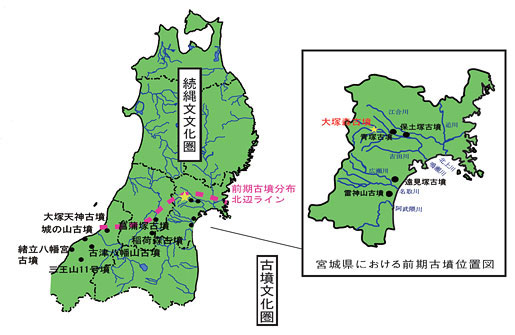
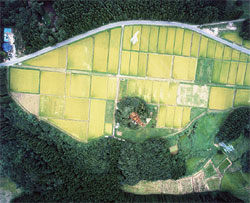
Location of the Otsukamori Tumulus
The Otsukamori Kofun is a circular burial mound from the early Kofun period (around the 4th century), located in Kami Town, Miyagi Prefecture. From 1995 (Heisei 7) to 1999 (Heisei 11), excavations were conducted mainly by the Tsuji Seminar (Japanese Archaeology), Department of History (now Department of History), and the university's Department of History (now ).
The Osaki Plain, where the burial mounds are located, is the northernmost distribution area of burial mounds during the early Kofun period, and at the same time, it is a distribution area for artifacts of the Jomon culture, which is centered in Hokkaido.
What kind of burial mound was the Otsukamori Kofun, built at the boundary between the Kofun culture of the west and the Jomon culture of the north?
The size and structure of the Otsukamori Tumulus
Surveys and excavations have revealed that the Otsukamori Kofun is one of the largest circular burial mounds in the Tohoku region, with a diameter of 50-52m, a height of 7.6-8m, two terraces (flat surfaces), and a moat with a maximum width of 21m.
Double-rimmed jar-shaped earthenware vessels have been unearthed from the flat surface of the mound's summit, as well as from the upper slope and terrace of the mound. These vessels were arranged on the flat surface of the mound's summit. The slope of the mound is covered with river stones, suggesting that it was a magnificent burial mound with a large moat when it was constructed.
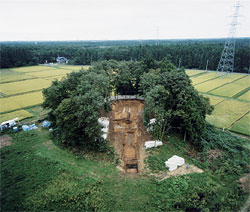
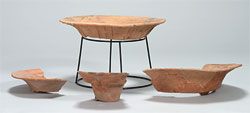
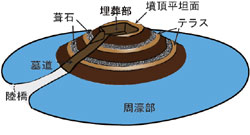
Burial facilities and excavated artifacts from the Otsukamori Tumulus
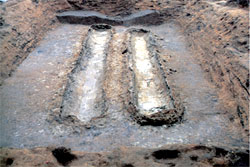
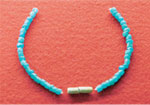
The burial chamber of the Otsukamori Tumulus is located on the flat surface of the mound's summit, and a burial passage for carrying the king's remains is attached to it.
The burial site first involves digging a rectangular burial pit (grave pit) approximately 6.5m x 10.5m in area and 2m deep. A clay bed is then created at the bottom of the pit using white clay to support the coffin. The wooden coffin is then placed with its head facing northeast. Finally, the coffin is covered in clay, completing the burial.
Although the coffin itself and the remains of the deceased had decomposed and disappeared, grave goods were unearthed from the western coffin because it had not been looted. These included a bracelet made of blue glass beads and steatite tubular beads, a quiver with a lacquered surface, and the lacquered rim of an arrowhead.
The armbands appear to have been worn on the deceased's wrists, allowing for an estimation of the deceased's hand position. The quiver was placed on the west side, above the head, and the ferrules of the arrowheads were found scattered on top of the coffin. Furthermore, the presence of an iron core inside the ferrules indicates that the tips were intentionally broken off. This likely suggests an act of ritualistic significance.
The burial of quivers is rare nationwide, and this discovery follows the Aizu Otsukayama Kofun in Aizuwakamatsu City, Fukushima Prefecture, where a triangular-rimmed bronze mirror with divine beast motifs was unearthed in the Tohoku region.
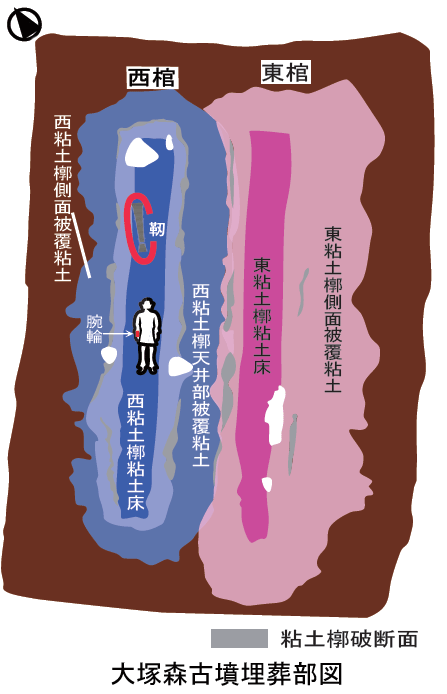
Diagram of the burial section of the Otsukamori Tumulus
The Otsukamori Kofun was located in the northern region of the Yamato court.
The structure of the burial facility of the Otsukamori Kofun is remarkably similar to that of the Tomizuka Kofun in Sendai City. The Tomizuka Kofun is a large keyhole-shaped burial mound, measuring 110 meters in length, making it the largest in the Sendai Plain and the fifth largest in the Tohoku region. The Otsukamori Kofun and the Tomizuka Kofun were built around the same time, suggesting a deep connection between the two.
It is presumed that the owner of the Otsukamori Kofun had close ties to the powerful force in the Sendai Plain that built the Tomizuka Kofun, and was a ruler who controlled the northernmost part of the Yamato Kingdom's territory.