Main Collections and Research
Research and investigation of the Kanjōnai Kofun (Minamisoma City, Fukushima Prefecture) (Kofun period)
The Tsuji Seminar (Japanese Archaeology) at our university led the investigation and revealed that burials in the vicinity, which are rare even in the Tohoku region, were practiced.
The museum displays pottery unearthed from ancient tombs and burial jars used in the surrounding areas, offering insights into the early Kofun period in the northern Hamadori region of Fukushima Prefecture.
The only known example of peripheral burial in an early Kofun period tomb in the Tohoku region.
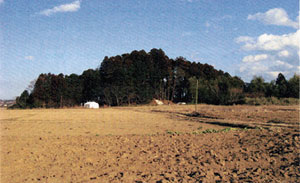
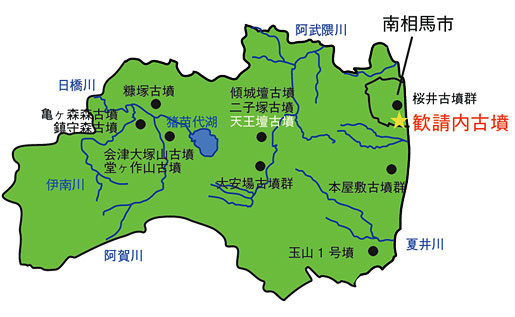
Location of the Kanshonai Kofun
The Kanshouchi Kofun is a rectangular burial mound from the early Kofun period, located in Odaka Ward, Minamisoma City, Fukushima Prefecture. Since 2007, the Tsuji Seminar (Japanese Archaeology) of the Department of History at this university has been leading the investigation, aiming to clarify the characteristics of the northern Hamadori region of Fukushima Prefecture during the early Kofun period. The investigation is still ongoing.
Fukushima Prefecture, where the Kanshouchi Kofun is located, exhibits a geographical distribution and characteristics of burial mounds that vary across several regions. Minamisoma City, where the Kanshouchi Kofun is located, is situated in the northern part of the Hamadori region. In the city's Haramachi district lies the Sakurai Kofun, a large keyhole-shaped burial mound from the early Kofun period, which is a national historical site. The Sakurai Kofun is believed to be the tomb of a chieftain who ruled the northern Hamadori region of Fukushima Prefecture during the early Kofun period.
The Kanshouchi Kofun is located on a hill that gently extends eastward from the Abukuma Highlands. Situated at the eastern end of this hill, it overlooks the confluence of the Odaka River and the Maekawa River, as well as the coastal plain facing the Pacific Ocean.
The size and structure of the Kanshonai burial mound
Until now, no archaeological excavations of burial mounds had been conducted in the Odaka district. Therefore, this investigation attracted attention as an important survey for shedding light on the characteristics of the Kofun period in this region.
Surveys and excavations have revealed that the Kanshouchi Kofun is a rectangular burial mound with a long axis of approximately 33m and a short axis of approximately 25m, a height of approximately 5m, and a surrounding moat with a terrace (flat surface) and a maximum width of 10.6m. The burial mound was constructed by utilizing the original topographical elevation, leveling the surrounding area and piling up the soil. The Kanshouchi Kofun is the largest square burial mound from the early Kofun period in Fukushima Prefecture.
Investigations into the burial area are scheduled to begin in 2010. The results of these investigations are highly anticipated, as they will provide valuable insights into the early Kofun period in this region.
Artifacts excavated from the Kanshonai Tumulus
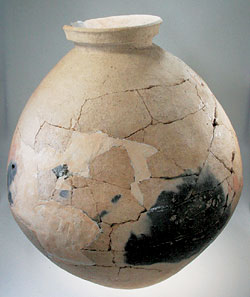
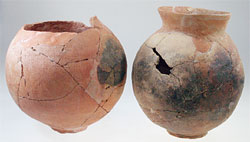
Numerous fragments of double-rimmed, perforated-bottom pottery have been unearthed from the burial mound of the Kanshouchi Kofun. These fragments were found on the slopes of the burial mound and within the surrounding moat. This is because the vessels, which were originally arranged on the flat surface of the mound's summit for funerary rituals, broke over time and were carried down the slopes of the mound.
In the early Kofun period burial mounds of the Tohoku region, as in other regions centered around Yamato, there was a custom of arranging perforated pot-shaped earthenware vessels on the flat surface of the mound's summit. The Kanjonai Kofun also practiced similar burial mound rituals.
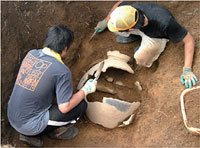
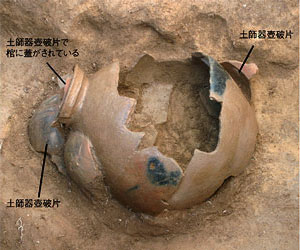
In addition, two large earthenware jars used as coffins (jar coffins) and earthenware jars that had been used as linings for the jar coffins were unearthed. One jar coffin was found inside the moat on the western side and another at the base of the tumulus on the southern side, buried on top of artificially broken pieces of earthenware jars. Based on their construction and shape, it is believed that the jar coffins were not everyday jars repurposed as coffins, but rather were made specifically for this purpose.
All of the burial jars were broken when they were unearthed, and no human bones or grave goods remained. It is believed that these burial jars contained infants related to the main person buried in the Kanshonai Kofun (ancient burial mound).
Kanshouchi Tumulus and surrounding burial rituals
The Kanjonai Kofun is a rare example in the Tohoku region of periphery burial rituals, where jar coffins are buried around the tumulus. Periphery burial rituals are commonly found in tumuli in western Japan, centered around the Yamato court. However, in the Tohoku region, it has only been confirmed at the Kanjonai Kofun and the Tennodan Kofun in Motomiya City, Fukushima Prefecture.
The Tennodan Kofun is a burial mound from the middle of the Kofun period, and cylindrical haniwa (clay figures) were repurposed as coffins. In the Tohoku region from the early Kofun period, the Kanjonai Kofun is the only burial mound that uses surrounding burials.
Haramachi Ward in Minamisoma City is home to the Sakurai Kofun Group, including the Sakurai Kofun, a national historical site, and is a densely populated area of early Kofun period burial mounds. However, the Odaka Ward, where the Kanjonai Kofun is located, has not been extensively investigated, and many aspects of the early Kofun period remain unclear.
Investigations have revealed that the Kanjouchi Kofun, the first chieftain's tomb of the Kofun period who ruled the Odaka district, adopts a square shape for its form, similar to the Sakurai Kofun, and also employs customs such as arranging double-rimmed pottery vessels. This strongly suggests that there was a political connection with the person buried in the Sakurai Kofun. Furthermore, the presence of surrounding burial rituals, which are seen in kofun tombs in Yamato, suggests that the person buried in the Kanjouchi Kofun may have had connections with various regions.