
Main Collections and Research
Research on the Oshima Stone Monument Group (Matsushima Town, Miyagi Prefecture) (Kamakura, Nanboku-cho, and Muromachi periods)
A slab of stone is a type of stone memorial tower from medieval Japan, made by processing and shaping a flat stone and inscribing it with a seed syllable, the date of construction, and a text (prayer) stating the purpose of the memorial service. This paper introduces the results of our research and investigation activities, focusing on slabs of stone collected jointly by our university and Zuiganji Temple in Matsushima Town from the shallow seabed of Ojima Island, located in Matsushima, one of Japan's three most scenic spots.
Matsushima, a sacred site in the Middle Ages, and its stone monuments.
What is an itabi (stone monument)?
Itabi are a type of stone memorial tower from medieval Japan. They are made by processing and shaping stone, and then inscribing seeds, dates, and prayers to pray for the rebirth of the deceased in paradise. They are thought to be a part of Buddhist culture that began around the first half of the 13th century, mainly among samurai groups in the Kanto region.
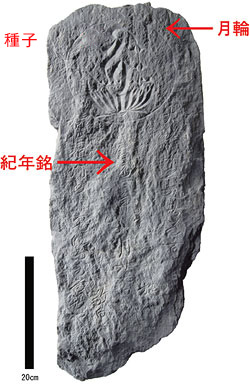
<Glossary>
| Seed | One of the characters used to represent the principal deity on memorial towers, such as those dedicated to various Buddhas. A Sanskrit character. |
|---|---|
| Prayer | This document explains the purpose of its construction and the meaning of the prayers offered. |
| Date inscription | The date the stone monument was erected and the date of death of the person being commemorated are recorded. |
| Gachirin (moon ring) | A symbol of a pure heart, likened to the full moon. A circular carving around the seed syllable, used as a decorative ornament to beautifully adorn various Buddhas. |
| Lotus seat | Also called a lotus pedestal. It is a decorative object similar to the moon disc, and is modeled after the lotus flower on which the Buddhas sit. |
In Miyagi Prefecture, more than 5,500 stone steles have been identified. In the medieval Mutsu and Dewa provinces (present-day six prefectures of Tohoku), where written historical records are scarce, these stone steles are extremely valuable historical materials and cultural assets, serving as clues for studying local history.
Stone monument of Oshima Island
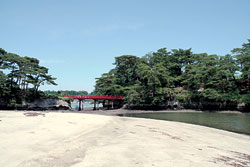
Matsushima, one of Japan's three most scenic spots, has been a sacred site since the Kamakura period, with numerous stone steles erected there. Many stone steles still exist on Oshima Island, located within Matsushima, but investigations that began in 2006 have revealed that even more stone steles remain scattered on the seabed surrounding the island.
As part of the "Ministry of Education, Culture, Sports, Science and Technology Graduate Schools Education Reform Support Program," Nanami Seminar (Japanese Medieval History) has been collecting and investigating these materials in collaboration with Matsushima Zuiganji Temple. As of August 5, 2009, they have identified 1,378 fragments of stone steles (including complete pieces). Of these, 449 steles, or more than 30% of the total, are inscribed with seeds or characters.
Surface marking work on stone monuments
During low tide, the tidal flats that form from the western to the southern tip of the island are targeted, and stone steles are manually retrieved from the mud within a 2-3 meter radius of the shore using a pin pole. Each retrieved stele is numbered sequentially, and its location is recorded on a map.
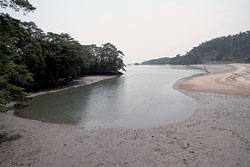

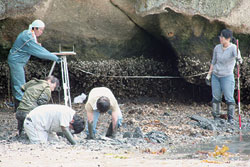
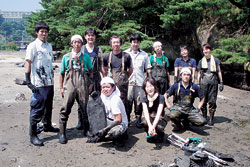
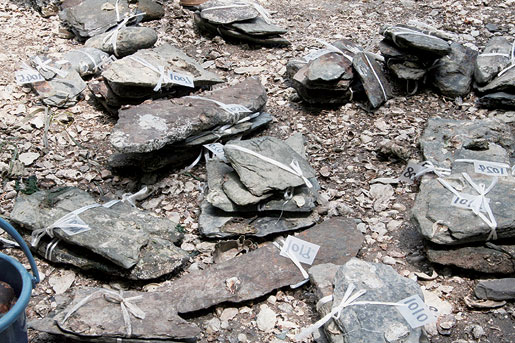
Distribution of excavated underwater stone steles from Oshima Island
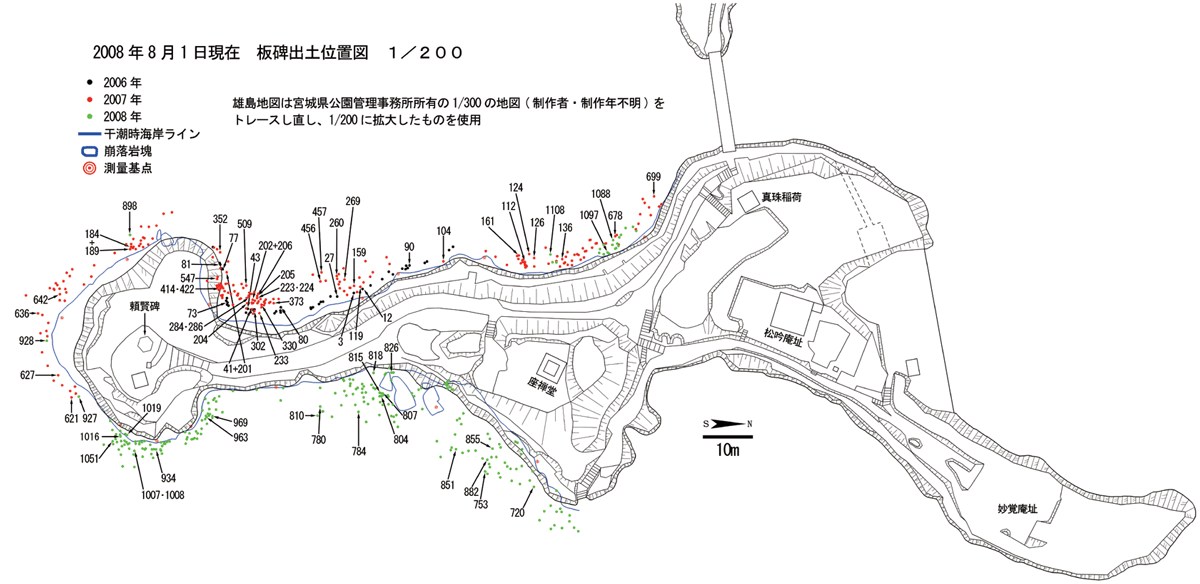
The diagram shows the locations where stone steles were excavated from the seabed of Ojima Island during surveys conducted from 2006 to August 1, 2008. The main distribution is concentrated from the central to the southern tip of the island, and a number of steles were found not only around the island but also in the sea 3 to 4 meters from the shore. In addition to natural erosion due to collapse, some are suspected to have been intentionally dumped from the island.
Stone materials and origins of stone tablets
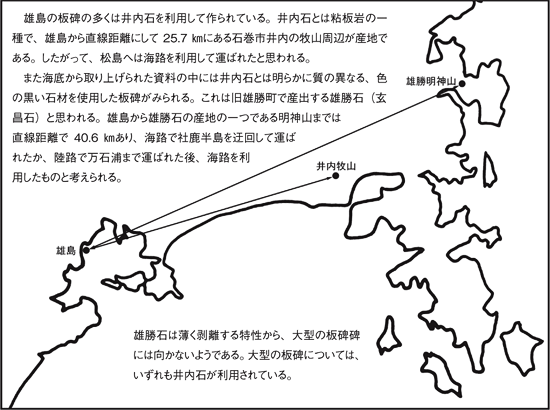
1. Inaiishi (Inai Stone)
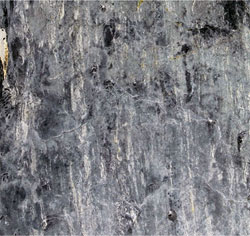
A type of slate, this sandy shale ranges from bluish-black to blackish-gray. It is found in Inai-cho, Ishinomaki City. The black and white stripes were formed when the strata were deposited, and the white parts are quartz sand.
2. Ogatsuishi (Ogatsu Stone)
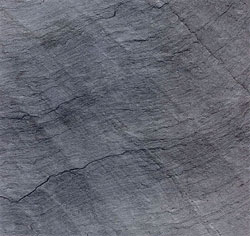
Like Inouchi stone, Ogatsu stone is a type of slate. It is formed from accumulated clay and mud that have turned into slate, resulting in small and uniform particles. The carbonized material in the clay gives Ogatsu stone its black color. It is sourced from Ogatsu-cho, Ishinomaki City. Taking advantage of its characteristic of easily flaking into thin layers, it is used for slate tiles and other applications. The roof of Tokyo Station is covered with this Ogatsu stone.
The work of organizing stone steles
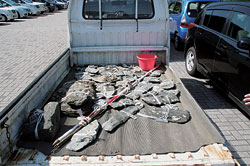
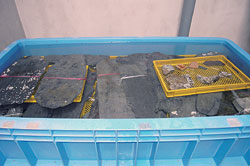
After being recovered from the seabed, the stone steles are transported to the Zuiganji Treasure Hall, where they are immersed in fresh water for approximately one year to remove the salt. Once the desalting is complete, the following sorting work is carried out on the steles under the guidance of the museum's curators.
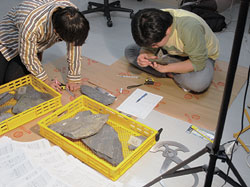
(1) Creation of an observation sheet
The collected stone steles are observed on their surfaces, and meticulous records are made, paying close attention to the seeds, inscriptions, and the processing and carving techniques of the stone.
Stone steles that show traces of ruled lines or processing are selected and sent for rubbings and measurement drawing.

(2) Making a rubbing
In addition to the inscription, the stonework and adjustment marks made by chisels are carefully prepared so that they can be observed with the naked eye.

(3) Creation of measured drawings
Based on images from a digital camera, the depth of the carving, the texture, and other details of the stone's shape, manufacturing techniques, and lettering—which are difficult to decipher from rubbings alone—are transferred to drawings.