Main Collections and Research
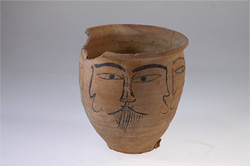
Ichikawabashi Site (Tagajo City, Miyagi Prefecture) (Heian period): Symbol exhibit "Ink-inscribed human face pottery"
Discovery and Aftermath
Around 1961, a large-scale renovation project was carried out on the Sunaoshi River near Ichikawa Bridge in Tagajo City. Because the area was the center of the ancient Mutsu Province, many earthenware and roof tiles were unearthed when the riverbed was excavated. The earthenware vessel with the ink-inscribed human face appears to have been among them.
In 1962, Mr. Koichi Watanabe, a staff member of Tohoku Gakuin University, acquired it from a construction worker and displayed it in the reception room to commemorate the establishment of the Faculty of Faculty of Engineering.
Subsequently, Takashi Kato, then Associate Professor of History in the Faculty Faculty of Letters, brought the ink-inscribed human-faced pottery back to Tsuchitoi Campus and used it as research material. Upon his retirement, he entrusted it to the Tagajo City Buried Cultural Properties Center. It was on display at the Tagajo City Buried Cultural Properties Center until recently, but in April 2009, with the establishment of the university museum, it became part of our museum's collection.
Features
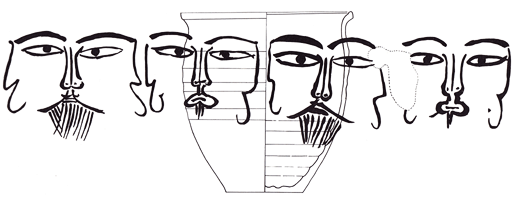
The pottery vessel is 16.2 cm tall. It was made on a potter's wheel, and four faces are depicted around its perimeter, each with differences in the style and expression of the beard. The surface of the vessel is precisely divided into four sections, and each face is meticulously rendered. While many pieces of pottery depicting human faces in ink have been discovered throughout Japan, this particular piece is considered the most refined and outstanding, making it nationally renowned.
Era and Usage
Based on the characteristics of the pottery, it is believed to be a work from the Heian period. The faces depicted on the pottery are said to represent plague gods, and it is thought that the pottery was used in purification rituals to seal in sins and impurities and then float it down the river.
Judging from the location where it was discovered, it is likely that people who worked at Tagajo, which was an ancient government office in Mutsu Province, drew human faces on it as a prayer and then floated them down the Sunaoshi River to ward off impurities.