
Center Overview
Features of the Center for Liberal Arts Education
Along with the establishment of new faculties and departments and the relocation of the campus in 2023, Tohoku Gakuin University has launched a new liberal arts curriculum. Since the founding of the Sendai Theological Seminary in 1886, the university has emphasized liberal arts education based on its founding principles of "respect for individual dignity and the completion of character based on evangelical Christianity." Building on this tradition, and in order to cultivate the abilities required in an information-driven and globalized society, the university has introduced new university-wide courses open to all Tohoku Gakuin students, regardless of their field of study (humanities or sciences) or faculty/department.
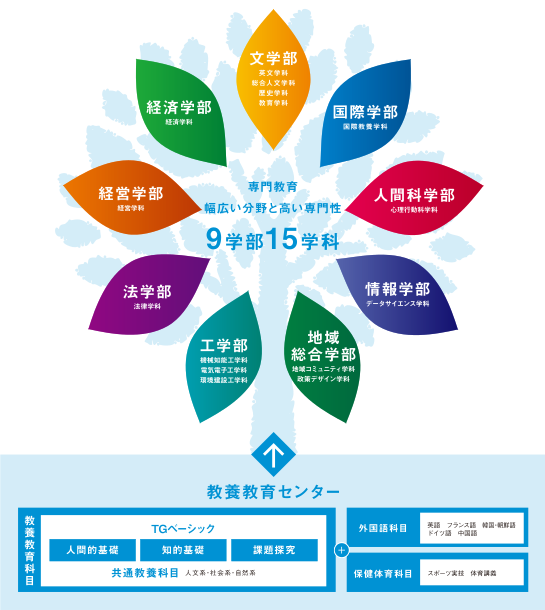
Building upon a foundation of general education, we expand the branches of learning into specialized fields.
Tohoku Gakuin University's liberal arts education program helps students acquire essential "basic and general skills" for social life through "liberal arts subjects" including "TG Basic," "foreign language subjects," and "health and physical education subjects." Building upon this foundation, students then pursue a deeper, more multifaceted, and advanced approach to their respective specialized academic disciplines.
The evolution of "TG Basic"
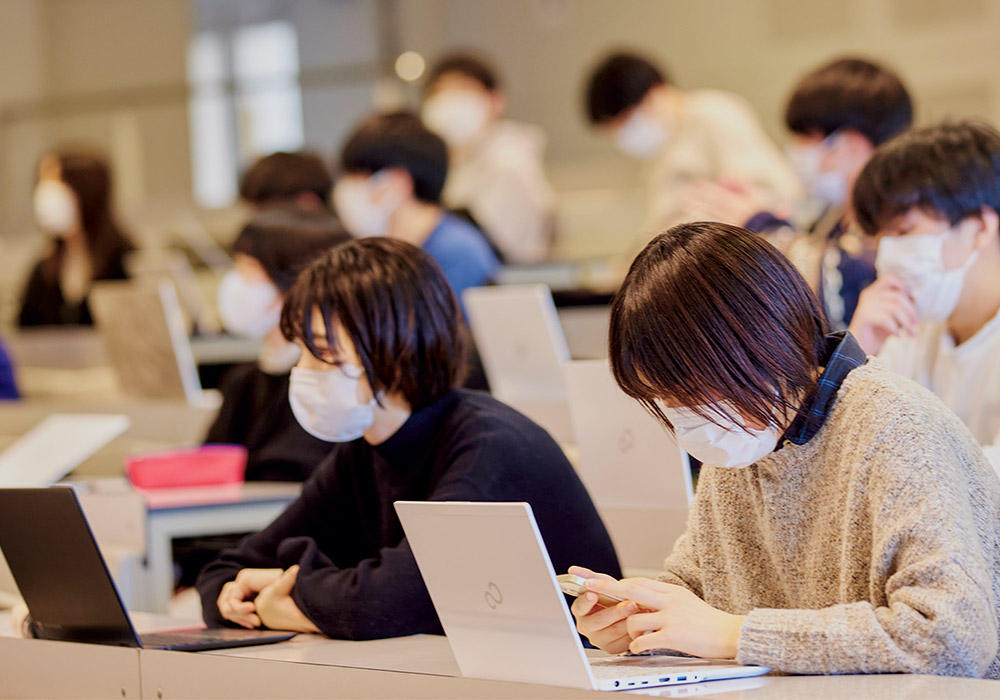
"TG Basic," a distinctive feature of our university, forms the foundation of our liberal arts education. Since introducing the "TG Basic" subject group in 2013, we have solidified our foundation as a liberal arts-oriented private comprehensive university. It encompasses a broad range of knowledge and skills that all students, regardless of their faculty, should acquire as proof of their studies at our university, and it contributes to the high regard in which our graduates are held by society.
The "TG Basic" curriculum was partially revised in 2023 to address the increasing demand for "bachelor's degree skills" and "basic professional skills" in today's rapidly changing society. "Bachelor's degree skills" refer to communication skills, logical thinking, information literacy, and problem-solving abilities, while "basic professional skills" refer to initiative, execution ability, problem-finding ability, communication skills, and flexibility. As society becomes more complex and sophisticated, there is a growing need to cultivate the foundation of these abilities while students are still in school.
For example, in the "Human Foundations" subject group, "For a Good Social Life A, B, C" helps students acquire the knowledge necessary for a better social life and a healthy student life. In the "Intellectual Foundations" subject group, "Information Literacy" is a university-wide compulsory subject, where students acquire the basic knowledge and skills of AI and data science that will be required after graduation. In addition, in the "Problem-Solving Workshop" subject group, students set their own themes for each topic covered in the class, conduct research, and develop problem-finding and problem-solving abilities through presentations and debates.
Broaden your horizons with "general education subjects".
In the general education courses taken in the first year, students can learn the fundamentals of fields outside of their major. By broadening their academic perspective through the study of foundational subjects in three systems—humanities, social sciences, and natural sciences—students cultivate the ability to take a deeper, more multifaceted, and advanced approach to things, not only in their specialized subjects but also in their future careers. Furthermore, without being confined to the traditional academic fields of literature, history, cultural anthropology, sociology, and economics, new subjects such as "Linguistics" and "Gender Studies" were introduced in the 2023 academic year in response to globalization and changes in social values.
Responding to globalization through "Foreign Language Subjects"
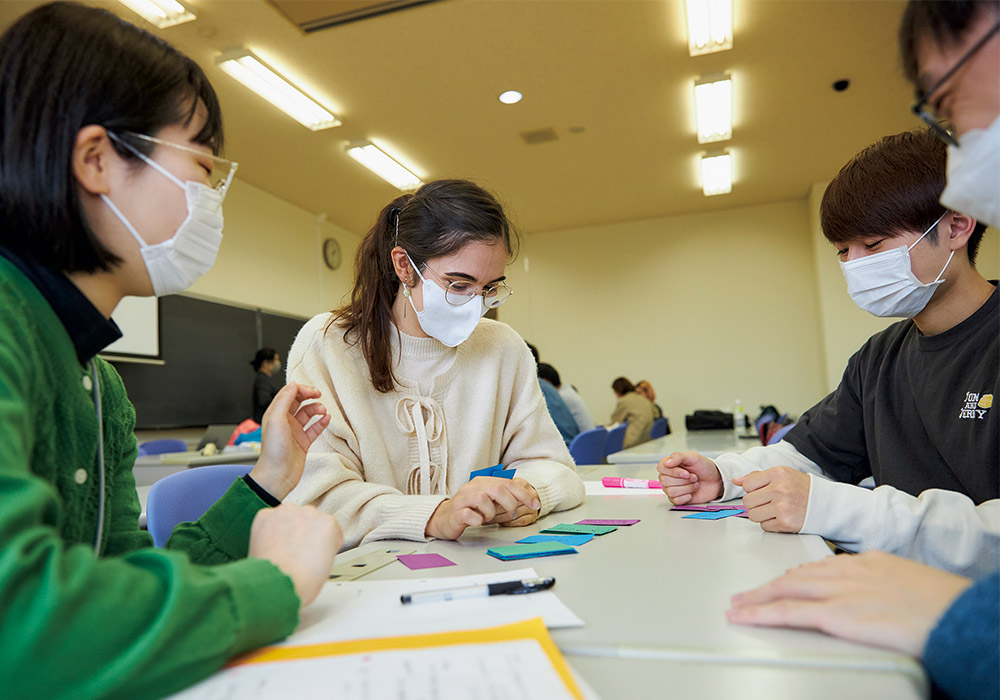
Along with "TG Basic," English education has been a core component of our liberal arts education. Amidst the advancement of globalization, our university, inheriting the tradition of the English Department of Tohoku Gakuin Professional School established after the war, has provided high-quality English education. From 2023, this English Education Center will be transformed into the "Foreign Language Education Center," providing broad support to students in all faculties studying not only English, but also German, French, Chinese, and Korean. Students who struggle with English can acquire basic English skills through the foreign language course "Basic English" or the English learning support system "Eigo Relax." Furthermore, courses are available in all foreign languages up to the third year, offering more advanced learning opportunities. We are creating a learning environment where all students can develop their language skills and utilize them in their social lives.
PICK UP! Curriculum
Studying the Bible (1st year)
Approximately one-third of the world's population are Christians. Therefore, knowledge of the Bible is essential for living in a global society. Furthermore, studying the Bible is also about understanding the founding principles of Tohoku Gakuin University. What is written in the Bible, and what is its background? In "Studying the Bible," we will learn the fundamental aspects of the Bible.
Understanding the world of the Bible through everyday objects.
Yumi Watanabe, 1st year student, Department Faculty of International Studies Department of International Studies
(From Miyagi Prefecture / Izumidateyama High School graduate)
The Bible is generally considered somewhat difficult to understand. This lecture, however, teaches the world of the Bible by relating it to things around us, making it very easy to understand and allowing even those without prior knowledge of Christianity to deepen their understanding. For example, the passage "Encounter with the Holy" is made much easier to grasp by replacing it with a scene from a well-known animated film. The lecture also connects the Bible to a wide range of fields, such as contemporary social issues and cutting-edge science and technology, which has made me more interested in what's happening in the world. I feel that through the Bible, I'm developing a more multifaceted perspective and a broader way of understanding things.
Gender Studies (1st year)
In the society we live in, a gender perspective is becoming increasingly important and necessary. This course aims to explore gender issues in contemporary society and culture through interdisciplinary themes such as "sexual diversity and literature," "AI and gender," "reproductive technology and gender," and "lookism and 'perversion'," and to understand the significance of gender studies from a broad perspective.
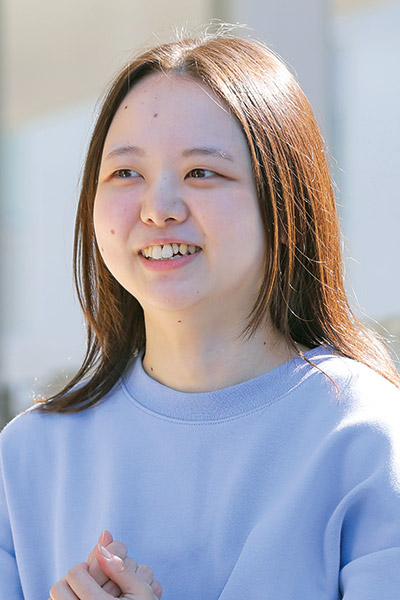
Gain new perspectives and insights through films and literary works.
Kanon Ito, 1st year student, Department Department of Psychology and Behavioral Sciences Faculty of Human Sciences
(From Fukushima Prefecture / Koriyama High School graduate)
Until now, I thought gender was only about LGBTQ+, but I've learned that it's actually a broader concept that includes various issues surrounding sex, such as feminism and sexuality. In the lectures, we're studying well-known literary works and films, such as Shakespeare's "Romeo and Juliet" and Natsume Soseki's "Kokoro," from the perspectives of gender and sexuality. In a society where the perception that heterosexuality is normal is still deeply ingrained, rereading classic works while focusing on sexual norms and sexual desires makes us realize how strongly our preconceived notions about gender and sex have influenced how we interpret these works. We're learning a fresh perspective on things, realizing that what we thought was "obvious" is actually not the case.