
The founding spirit remains unwavering even during wartime.
Towards post-war reconstruction and development
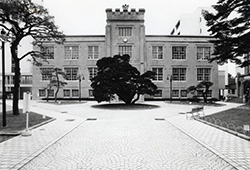
Around 1925, the number of Tohoku Gakuin alumni exceeded 1,000, and graduates were active in various fields such as education, missionary work, government, and business. However, after the Great Depression of 1929, a storm of economic depression swept across the world, and Tohoku Gakuin faced unprecedented financial difficulties. Furthermore, Japan rapidly moved towards militarism, military training was imposed on students, and even Christian schools were assigned military instructors. Thus, the Manchurian Incident broke out (1931), escalated into the Sino-Japanese War (1937), and led to World War II.
To commemorate the 50th anniversary of its founding in 1936, the 80-year-old headmaster Schneider delivered a sermon titled "I am not ashamed of the Gospel," which was broadcast nationwide via NHK and left a deep impression. It was also an expression of prayer to uphold the Gospel of Christ, the founding spirit of the institution, no matter what era it is.
Nevertheless, as the war situation worsened, Tohoku Gakuin's hardships, both material and spiritual, reached their peak with the Sendai air raid on July 10, 1945. The buildings of the specialized department in Minami-Rokkencho and the junior high school in Higashi-Nibanchō were destroyed or damaged by fire, and it seemed as if everything had been lost.
However, after the war, Tohoku Gakuin achieved rapid recovery. Based on a new educational philosophy centered on peace and democracy, the school restructured its system, establishing a new junior high school, a new high school, and a new university with a Faculty of Letters and Economics. Excellent faculty and staff were recruited, and repairs, expansions, and new constructions of school buildings, grounds, and facilities progressed, and the university, junior high school, and high school steadily built up their capabilities as research and educational institutions. Having gone through a turbulent period from its nascent stage, Tohoku Gakuin entered a new era of development as a place for nurturing the next generation of talent.
In 1962, Faculty of Engineering (Departments of Mechanical Engineering, Electrical Engineering, and Applied Physics, later Civil Engineering) were newly established in Tagajo City. In 1964, the Faculty of Letters and Economics was split into Faculty of Letters (Department of English, Department of Christianity and History, Second Division Department of English) and Faculty of Economics (Department of Economics, Department of Commerce, Second Division Department of Economics), and in 1965, Faculty of Law (Department of Law) was newly established. Thus, Tohoku Gakuin University became the only private comprehensive university in Tohoku with Humanities, Economics, Law, and Faculty of Engineering. Furthermore, around this time, Graduate Schools graduate schools were established in each faculty to train researchers. In 1989, the fifth faculty, Faculty of Liberal Arts, was established. Following the Faculty of Liberal Arts reorganization in 2005, the Faculty of Engineering reorganization in 2006 and other reforms demanded by the times have been advanced.
Tohoku Gakuin University has produced approximately 150,000 graduates to date. Leveraging our rich human resources, including our alumni, and the power of our network, we aim to continue fostering individuals who will pioneer a new era, as a comprehensive university rooted in and contributing to the local community.