
Philosophy and Goals
Philosophy/purpose
By cultivating students' command of English, an international language, and by fostering a keen sense of other cultures and otherness, we aim to develop truly international people who are tolerant of diverse cultures.
Educational goals
- Develop a keen sense of language.
- Become familiar with the art and science of words.
- Laying the foundations for human understanding.
- Develop the ability to think logically and critically.
- Accumulate the knowledge to see yourself from a broad perspective.
The ideal student for this department
- Possess sufficient basic academic ability and have a strong intellectual curiosity.
- Possess logical thinking skills and can clearly explain their thoughts in their own words.
- He has a strong desire to learn foreign languages, including English, and is actively involved in doing so.
- Students have a thorough understanding of the department's curriculum and have a plan for their four years of study.
Undergraduate learning objectives
- Through a broad range of liberal arts courses, including the required "Christian Studies," and specialized courses, students can understand the contemporary significance of past intellectual accumulations and reflect this in their own learning and way of life.
- Through the study of foreign language subjects and specialized education subjects (Category 1), students will acquire a well-rounded proficiency in foreign languages, particularly English.
- In the field of English and American literature, students will gain an understanding of the characteristics of English and American poetry, drama, and novels, as well as acquire fundamental methods for appropriately interpreting and evaluating individual works. In the field of English linguistics, students will learn various aspects of linguistic theory and acquire fundamental methods for better understanding the characteristics of the English language.
- Through taking general education courses and specialized courses outside of their chosen field of specialization, students will develop a fundamental attitude of applying perspectives and knowledge from other fields to their chosen area of specialization.
- Through "exercises" and "graduation exams/thesises," students will comprehensively utilize their learning achievements up to that point and develop the attitude of tackling self-assigned tasks from their own perspective.
History
The history of practical English education that has continued since the founding of Tohoku Gakuin.
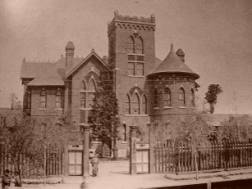
The history of Tohoku Gakuin, spanning over 130 years, is inextricably linked to the history of Department of English. Founded as a seminary for training Christian missionary pastors, Tohoku Gakuin's classes were conducted in English by American missionaries. To attend lectures, students had to master the four English language skills. This curriculum evolved into Department of English. From the very beginning, Tohoku Gakuin's English education was fundamentally based not just on learning "English," but on learning "in English." In 1920, Tohoku Gakuin's Teacher Training Department was recognized as one of the few schools in Japan where graduates could obtain English teacher qualifications without examination. Graduates of Tohoku Gakuin are active in teaching throughout Japan, from Kanto to Kyushu, primarily in Hokkaido and Tohoku, which is why it has become known as "Tohoku Gakuin of English."
In its early days during the Meiji era, the university boasted a distinguished faculty that included poet Shimazaki Toson (whose poems, later included in his first poetry collection, "Wakana-shu," were written while he was working at Tohoku Gakuin), Yamauchi Heisaburo (a graduate of the university), known for his translation of Dante's "Divine Comedy" (Iwanami Bunko), Irie Shukuei, who single-handedly compiled the "Detailed English-Japanese Dictionary," and Paul Gerhard, a renowned phonetician who developed a new English teaching method he learned in America and achieved great success in English education (he taught at Tohoku Gakuin for 40 years starting in 1897). Saito Shizuka, who won the Okakura Prize for his groundbreaking "Dual-Discussion English-Japanese Dictionary," which combined English-Japanese and English-English elements, was also a graduate of Tohoku Gakuin and later became a professor at the university.
When the university was upgraded to a new-system university in 1949, Department of English developed into a department that encompassed three types of departments and programs: Department of English department of a comprehensive university that academically studies English language and literature, the English department of a foreign language university that aims to teach practical English skills, and the English teacher training program of a teacher training university. It has continued to send talent to a wide range of fields, not just English language education. In 1964, Graduate Schools was established, and it has already sent more than 80 researchers and educators to national, public, and private universities, and continues to do so to this day.