
Teacher Profiles

MASAOKA, Nobuhiro Professor (Folklore and Regional Studies)
Research topic
While paying attention to historical changes, we are considering new ways of understanding folklore, including examples from minorities and South Korea.
Research Topics
The Significance of Studying Folklore in the Tohoku Region: Re-examining its Meaning in Relation to Changes in Daily Life, and Toward a New Understanding of Folklore
When we think of folklore, we often imagine the culture of the good old days of Japanese life, passed down unchanged since ancient times. However, a closer look reveals that it has changed significantly over time, and this is not always the case. Folklore reflects the way of life, and naturally, it changes as society changes. In particular, in the Tohoku region, many things have changed or been newly created since the modern era, and this is clearly evident. This re-examination of the image of folklore has the potential to overturn even the common sense of folklore studies, and I believe this is one of the reasons why we should consider folklore in the Tohoku region.
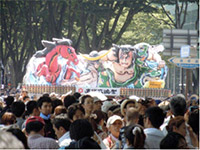
Tourism use is also one of the characteristics of modern folklore.
Examples of graduation thesis titles from the Masaoka Seminar
- "Local Perceptions of Folk Performing Arts Transmission Activities: A Case Study of the 'Nagafukuro Rice Planting Dance' in the Former Akiu Town, Miyagi Prefecture"
- "The Acceptance of 'Private Cemeteries' and Changes in Grave-Making Rituals in Urban Areas of Okinawa Prefecture: A Case Study of Naha City"
Recent works
- "Utilization of Cultural Resources and 'Folklore' in Buraku Communities," *Local Resource Utilization and Folklore Studies*, Yoshikawa Kobunkan, 2007.
- "Perspectives and Methods for Considering Sendai Festivals," Osaki Hachimangu Shrine, 2010.
- "Culture of Daily Life and Challenges Towards Reconstruction," *21st Century Hyogo*, Vol. 12, 2012.