
Philosophy and Goals
Philosophy/purpose
Cultivate talent with a global perspective who can create a better community.
Educational goals
- Learn and think in the local community.
- Develop an attitude of looking at the region from a broad perspective.
- Acquire the ability to deeply analyze local issues.
- Understand that local issues are complexly interrelated and involve a variety of factors.
What Department of Regional Design aims for
The wave of globalization sweeping the world, the widening gap between central and local governments, the global environmental problems erupting, the worsening aging population… You have probably all heard these terms in newspapers and on television news. These problems are not unrelated. The problems inherent in the systems that propelled the 20th century are manifesting themselves in various forms. So, what is necessary for us to overcome these difficulties and live secure and prosperous lives in the 21st century?
From now on, the idea of designing the future of local areas from the central government and controlling the whole picture will simply not work. What is important now is to have ideas that come from the "ground"—from the local community. It is about each and every individual taking ownership and working towards a better community and a better life.
Based on the above considerations, Department of Regional Design sets forth the educational goal of "nurturing individuals who possess a global perspective and can create better communities."
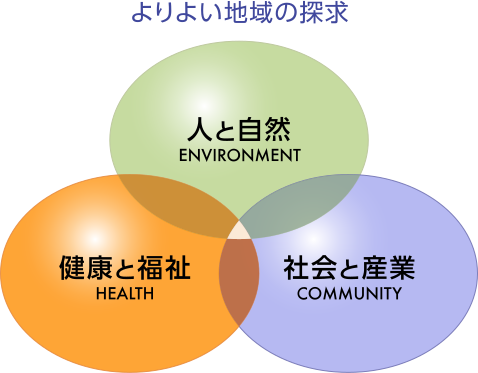
The three areas of focus in Department of Regional Design: ENVIRONMENT / HEALTH / COMMUNITY
So, what are the things necessary for a better community and a better life? Department of Regional Design addresses these questions through three areas: "People and Nature," "Health and Welfare," and "Society and Industry."
A good life requires a healthy natural environment. In the "People and Nature" domain, we focus on the relationship between humans and the air, water, land, and living organisms that constitute the natural environment, and learn how to live in harmony with nature.
However, no matter how good the natural environment may be, each individual living there must be healthy. In the "Health and Welfare" field, we learn about the things necessary to maintain a healthy life, both physically and mentally, throughout one's life, drawing from the fields of community sports and community welfare.
Of course, to live in a community, one must maintain a livelihood. Issues concerning the local economy, such as commerce, industry, and agriculture, are important. Furthermore, trustworthy human relationships and attractive local cultures, both old and new, are essential conditions for living a safe and fulfilling life in a community. These are the things we learn about in the "Society and Industry" area.
Comprising the three areas described above, Department of Regional Design cultivates individuals who will take action to realize better communities.
The ideal student for this department
- Possess sufficient basic academic ability.
- They are interested in the diverse phenomena and problems occurring in the local area and have a strong desire to explore and solve them in depth.
- Students have experience actively participating in activities both inside and outside of school, and can express and explain the content of those activities in their own words.
- Students have a good understanding of the educational content and characteristics of this department, and have a clear purpose and motivation to continue to be actively involved in the local community in the future.
Undergraduate learning objectives
- Learn and think in the local community.
- Develop an attitude of looking at the region from a broad perspective.
- Acquire the ability to deeply analyze local issues.
- Understand that local issues are complex and involve a variety of interconnected factors.