
*All laboratory names are provisional.
Artificial Intelligence Research Lab
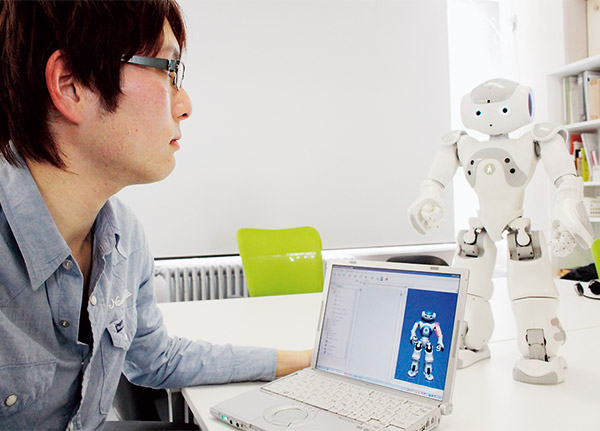
We will conduct control experiments for humanoid robots using artificial intelligence technology.
Wouldn't it be wonderful to have robots that live alongside humans and fulfill various requests? In our laboratory, we are researching learning robots that can think for themselves, practice, and gradually become able to do tasks they couldn't do before.
(GOUKO, Manabu, Professor)
Information and Coding Theory Laboratory

You can try out the error correction code function using a QR code with an image.
Error correction codes, which have the function of automatically repairing corrupted information, are one of the essential foundational technologies for providing high-quality information transmission and information storage services. Here, we are conducting research on the construction methods, performance evaluation, and applications of codes that will realize a comfortable information network society.
(YOSHIKAWA, Hideki, Professor)
Information and Communication Systems Laboratory
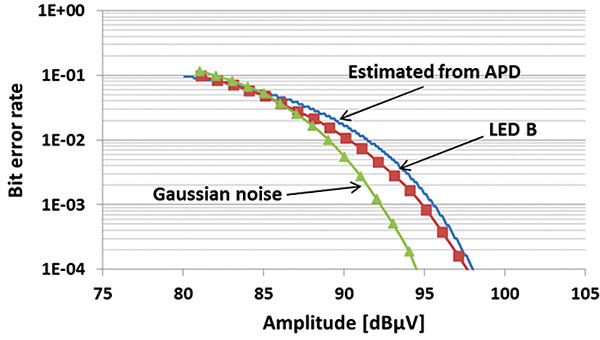
This graph shows an example of evaluating the communication quality of terrestrial digital broadcasting, which was interfered with by electromagnetic noise from LED light bulbs, which have become increasingly popular as energy-saving home appliances in recent years, using a parameter called "amplitude probability distribution."
Mobile phones are digital, television broadcasting is digital, and of course computers use digital codes for calculations; we now live in an era where nothing can be discussed without mentioning digital technology. Aiming to maintain and improve the quality of digital communications, which will become even more important in the future, we are researching evaluation technologies for them.
(ISHIGAMI, Shinobu, Professor)
Information Interaction Laboratory
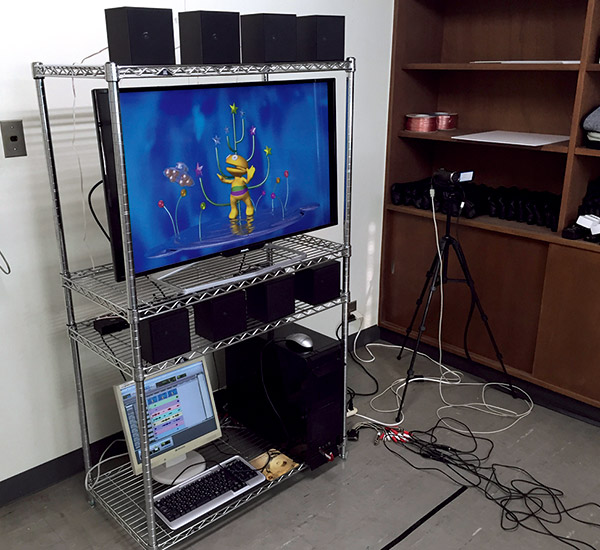
A 3D sound system compatible with large-screen TVs. No matter where you are, it sounds as if the sounds are coming from objects on the screen (UFOs, stars, balls).
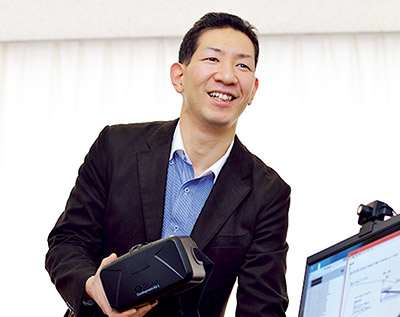
(KIMURA, Toshiyuki, Associate Professor)
Conventional multimedia systems have been difficult to use, making them unsuitable for non-experts. Our laboratory is developing a multimedia system that anyone can easily use, utilizing 3D sound systems compatible with large-screen TVs and personal 3D sound field reproduction systems.
Wireless Information and Communication Laboratory
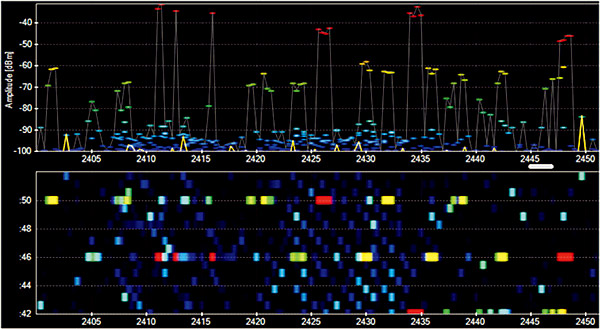
Our surroundings are filled with radio waves transmitted and received by mobile phones, Wi-Fi networks, and other devices. The photo shows the radio wave intensity in the ISM band and its change over time.
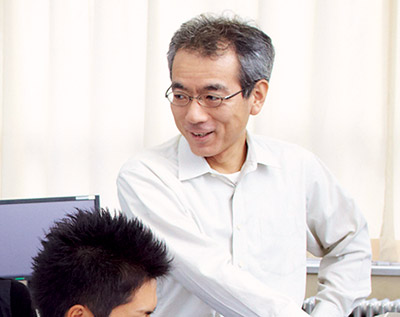
(SUZUKI, Toshinori, Professor)
We research wireless systems that transmit information quickly and reliably under any circumstances, as well as methods for estimating human congestion and equipment locations by analyzing radio waves. We also research highly efficient wireless communication methods to address the rapidly increasing communication traffic in recent years.
Biomedical Information Engineering Laboratory
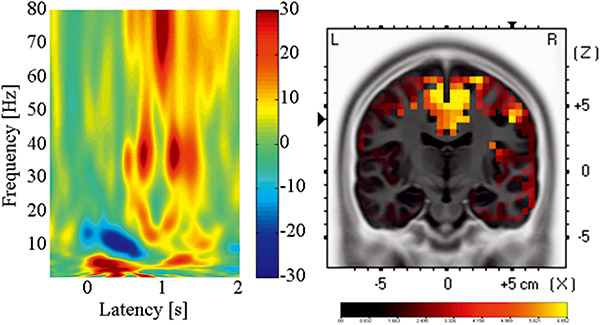
Time-frequency analysis of electroencephalogram (EEG) signals and signal source estimation
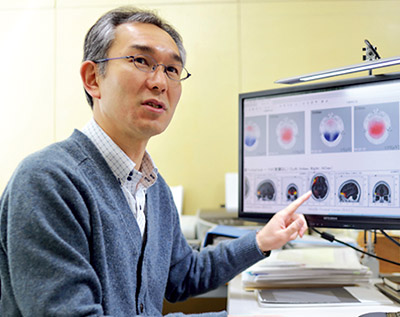
(KATO, Kazuo, Professor)
We conduct research based on cutting-edge information engineering perspectives, including the measurement of information from living organisms, the extraction of biological information through noise reduction, and various signal analyses.
Furthermore, we are working on elucidating various human functions, such as the higher-order functions of the cerebrum, and applying these findings to biomedical engineering.
Information Educational Engineering Laboratory
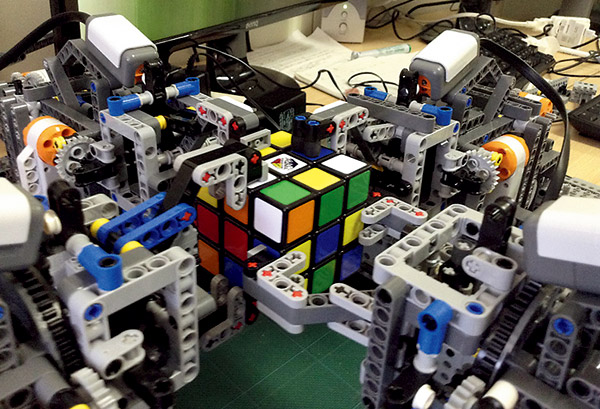
Pattern recognition technology and puzzle-solving theories are also being applied to cryptography research. The photo shows a robot solving a Rubik's Cube.
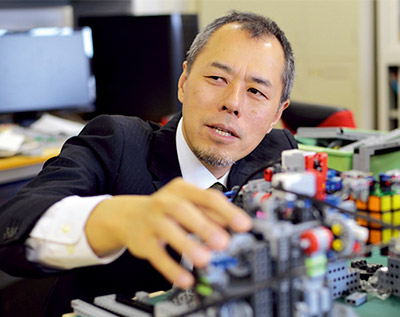
(SHIKODA, Arimitsu, Professor)
I am conducting research on attack methods against microcontrollers that have implemented cryptographic programs (techniques to intentionally cause the microcontroller to malfunction and extract confidential information). By studying attack methods, we can understand defensive techniques. In addition, as part of my cryptography-related research, I am also developing puzzle-solving robots.
Information Security Research Lab
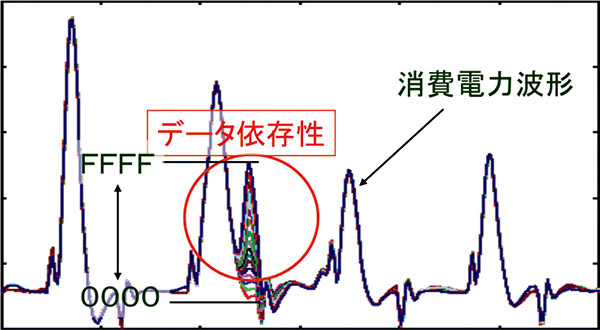
"Research on IC card encryption technology, attacks, and defenses": Extracting the secret key from the operating power of an IC card.
We are supporting a safe and secure information society by researching how to steal encryption technologies and secret keys used in IC cards and IC tags by utilizing hardware and cryptographic characteristics, and by developing defense technologies in advance.
(KAMINAGA, Masahiro, Professor)
Spatial Information Laboratory
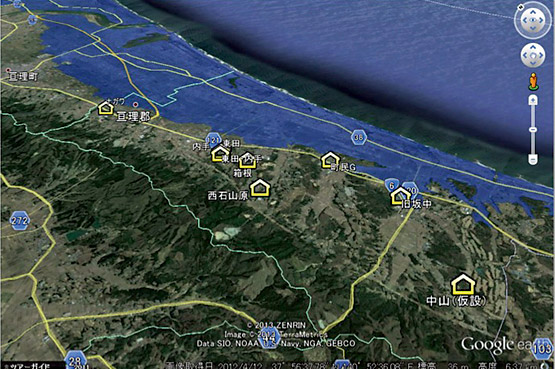
By displaying information such as reconstruction plans and disaster prevention information from affected municipalities on Google Earth, we aim to support post-earthquake recovery efforts.
(MONOBE, Kantarou, Associate Professor)
Information Modeling Engineering Laboratory
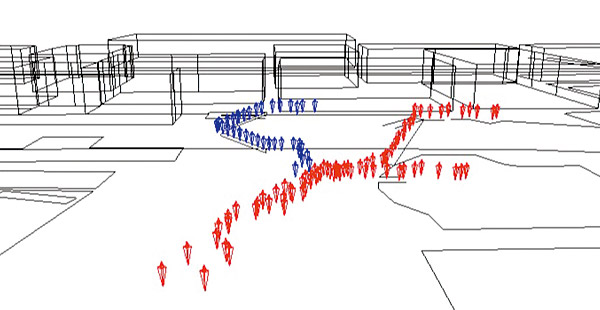
We conduct research on evacuation simulations, using information technology to improve local disaster prevention plans. We study human behavior in various scenarios and algorithms for representing that behavior, and then develop programming solutions.
(KADOKURA, Hiroyuki, Associate Professor)
Materials Informatics Laboratory
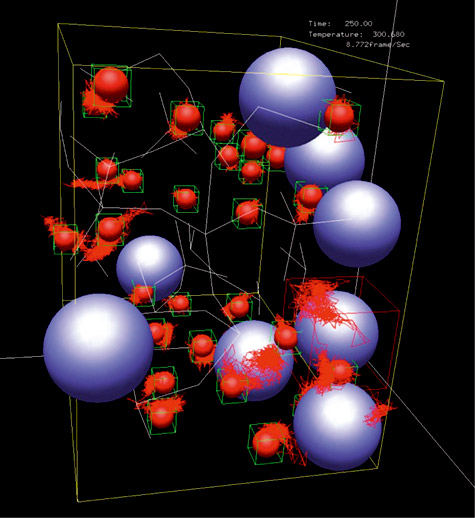
Ion conduction simulation in superionic conductive glass
We analyze the information about atomic systems as big data on the order of Avogadro's number by simulating the spectra of materials obtained from spectroscopic experiments using terahertz light, which is a higher frequency than the millimeter waves used in communications, using molecular dynamics methods.
(AWANO, Teruyoshi, Professor)
Graphics Information Processing Laboratory
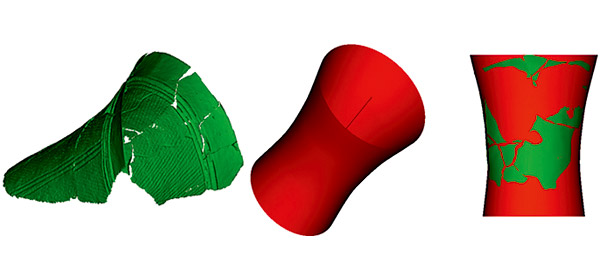
I am researching techniques that use computer graphics and numerical calculations to infer the shape of a three-dimensional object from a part of it. For example, this could be applied to creating an image of an entire piece of pottery from a fragment.
(KINOSHITA, Tsutomu, Associate Professor)
Information Transmission Systems Laboratory
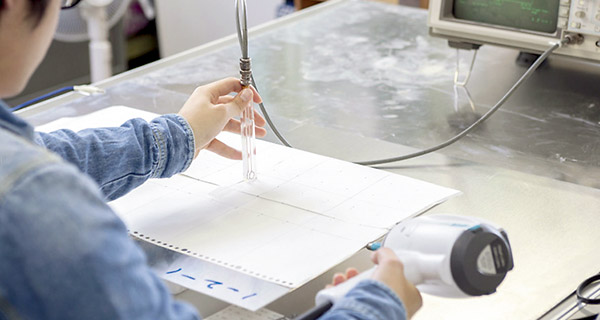
This image shows the process of injecting an impulse current associated with ESD (electrostatic discharge) into an electronic system and measuring electromagnetic field fluctuations around the system. By analyzing these fluctuations, the system's tolerance to electromagnetic noise can be evaluated.
The operation of electronic circuits generates weak electromagnetic waves in their surroundings. By measuring and analyzing these electromagnetic field fluctuations in detail, we can check the operating state of electronic systems and investigate the causes of malfunctions. Our laboratory utilizes techniques to capture such electromagnetic waves to provide fundamental data for the development and design of high-performance electronic systems.
(KAWAMATA, Ken, Professor)
Lattice Cryptography Laboratory
This laboratory focuses on research into lattice-based cryptography. Lattice-based cryptography is an important candidate for next-generation cryptography and is known to provide high security even in quantum computing environments. We address challenges in computer-based security analysis and fundamental theory.
(FUKASE, Masaharu, Instructor)
Wireless Network Engineering Laboratory
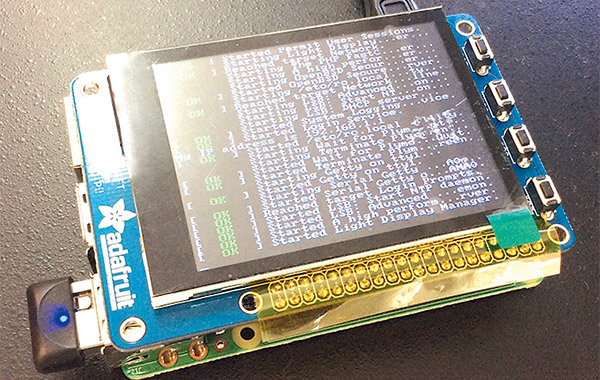
As the application fields of information and communication technology expand, there is a growing need for methods to reliably deliver data under various conditions. This laboratory conducts research on communication devices that operate using radio waves in the environment, network control, and their applications.
(MORISHIMA, Yu, Instructor)