
We cultivate teachers who meet the demands of the times.
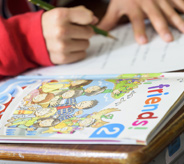
Develop the leadership and interpersonal skills necessary to create a bright future for children with unique personalities.
The environment in which children grow up is becoming more diverse due to changes in local communities and the times. To spend each day with children and build the future together, it is necessary not only to have teaching skills as a teacher, but also to have a rich humanity. You can grow in a privileged environment of a comprehensive university with a liberal arts education based on Christian teachings.
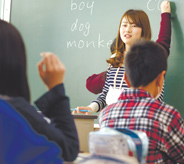
For those aspiring to become elementary school teachers, we offer practical teaching skills that will also be applicable to the new subject of foreign language (English).
Whether you're proficient in English or not, our comprehensive curriculum and deep faculty, backed by a long history and proven track record in English education, will enhance your English teaching skills.
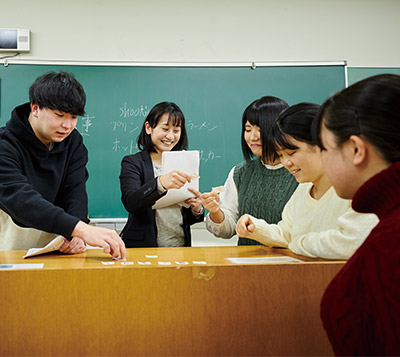
Another option is to become an English teacher at a junior high or high school.
This curriculum provides highly specialized skills that will give you confidence in teaching at the junior and senior high school levels. You can aim to become not only an elementary school teacher, but also a junior or senior high school English teacher.
Characteristics of Department of Education
- To accommodate the expansion of integrated elementary and junior high school education, and integrated junior and senior high school education, you can obtain three types of teaching licenses: elementary school, junior high school, and senior high school (English).
- To address the diverse needs of children and students growing up in varied living environments, we cultivate teachers who possess practical teaching skills in both academic instruction and student guidance.
- In line with the introduction of English as a subject in elementary schools in 2020, this program aims to train elementary school teachers who can confidently teach all elementary school subjects and areas, including foreign languages (English).
- We cultivate multifaceted and diverse teaching skills that can address contemporary educational challenges, such as local issues like safety and disaster prevention education, the use of ICT, and the introduction of "active learning" (proactive, interactive, and deep learning).
- The enrollment capacity for each grade level is 70 students, allowing for small-group education.
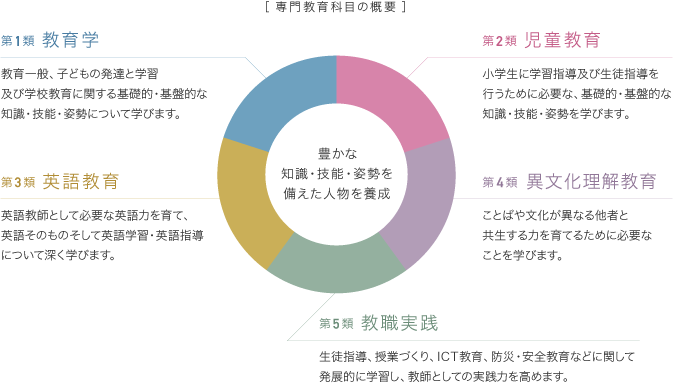
Specialized subjects in Department of Education
The specialized subjects in Department of Education are comprised of the following five categories:
Distinctive specialized education subjects
Learn English through real-life experiences!
<Practical English Education (Overseas Training)>
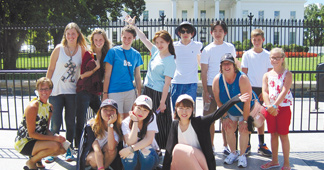
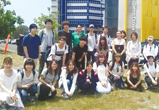
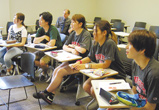
I will participate in a three-week overseas training program where I will take an intensive English course to improve my English skills and learn about English education theory and practical methods. I also plan to observe and participate in classes at local schools.
Grow through experiences outside of school!
<Learning Support Practice (Internship)>
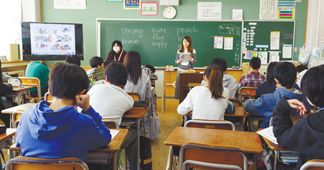
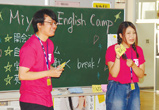
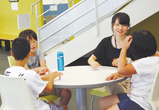
We will also actively support extracurricular activities. We will collaborate with local boards of education and schools to provide learning support in schools. In addition, as part of the university's initiatives, we are also engaged in "Elementary School Foreign Language Volunteer Activities" in cooperation with the Sendai City Board of Education, where we teach foreign languages in collaboration with elementary school teachers.
Learn effectively in small groups!
<Subject education method (each subject)>
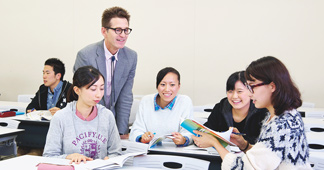
By fostering active and interactive learning in small groups, we effectively develop teachers' practical teaching skills.
Become proficient in ICT!
<ICT Education Theory and ICT Education Practice>
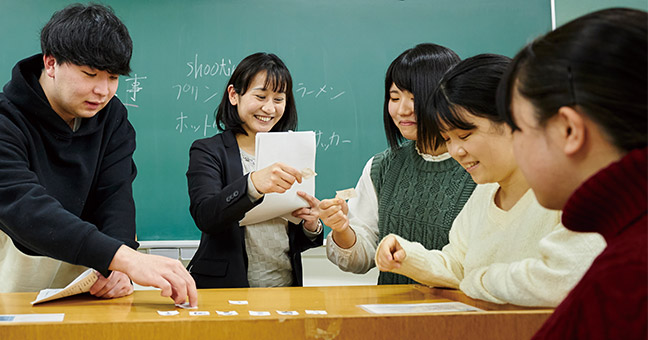
This program will provide a multifaceted and comprehensive learning experience about ICT, which will be increasingly utilized in schools, thereby broadening the scope of practical teaching skills.
Learn tolerance through understanding different cultures!
<Intercultural understanding, multiculturalism, and global education>
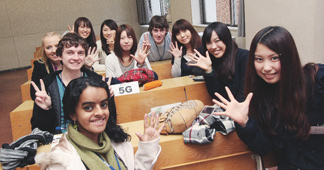
We cultivate the knowledge, skills, and attitudes necessary for intercultural exchange with other countries and for navigating the multicultural environment of Japanese society, thereby deepening practical leadership abilities.
Let's make use of our earthquake experience!
<Safety and disaster prevention education practices>
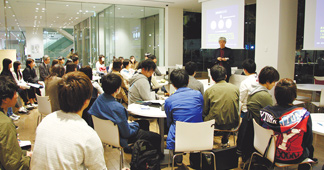
To meet the safety management demands of the times, our university, located in an area affected by the Great East Japan Earthquake, will study safety and disaster prevention in education.