
Environmental Civil Engineering course and Architecture course
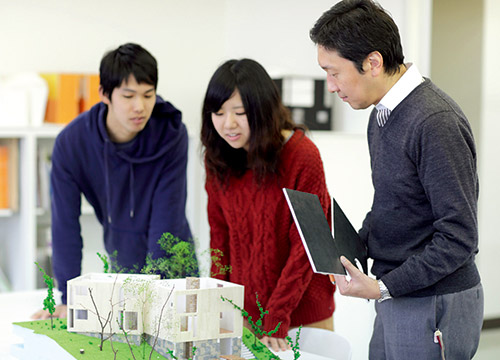
In this department, students are divided into courses from the first semester of their second year,*1 and learn detailed specialized knowledge. In the Environmental Civil Engineering course, students can learn how to solve environmental problems on a global scale and locally, as well as the design and construction of structures such as roads, bridges, dams, ports, and airports. In the Architecture course, students can learn about building design, structural planning, equipment planning, and architectural history. In addition, students can take subjects outside of their course specialization, allowing them to acquire a wide range of specialized knowledge.
*1: Course changes after course assignment are not permitted. Also, the architecture course has a capacity of 40 students.
The ideal engineer to be trained
This department aims to cultivate practical construction engineers who will be at the core of society, possessing the following qualities:
- Ethical views based on Christian principles
- General knowledge necessary for working adults
- Basic academic skills and basic specialized knowledge
Specialized courses
- Environmental Civil Engineering Course
- In the environmental field, students learn basic knowledge and environmental conservation techniques for solving environmental problems, from microscopic bioengineering and chemical perspectives to macroscopic global environmental perspectives, covering phenomena such as water pollution in urban and aquatic environments, purification methods, and soil contamination. In the civil engineering field, students acquire comprehensive knowledge necessary to build better structures for structures such as dams, bridges, tunnels, and roads, covering the entire process from basic surveys to planning, design, estimation, and construction, as well as feedback on construction results. Students also learn about the mechanisms behind natural disasters and countermeasures and maintenance methods.
- Architecture Course
- Architects, who lead the creation of buildings and cities, such as buildings and homes, are responsible for mobilizing specialized knowledge in design, facilities, materials, and more to create safe, high-performance, and highly efficient buildings. They are also required to design attractive spaces. For this reason, the Architecture course offers a multifaceted learning curriculum that can meet a variety of architectural needs, helping each student to hone their desired expertise.
Initiatives and Activities
Department of Civil and Environmental Engineering (Environmental Civil Engineering Course for students entering in 2013) received evaluation and accreditation from the Japan Accreditation Board for Engineering Engineering (JABEE) in May 2007, stating that "the engineering education program implemented in this department meets the standards required by society," and education is conducted based on that program.
Specifically, in order to cultivate engineers as described in the "Ideal Engineer Profile," we have set the following learning and educational achievement goals (A) to (H), and have established educational programs (curriculum, teaching methods, educational organization, educational facilities, student support system, etc.) to achieve them.
- (A) Develop a multifaceted perspective on global environmental issues and other matters, while also understanding the regional characteristics of Tohoku, as an environmental construction engineer [An engineer with a multifaceted perspective]
- (B) Through Christianity, students will steadily acquire common sense and general knowledge as members of society, as well as develop an ethical sense as engineers and the ability to act while considering the relationship between science and technology and nature and society. [Common sense as a member of society and engineering ethics]
- (C-1) Acquire knowledge and academic ability in mathematics, natural sciences, and fundamental engineering, and develop the ability to apply this knowledge to problem-solving [Knowledge and applied ability in mathematics and science and technology]
- (C-2) Acquire basic knowledge and skills related to information technology and develop the ability to utilize them in real-world situations [Skills and application abilities in information technology]
- (D) Acquire fundamental specialized knowledge and academic ability in environmental construction engineering, and develop the ability to apply and develop it as a core engineer [Basic academic ability and applied ability in specialized subjects]
- (E) Actively acquire information on science and technology to solve societal needs, and develop problem-solving abilities through the cycle of planning, execution, analysis/evaluation, and improvement for challenges [Design ability for problem solving]
- (F-1) Acquire the ability to use Japanese that is technically and socially sufficient [Japanese expression ability]
- (F-2) Acquire basic English communication skills [Basic international communication skills]
- (G) Through graduation training, experiments, exercises, and practical training, students will recognize the importance of proactively learning on their own and acquire the "ability to continuously learn" in order to obtain the various necessary qualifications as core engineers in the construction industry. [Self-learning ability and continuous learning ability]
- (H) Through graduation training, experiments, exercises, and practical work, students will acquire the ability to plan, execute, and summarize projects independently [Planning ability and overall management ability].