
Cultivating electrical and electronic engineers with broad problem-solving abilities through the acquisition of cutting-edge technologies.
~Contributing to industry and local communities with immediate skills~
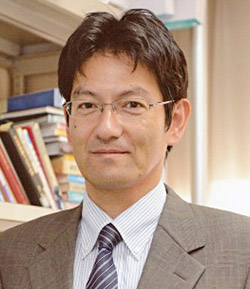
Head of the Department of Electrical and Electronic Engineering
KAWAMATA, Ken
Through research and development in electrical and electronic technology, from fundamentals to applications, and further to cutting-edge technologies, we aim to cultivate human resources who can immediately contribute to industry and local communities.
The Department of Department of Electrical and Electronic Engineering has three core areas: "Power and Control Systems," "Information and Communication Systems," and "Electronics and Materials Systems." Students can acquire a broad range of specialized knowledge along with cutting-edge technologies. We believe that these disciplines are essential to our daily lives and will contribute to a future advanced circular economy and intelligent society.
The goal of this department is to train electrical and electronic engineers who possess a foundation in the fundamental theories of information and communication technology (ICT) and are capable of responding to the demands of modern society, where the efficiency of electrical energy utilization is constantly increasing. We aim to cultivate individuals who can handle not only the basic domains of electrical and electronics but also a wide range of integrated technologies.
In the "Power and Control Systems" course, students will learn about various power application technologies, from the transmission and distribution of electrical energy, to the application of power electronics and control systems to mobility, and even to healthcare and welfare.
In the "Information and Communication Systems" course, students learn about information conversion technologies, processing technologies, transmission technologies, and switching technologies related to ICT (Information and Communication Technology) from both hardware and software perspectives.
In the "Electronics and Materials" field, students will learn about various areas related to electronic materials that support high-performance devices that underpin social infrastructure and help develop new electronics.
To achieve the above goals, this department offers a comprehensive curriculum that allows students to acquire skills ranging from fundamentals to advanced applications.
In the first year, students study a wide range of general education subjects along with fundamental subjects such as physics and mathematics. In particular, the "Freshman Seminar" aims to broaden students' technical perspectives and increase their motivation to learn by providing easy-to-understand explanations of each faculty member's research.
In the second year, students study foundational subjects in "Power and Control Systems," "Information and Communication Systems," and "Electronics and Materials Systems," while simultaneously enriching their practical skills with experimental subjects such as "Electrical and Electronic Engineering Experiments I and II" to cultivate fundamental abilities.
In the third year, students focus on more advanced specialized subjects within their respective fields, but by offering elective courses, they can acquire a broad range of knowledge. In particular, the "Junior Seminar," offered in the second semester of the third year, places all students in the research laboratories of full-time faculty members who are active on the front lines of education and research. There, they prepare for their graduation research and cultivate flexible thinking through problem-solving.
In their fourth year, students conduct their graduation research in their assigned laboratory, acquiring research skills in various specialized fields while demonstrating creativity and ingenuity, and developing problem-solving and presentation abilities.
A major feature of this department's curriculum is the opportunity to acquire numerous licenses and qualifications. For example, by completing the required courses during your studies and gaining practical experience after graduation, you can obtain the national qualification of Chief Electrical Engineer. There are also exemptions from some exams for the Electrician's License. Furthermore, you can obtain qualifications such as Chief Telecommunications Engineer, First-Class Land Mobile Radio Operator, Third-Class Maritime Mobile Radio Operator, and teaching staff license (Industrial High School, Class 1). In addition, it is possible to obtain specialized licenses by continuing your studies at Graduate Schools.
Upon completing four years of study in this department, we are confident that students will become experts in electrical and electronic technology, equipped with a solid foundation in information and communication technology (ICT), and capable of making significant contributions to society.