Disaster and emergency response
Student Disaster Prevention Manual
Earthquakes, typhoons, heavy snow, floods, fires, etc. – For emergencies –
Disasters can strike at any time. It's important to be prepared in advance so that you can act calmly in the event of an emergency.
In the event of a major disaster, the university will establish a disaster emergency response headquarters and provide necessary information and instructions regarding evacuation and departure times to students who are on campus.
Disaster preparedness tips
Please keep the following points in mind and take precautions to protect yourself from disasters in your daily life.
- As of April 1, 2013, smoking is completely prohibited throughout the entire campus of our university.
- Do not place any obstructions in front of fire doors, indoor fire hydrants, corridors, or stairwells.
- In the laboratory, do not place flammable materials near heat sources.
- In club rooms and lounges, always strive to keep them tidy and organized so that a safe evacuation can be arranged in case of an emergency.
- Actively participate in disaster prevention drills conducted on campus and familiarize yourself with the use of fire extinguishers and evacuation equipment.
In the event of a major disaster
If a strong earthquake (or other major disaster) with a seismic intensity of 5 or higher occurs in the six prefectures of Tohoku, the university will send a safety confirmation message to MYTG. After receiving the message, please register your safety status as soon as possible.
Please see below for registration instructions.
Student Operation Manual (Safety Confirmation Response)
When I was on campus
Emergency broadcast based on the decision of the Disaster Emergency Response Headquarters
The university will make emergency broadcasts in accordance with the severity of the disaster after it occurs.
What to do if an earthquake occurs on campus
- If using open flames, extinguish them quickly.
- Open doors and windows, secure escape routes, and do not rush outside.
- Get under a desk or other object to protect yourself from falling or toppling objects and keep an emergency exit open.
- Never use elevators or escalators.
- When evacuating, follow the instructions of the teachers and staff.
- Evacuate on foot, and pack only the bare minimum of belongings.
- At the evacuation site, follow the instructions of the teachers and staff and do not act on your own initiative.
- The university will issue staggered departure times as soon as it obtains accurate information regarding transportation and other factors, in order to avoid social disruption.
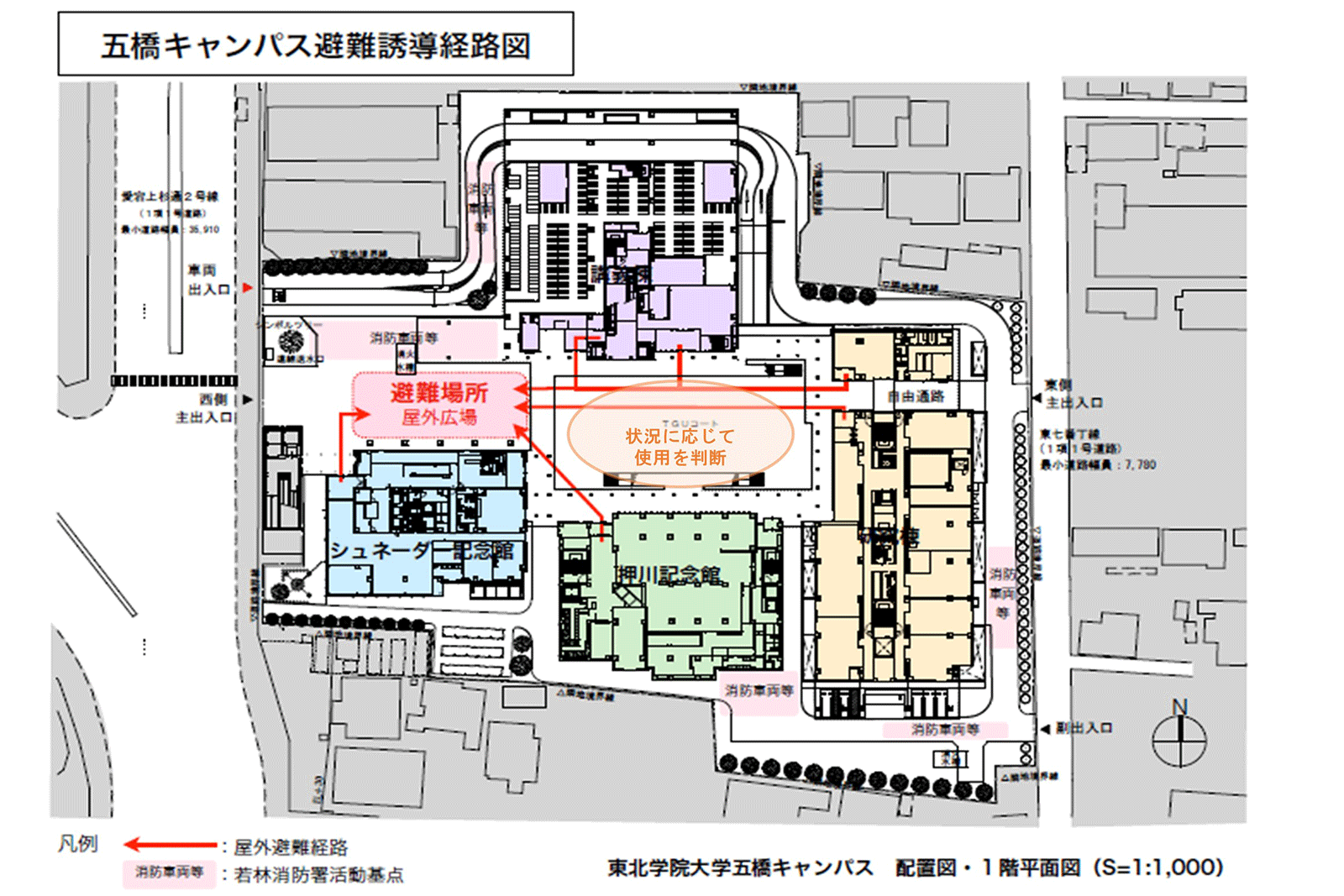
*Regarding evacuation from the Schneider Memorial Hall (high-rise building) on Itsutsubashi Campus
- Evacuation from the 2nd to 5th floors should be done via the east staircase inside the Coratelier Library.
- For floors 6 through 16 (the top floor), evacuation should be done using the two emergency staircases located in the center of the building.
If there is a fire on campus
- If you discover a fire, inform those around you and ask for help.
- Even for small fires, report it to the faculty and staff and evacuate according to their instructions.
- Never use elevators or escalators.
When I was off campus
If you are at home, stay where you are and pay attention to the following:
- Listen to accurate information on television, radio, etc.
- Pay constant attention to information from local government disaster prevention radio broadcasts, fire stations, police stations, and other sources.
- Pay attention to information from the university through the "Student Safety Confirmation System," "MYTG," etc.
- Avoid using unnecessary open flames as much as possible.
- Check the fire extinguisher and fill the bathtub and buckets with water.
- Change into light and safe clothing.
- Keep valuables and immediate necessities readily accessible.
When commuting to or from school, please use your own judgment to decide whether to go home or continue on to the university.
- Listen carefully to station announcements and don't be misled by rumors or irresponsible behavior.
- Follow the instructions of station staff and police officers and act calmly.
- If you are driving, pull over to the side of the road and evacuate to a safe place while observing the situation.
- Take action while listening to earthquake and traffic information on the radio or other means.
- If you live a short distance away, walk home and avoid using public transportation where disruption is expected.
- If you are near the university, head to the university and evacuate to the designated evacuation area on campus.
- When moving around, be careful of falling objects and stay away from walls and structures.
Contact information for the university (emergency contact)
Checking on their safety
| Student Division | Tsuchitoi | 022-264-6471 |
| Itsutsubashi | 022-354-8220 |
Class inquiries
| Educational Affairs Division | Tsuchitoi | 022-264-6451 |
| Itsutsubashi | 022-354-8200 |
Disaster message dial "171"
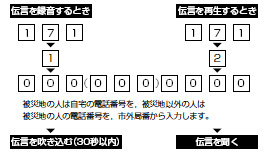
NTT will launch a "Disaster Message Dial" service in the event of a surge in calls to disaster-stricken areas to check on the safety of residents. This voicemail service uses the home phone numbers of those affected as keys to record and play back messages, enabling communication. It will be an effective means of contact when phone lines to disaster-stricken areas are overwhelmed and unable to connect.
- Use a public telephone
- During a disaster, public telephones are more likely to connect than regular telephones. It's helpful to note down the locations of public telephones around your home in advance.
- Create relay points in remote locations.
- Even during a disaster, phone calls from the affected area to the outside world are generally relatively easy to make. Ask relatives or friends in distant locations to set up a communication relay point.
- Students contact their families
- Contact your family as soon as possible to let them know you are safe.
Class cancellations and exam postponements during disasters
- In the event that it becomes extremely difficult to conduct classes and exams due to a disaster or other unforeseen circumstances, we will contact you through MYTG, the university website, and the media. Please be sure to check these sources yourself.
- Information regarding class cancellations, exam postponements, and the resumption of classes and exams will be communicated through MYTG, the university website, and the media.
For inquiries regarding classes and exams, please contact the Academic Affairs Division (Tsuchitoi, Itsutsubashi). - The following applies to students who are absent due to delays in public transportation:
Even after public transportation services that were out of service are resumed, if you are unable to attend classes or exams due to delays caused by the disruption or obstacles to commuting due to road and traffic conditions, the following procedures will apply.
For further details, please consult with the Academic Affairs Office (Tsuchitoi, Itsutsubashi).Absence form Documents to submit Document submission destination handling Students who were unable to attend classes The prescribed "notification form"
(Attach a letter of explanation such as a delay certificate issued by the public transportation provider.)Please contact the Academic Affairs Office (Tsuchitoi or Itsutsubashi) by the designated date and time. This will not be treated as an absence. Students who were unable to take the exam The prescribed "Application Form"
(Attach a letter of explanation such as a delay certificate issued by the public transportation provider.)Please contact the Academic Affairs Office (Tsuchitoi or Itsutsubashi) by the designated date and time. Applicants can take the make-up exam without requiring permission from the subject instructor. - If a disaster or accident occurs during a class or exam and the class or exam is canceled, the same procedure as in case 2 will be followed.
Regarding evacuation in emergencies
In the event of a disaster or other emergency requiring evacuation off campus, please follow the procedures below.
- In the event of an emergency, evacuation instructions will be announced via emergency broadcast from the university, so please remain calm and follow the instructions.
- When evacuating, please be careful not to cause congestion in stairwells, corridors, etc. (Do not place luggage or other obstructing objects in corridors, stairwells, emergency exits, etc.).
- Please make sure to memorize the building name, classroom number, emergency exits, stairs, entrances, etc., at all times.
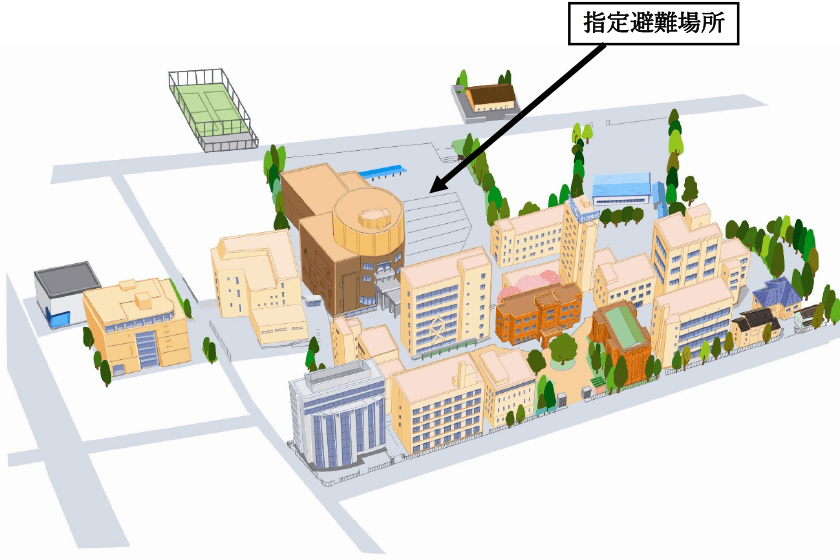
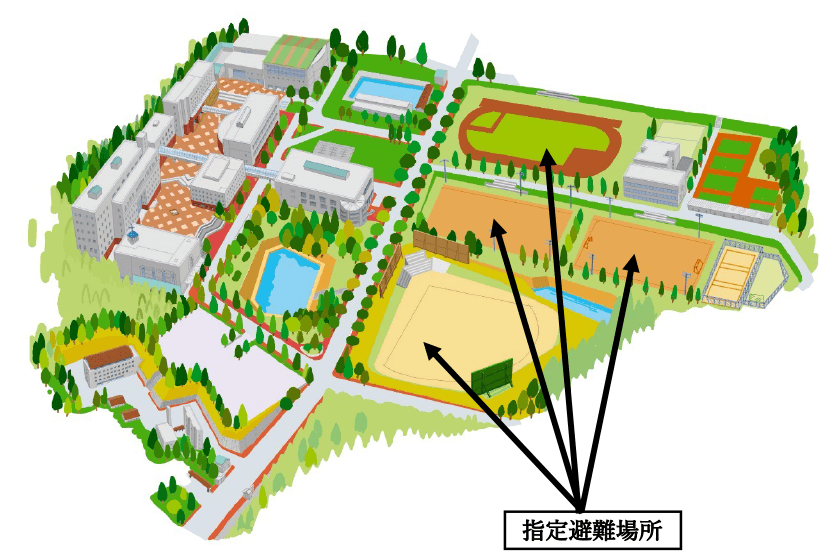
Designated evacuation sites (Please check the designated evacuation sites on campus)
*It is expected that many evacuees will gather at the evacuation center. As a measure against COVID-19, it is important to avoid the three Cs: closed spaces, crowded places, and close contact. To prevent crowding and close contact, it is effective to sit with your back to people rather than facing them, or to create partitions using cardboard or other materials. This will also help prevent droplet infection from coughs and sneezes, so please keep the following points in mind.
- Wear a mask.
- Maintain sufficient distance from other people.
- Since droplets from sneezes and other exhalations tend to linger near the floor, instead of sleeping directly on the floor of an evacuation center, lay down cardboard or something similar to create some distance from the floor.
- Disinfect your hands before and after touching common surfaces that many people touch, such as toilets, doorknobs, and handrails.
- Let's refrain from speaking loudly.