
FAQ
Q1. What kind of department is Department of Policy Design?
Department of Policy Design values the following four things:
- ① Training of personnel who aim to solve local issues
If you have a feeling that something is off, or that something seems strange, don't you think? Instead of dismissing that feeling, we should identify it as an issue we need to address, investigate its causes, analyze case studies, find partners to collaborate with, and actually take action towards a solution. That sounds difficult, doesn't it? In Department of Policy Design, you will learn all of these processes.
- ② Realizing a sustainable local community through collaboration between the public, the common people, and the private sector.
Even the smallest problems can feel daunting and inefficient when tackled alone, right? The key is collaboration (partnership). Depending on the issue, the partners you collaborate with will differ—from ordinary students to local businesses, NPOs, and city halls. Determining who and what organizations to work with to achieve greater success is crucial for realizing a sustainable community.
- ③ View local communities from a global perspective.
-
It's been decades since people started saying "the world has globalized." But do we really think about things globally in our daily lives? Probably not, right? In reality, our lives are not confined to just our local area. The opposite is true; if we break down most of the things and information around us to their raw materials, almost all of them originate from other countries and regions.
This means that local community problems can no longer be addressed by considering them solely within that region. Let's cultivate a perspective that allows us to consider familiar issues on a global level!
- ④ Realization of a symbiotic society
Even within a specific region, the people living there differ in gender, age, occupation, income, family structure, health status, political affiliation, hobbies, skills, dreams, and even their country or region of origin. If we exclude or ignore these differences, the "problems" will remain problems. What is important is to view the problems facing a region as challenges toward realizing a community where diverse people can coexist.
Q2. What challenges does the region face?
The challenges faced by each region are diverse. The following table shows some of them in relation to the SDGs.
The important point here is that each of these issues is closely interconnected at its core. Therefore, solving one issue often does not necessarily lead to a fundamental solution to the problem. On the contrary, it can even worsen the situation by negatively impacting other issues or creating new ones.
For such "troublesome" challenges, new solutions different from conventional ones are required. That solution is "policy design." Please see Q3 and Q4 for details.
List of major regional issues (regional SDGs)
| Each of the SDGs | SDGs and their corresponding major regional challenges |
|---|---|
 Let's end poverty
|
Child poverty, women's poverty, welfare, working poor |
 End hunger
|
Shortage of agricultural workers, food self-sufficiency rate, smart agriculture |
 Health and well-being for all
|
Super-aging society, healthy life expectancy, social security costs, shortage of care workers, dementia, lifestyle-related diseases, uneven distribution of doctors, lonely deaths |
 Quality education for all
|
Educational inequality, school absenteeism and bullying, developmental disabilities, lifelong learning, financial education |
 Let's achieve gender equality
|
Female leaders, balancing work and childcare, waiting lists for childcare, increasing rates of singlehood, men's participation in housework and childcare. |
 Safe water and sanitation for the whole world
|
Water shortage, depletion of fishery resources |
 Energy for everyone, and clean energy.
|
Renewable energy |
 Decent work and economic growth
|
Work-life balance, non-regular employment, entrepreneurship, inbound tourism, lack of successors, financial inclusion |
 Let's build a foundation for industry and technological innovation.
|
Preservation of traditional techniques, the digital divide, artificial intelligence (AI), robots |
 Let's eliminate inequality among people and countries.
|
Population decline, regional economic disparities, human rights violations, LGBTQ+ people, people with disabilities, foreign workers |
 Creating a city where people can continue to live.
|
Population decline, aging infrastructure, limited access to shopping, vacant houses, disaster recovery, disaster mitigation and prevention. |
 Responsibility to produce and use
|
Food waste, plastic waste |
 Take concrete action against climate change
|
Greenhouse gases, urban heat island effect, torrential downpours, floods |
 Let's protect the richness of the ocean.
|
Marine pollution, overfishing of marine resources, and a shortage of workers in the fishing industry. |
 Let's protect the richness of the land.
|
Biodiversity, forest conservation, and shortage of forestry workers |
 Peace and justice for all
|
Domestic violence (DV), child abuse, special fraud, youth political participation |
 Achieve your goals through partnership.
|
Fiscal deficit, weakening of communities |
Source: Created based on Yusuke Kakei (2019), "How to Create Sustainable Communities," Eiji Publishing.
Q3. What is "policy design"?
Policy design is the process of creating policy tools and activities that contribute to solving local issues through the cooperation and collaboration of everyone involved. To raise awareness of these activities and expand the circle of people who support and cooperate with them, empathy and inspiration are essential. That's why we decided to use the term "policy design."
Incidentally, when you hear the word "design," you might imagine studying art or computer graphics (CG). While those kinds of studies are very interesting, the design you learn in Department of Policy Design is called "social design." Social design means analyzing, designing, and changing society in order to realize a better society in new fields. For more details, please see the Ministry of Economy, Trade and Industry's "JAPAN+D Project."
Q4. What can be achieved through policy design?
Let's use the solution of "child poverty" as an example to explain this. The key concept here is "collaboration between the public, the public, and the private sector."
In Japan today, it is said that one in seven children lives in poverty (relative poverty). Relative poverty means that a child is not so poor that they cannot afford basic necessities like food, clothing, and shelter (absolute poverty), but is poorer than their classmates and others around them, for example, by not being able to buy stationery or equipment for extracurricular activities. Children facing relative poverty are at a significant disadvantage compared to children who do not face relative poverty in terms of healthcare, food, education, and higher education, and are said to be more likely to remain in similar poverty even after becoming adults. Child poverty has a significant negative impact on society not only in terms of the individual but also in terms of taxes and social security, so we need to take this issue as "our own problem" and work together to solve it.
One solution that has recently gained attention as an effective solution to child poverty is the "children's cafeteria." Children's cafeterias are community spaces that provide free or low-cost meals to children who cannot afford to eat enough for economic reasons. It is said that the first children's cafeteria was started by the owner of a greengrocer in Tokyo, but this initiative has spread throughout Japan, and there are now more than 7,000 children's cafeterias.
Furthermore, the "public-community-private partnership" shown in the following diagram plays a crucial role in the establishment and operation of children's cafeterias.
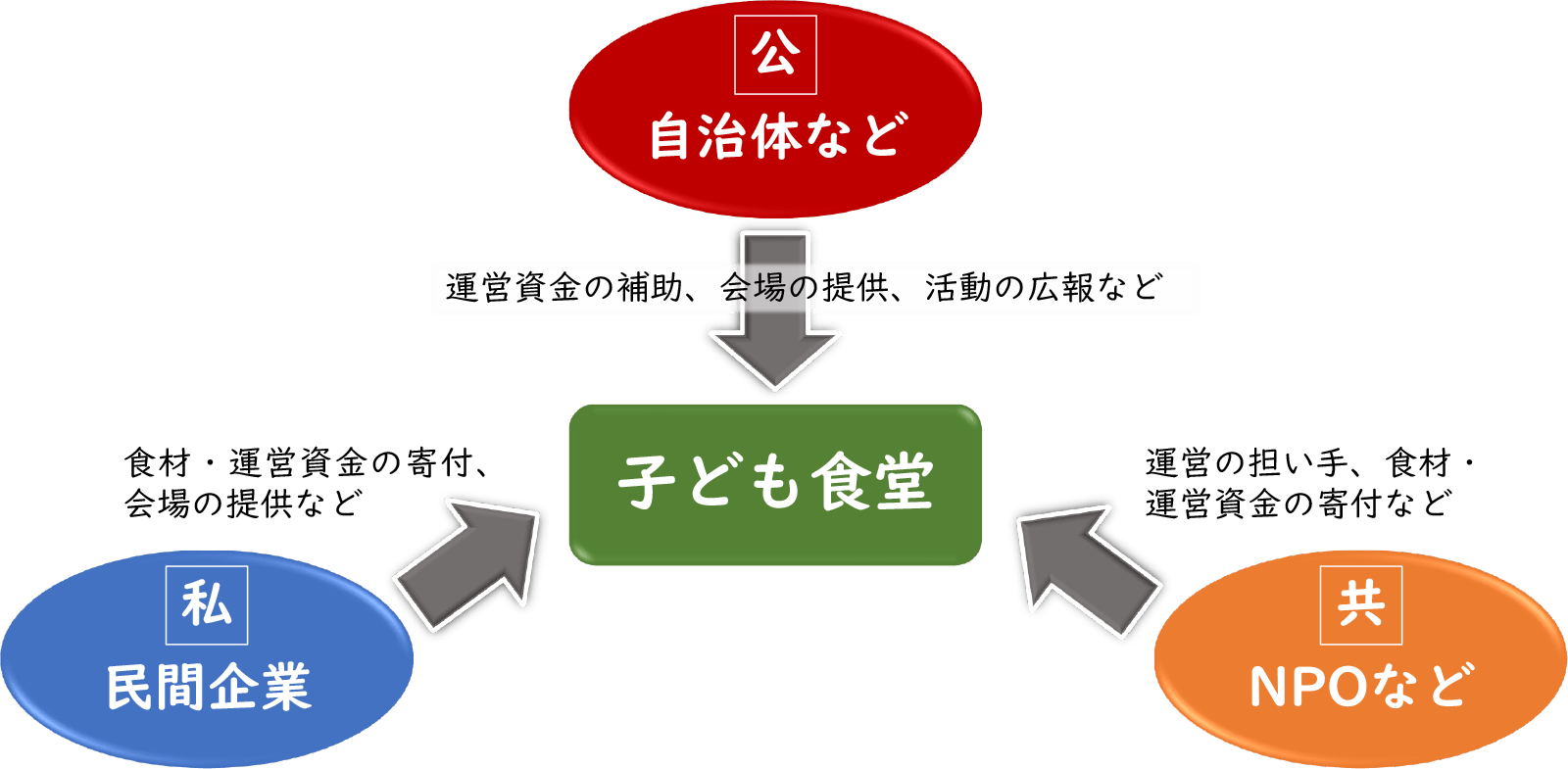
The establishment and operation of children's cafeterias cannot succeed without the participation of people from the public, private, or community sectors. It only becomes feasible when people from each of these sectors are moved by and empathize with the children's cafeteria initiative and collaborate with each other. Creating mechanisms that generate this movement, empathy, and collaboration among people—that is "policy design."
Q5. What are "changemakers" and "policy entrepreneurs"?
Isn't this strange? I don't like this, I wish it were like this...
Many people have likely felt this way in their daily lives, reading newspapers, or watching the news. But nothing changes if you stay silent. Enthusiasm alone isn't enough, and giving up also won't change anything. In fact, things might even get worse. However, by considering and acting on the following points, even seemingly impossible things can become possible.
- Where does the problem lie, and why did the situation come about?
- What should be done to improve the situation?
- Where should we focus our efforts, and how do we need to collaborate with people?
In this way, people who create new value and change society are called "changemakers" or "policy entrepreneurs." In other words, "changemakers" and "policy entrepreneurs" do not refer to specific professions, and at the same time, the point is that it is not only politicians and other specific people who think about and change policies.
Each and every one of us living in our local community can become a policymaker and a change driver. Policy entrepreneurs are individuals who can present new value, both within and outside organizations, and realize it as a sustainable initiative. They are the most sought-after people in the society you will live in now and in the near future.
Q6. What are the "V-Skills" that you acquire in Department of Policy Design?
"V Skills" is a collective term for the following five abilities, which are the fundamental capabilities we use to design policies.
- Empathy: The ability to listen empathetically to the voices of those involved, understand the complexity of the problem, and gain a deep understanding of it.
- Thinking skills: The ability to think about solutions to problems from multiple perspectives and in a logical manner, considering public, community, and private viewpoints.
- Creativity: The ability to break free from existing rules and propose new solutions through trial and error.
- Communication skills: The ability to deliver new solutions to many people and gain their understanding and support.
- Collaboration: The ability to involve people from public, private, and community sectors and work together to achieve solutions.
In Department of Policy Design, students will develop these five skills in a balanced manner through a variety of specialized subjects in three areas: public administration, economy and industry, and civil society, as well as small-group seminars and practical training courses that involve close interaction and collaboration with society.
Furthermore, the V-Skills acquired in this course are almost identical to "design thinking," which has been actively adopted by many companies and government agencies in recent years. Design thinking is a method that starts with empathy and continuously cycles through empathy ⇒ thinking ⇒ creativity ⇒ communication ⇒ collaboration to generate innovative solutions to complex problems where conventional solutions are ineffective.
- Introduction of Design Thinking at Fujitsu Limited
- NIRA Research Institute: Human-centered policies through design thinking
Recently, reskilling for working adults has been gaining attention, but unlike learning a foreign language or obtaining various qualifications, design thinking is difficult to learn on your own. If you can acquire design thinking skills through academic study, your opportunities for success in society will expand dramatically.
Q7. What are the differences between this department and Department of Regional Community Studies?
If the Department of Regional Department of Regional Community Studies focuses on "exploring" regional issues, then Department of Policy Design focuses on "solving" regional issues.
However, since both Department of Policy Design and Department of Regional Community Studies aim to "cultivate human resources to create better communities," the differences may still be difficult to discern. In such cases, it might be helpful to consider them in terms of academic disciplines.
The curriculum in Department of Policy Design is based on economics and includes subjects such as public finance, sociology, business administration, social welfare, and anthropology. On the other hand, Department of Regional Community Studies has a strong focus on subjects in fields such as geography and ecology. If you're unsure, it's a good idea to carefully examine the curricula of both departments and choose based on your own interests and areas of study.
Q8. What are the differences between this faculty and Faculty of Law, Faculty of Economics, and Faculty of Business Administration?
Department of Policy Design seeks to solve regional issues through collaboration between the public, private, and community sectors. Therefore, it differs from other departments in its diverse learning approach. The reason for this combination of various academic fields is that regional issues can no longer be addressed by a single academic discipline alone. Based on this reality, we considered what we believe to be the best (most powerful?) combination when creating this new faculty and department.
Another major feature is the abundance of learning opportunities in the local community, such as policy design practicals and regional projects. It is also important to step outside the classroom and learn from various "real-world" experiences.
- Related Information
Q9. What kind of person is suited to this department?
Anyone who wants to contribute to creating a better community is welcome. In particular, we welcome the following types of people:
- ① Students with a strong sense of purpose who have a challenge they want to tackle on their own.
Department of Policy Design is a department that explores regional issues and seeks solutions.
- ② Students who want to learn about local community issues from a broad perspective and viewpoint and take action.
This department has full-time faculty members specializing in a wide range of fields, including economics and business administration, sociology and social welfare, cultural anthropology, and political science.
- ③ Students who are interested in realizing an inclusive society or the SDGs (Sustainable Development Goals)
-
You can learn from both theory and practice.
- Related Information
- Philosophy and objectives, educational goals, and ideal student profile.
Q10. Are you focusing on preparing for civil service exams?
While Department of Policy Design is not specifically aimed at training civil servants, its curriculum is designed to prepare students for the first stage of the civil service examination (administrative positions), covering specialized subjects such as political science, public administration, constitutional law, administrative law, civil law, labor law, economics, public finance, business administration, and social policy, as well as the second stage, which includes essays and interviews. Furthermore, the curriculum is directly related to the work of civil servants.
Furthermore, in local government civil service examinations, there is a growing tendency to place more emphasis on essay examinations and interview examinations (including group interviews) than on academic examinations (general education and specialized subjects) in the selection process. For example, in the 2026 Sendai City employee recruitment examination, the academic examination was worth 200 points in the first stage, while in the second stage, the essay examination was worth 200 points, in addition to the interview examinations (group and individual) being worth 600 points.
*The content and scoring of the exams vary depending on the type and category. The above is based on the exam outline for the "University Graduate Level" exam.
Sendai City: Sendai City Employee Recruitment Examination
For your reference, here are some questions that were actually asked in interview exams (group discussions) conducted by several local governments.
- Fukushima Prefecture Employee Recruitment Examination (FY2021)
- Summarize your group's opinion on whether you support or oppose making volunteer work and other community service experiences mandatory in high schools.
- Aomori Prefecture Employee Recruitment Examination (FY2022)
- According to the basic statistics on employment status published by the prefecture, as of October 2020, the labor force population (the population aged 15 and over with the willingness and ability to work) in the prefecture has decreased by 22,266 people compared to five years ago (2015). In your group, summarize and present what impact this decrease in the labor force population will have on the society of this prefecture, and what measures are necessary to overcome it.
- Akita Prefecture Employee Recruitment Examination (FY2022)
- Given the changing environment surrounding local governments, including population decline and the need to manage various crises, identify the most pressing issues our prefecture should address, and state your thoughts on the anticipated problems and solutions.
These kinds of problems are difficult to address simply by memorizing facts; they require empathy, critical thinking, and creativity, which are acquired through academic study.
Q11. What career paths are possible after graduation?
The skills you acquire through your studies can be applied to a variety of professions. You are expected to play an active role as a change-maker in creating better communities in public, private, and community settings. For example, we envision the following areas of activity:
- ① Contribute to the development of the local community through working for a private company. Engage in research and solutions to domestic (and international) social issues through work.
- ② They work for government agencies, non-governmental organizations (NGOs), NPOs, etc.
- ③ As a public servant, I will contribute to the implementation of public policies and the development and reconstruction of my hometown.