
Student Voices
#03 - 2nd Generation Member Interview
We asked second-year students in Department of Policy Design about what they have focused on most during their university life. (Participating students: Kurumi Sato, Rino Sato, and Riho Konno)
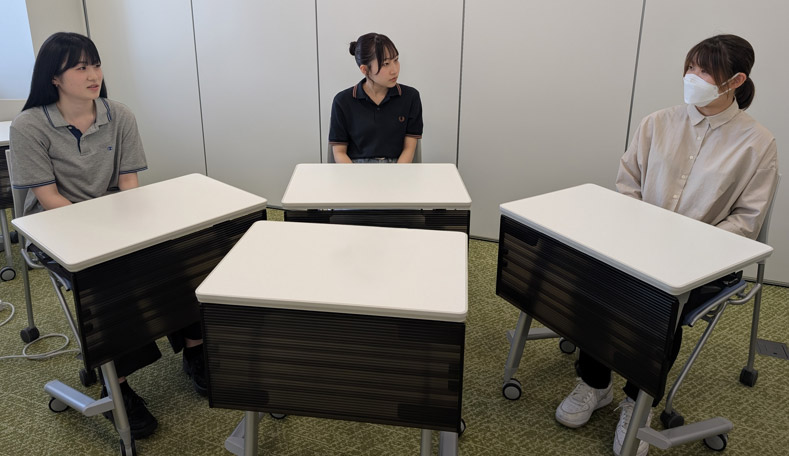
Kurumi Sato: Won the Audience Award at the "Sendai Co-creation Lab"
Could you please give me an overview of the Sendai Co-creation Lab?
- Kurumi Sato:
- "Sendai Co-creation Lab" is a program organized by NTT East that supports university students in developing and realizing new businesses, and I participated as a member of the first cohort.
In terms of specific activities, I reflected on my past experiences, combined particularly memorable events with what I perceive as local issues, proposed what could be done, and presented these ideas to representatives from various companies.
The project kicked off in mid-November, with a general schedule of monthly workshops and one to two online or in-person meetings with mentors each month. The mentors taught us about project management, presentation techniques, public speaking, and presentation skills. I was initially anxious because it required individual initiative, but it was reassuring to have many people to talk to and get feedback from, such as other university students and mentors, leading up to the final presentation on March 15th.
Could you tell me about the work that Kurumi Sato was involved in?
- Kurumi Sato:
- Looking back on my experiences so far, moving to Sendai was a major change for me, and I feel the most fulfilled I've ever been. So I thought about what had changed in the past year or so (I was a first-year university student at the time). One problem I realized was that my connection with my family had become weaker. I wanted to express my gratitude to my family, who always support me, as I couldn't see them as often as I wanted. I thought about how I could express that gratitude, and combined that with the idea of retort curry, which led to the development of the retort curry package.
I presented a product idea at YUI NOS to about 25 company representatives, targeting people who are too shy to say "thank you" on a regular basis, using cleverly designed retort curry packaging, making it suitable for occasions like Labor Thanksgiving Day, Father's Day, and Mother's Day. Specifically, the packaging differs depending on the recipient. For example, when a daughter sends it to her parents, the package includes sections for things like "My current obsession," "Things I want to do when I go home," and "A word I want to tell them," allowing them to fill in these sections and create an opportunity for conversation. I also designed the packaging box in a way that makes it easy to save, so that the recipient can keep it as a memento. I considered simply printing a message on the package beforehand, but I personally enjoy writing, and I believe that there is a special feeling that can only be conveyed through handwritten words, so I proposed this type of packaging.
As a result of my presentation, I received the Audience Award. This award is given based on votes from the audience, and although I was nervous because it had been a really long time since I spoke in front of people, I was genuinely happy.
Please share your thoughts on the presentation and what you learned from participating in the event.
- Kurumi Sato:
- Each participant launched and advanced their own project, so I realized the importance of planning and taking action. I also learned firsthand that nothing starts unless you take action yourself. I received wonderful comments from people at various companies, and it made me realize that creating something new is challenging but also enjoyable.
However, it was difficult to consider whether what I wanted to do and what society truly needed were aligned. I also learned about the problem of the means becoming the end. For example, when organizing an event, it's not good if the purpose of the event is lost and the act of organizing the event itself becomes the goal. The means become the main focus, and the original purpose can be lost, so it was challenging to ensure that the event was merely a means to an end and that I didn't lose sight of the main purpose and what I wanted to do.
In my case, even though my biggest goal was actually to express my gratitude, there were several times when I almost ended up focusing on designing retort curry packaging. My mentor helped me get back on track each time.
Participating in this program broadened my network of contacts. I was invited to attend related events and pitch contests, and through these activities, I felt my perspective expanding even further.
Questions from participating students to Kurumi Sato
- Riho Konno:
- I never would have thought of combining feelings of gratitude towards one's parents with instant curry, so I wondered about the reasoning behind that idea and where such flexible thinking comes from.
- Kurumi Sato:
- It was purely by chance. As I continued developing the concept, I think it was the result of combining things I like. Also, some of my friends occasionally mentioned that they crave their family's curry, and I realized that curry is completely different from family to family, and I thought it might be a food that embodies family love and symbolizes family. However, homemade curry doesn't keep for many days after it's made, so I opted for a retort curry that has a longer shelf life. Furthermore, since I started living alone, I have fewer opportunities to see my family and say "thank you," so I thought it would be nice to have an opportunity to express my gratitude, and proposed a product that combines retort curry with the feeling of gratitude.
- Rino Sato:
- Is the Sendai Co-creation Lab ending with this final report? Or will it continue in the future?
- Kurumi Sato:
- The companies we work with have expressed their hope that we will continue this project. The winner of the Excellence Award, Akimasa Sasaki (a student in Department of Policy Design), proposed creating a disaster prevention board game. It was well-received, and we declared to NTT that we would form a disaster prevention team to make it a reality. So now, three of us—Sasaki, Rento Yamanaka (a student in Department of Policy Design), and myself—are working on it together.
Rino Sato: Studying abroad in the United States and implementing a project after returning to Japan
Could you tell me about Rino Sato's experience studying abroad in the United States during her first year of university?
- Rino Sato:
- Last summer, I participated in SoftBank's TOMODACHI Summer SoftBank Leadership Program 2.0, where I took the Y-PLAN (a Y-PLAN program developed by UC Berkeley's Center for Cities + Schools (CC+S) to help young people participate in community development and foster their ability to bring about change in their communities) at the University of California, Berkeley. Through interactions with social entrepreneurs and local students, I developed action plans for regional issues that students wanted to address in Tohoku. After returning to Japan, with the support of mentors from each prefecture, we implemented projects in various parts of Tohoku that had connections to the participants. In the United States, from July to August, I lived with 12 other people, including 2 university students and 10 high school students, for about three weeks.
I had the opportunity to take classes from people like Dr. Deborah McCoy of the University of California, Berkeley, who was in charge of the US study program at the university. In addition, I learned about community revitalization through extracurricular activities, such as visiting towns where almost only Black people live and listening to adults and high school students who are involved in supporting the homeless. The town that made the biggest impression on me was North Richmond.
North Richmond is a town that has fallen into poverty due to its cultural background and other factors, and is home to a large Black population. At first, I had a scary impression of the town because of the barking of large dogs and the large amounts of illegally dumped garbage such as cars, but I was impressed by how the townspeople were actively working to address the garbage problem, the well-equipped youth center and senior center, and how these facilities were used to revitalize the town through various activities, as well as the many colorful paintings that were painted throughout the town. The town had made great progress in supporting the lives of its residents through the activities of the local people and organizations, but even now, illegal dumping of garbage continues to be a problem, and there is a lack of stores where one can buy healthy and fresh food, so residents have to go outside the town to take care of their daily errands. To solve these problems, we thought it was necessary to aim for community development that fosters connections, so we formed a team of students and worked on proposing policy ideas. Our team proposed activities that would connect the garbage problem with intergenerational exchange, which was desired by the people at the senior center.
Please tell me about the events that will take place after you return to Japan.
- Rino Sato:
- I'm from Fukushima City, Fukushima Prefecture, but I carried out my project not in my hometown, but in a town called Odaka in Minamisoma City. Odaka is a town whose population was reduced to zero due to the effects of the Great East Japan Earthquake and the nuclear disaster, and it's also a town where I have fond memories of my grandmother running a liquor store before the earthquake. Now it's a fascinating place that is taking on many challenges in its revitalization. Initially, I thought I would use my experience in America to organize an event that would bring together the community, which I felt was working hard individually before I went to the US, to work together as a whole.
But more importantly, I felt that in America, many young people are involved in their local communities, but when I returned to my hometown, I realized that young people don't have many opportunities to get involved with their local communities. Even before that, I thought that students and others don't have many opportunities to learn about the town in the first place. To verify if this was really true, I lived in a shared house in Odaka for a little over a week, and I went to the elementary and junior high schools to conduct surveys and talked to people at the ward office. There, I found many attractive things, such as the many active community development volunteers, people who have moved to the area, and people who are working hard to start businesses, as well as various projects and events being held to liven up the community. On the other hand, when I actually visited the elementary and junior high schools and surveyed the level of understanding and attachment to the local area, I found that many young people were not very interested or did not know what kind of activities Odaka is a town that is doing. I thought it was very sad that even though there are actually many attractive things happening here, local people may not know about them and think, "This town isn't very attractive," and end up getting jobs or going to school in other areas.
Ultimately, we decided to hold an event at NIKO Park, a facility where kindergarteners, elementary school students, and junior high school students play, to introduce them to Odaka. However, we realized that simply presenting PowerPoint slides summarizing things like, "This is what this town is actually doing," or "These are the people who are active here," would be difficult for young children to concentrate on. So, we brought things that we actually make in Odaka and showed them, and we also cooked meals together, trying to introduce them to the town through interaction. With the support of mentors and others, we proceeded with the event, and in December, we held a final presentation in Miyagi about the project's implementation, the process, and the lessons learned from the results. There, we talked about the content of our project, the challenges we faced during implementation, and how we overcame them. After the presentation, we also held a poster session, where we were able to interact with attendees by answering their questions.
Did anything change in your thinking after going through the program?
- Rino Sato:
- I used to think I was someone who didn't have many preconceived notions, but I've come to realize that there are truly things you can't know unless you try them or go to a place. There were quite a few moments when I was startled to realize that I had been making assumptions about certain things, and my perspective on myself has changed. In addition to the region I explored, I've also become interested in activities in other regions, and I've made opportunities to visit Onagawa in Miyagi Prefecture to learn about the town. From last summer to autumn, I also participated in a project where company representatives and students worked together to think about solutions to regional problems. I feel that I've become more proactive in challenging myself with various things than before.
Questions from participating students to Rino Sato
- Kurumi Sato:
- How did you handle conversations in America?
- Rino Sato:
- A woman named Mutsumi, who lives in America, helped us out as a mentor. We went out to buy breakfast and go to cafes by ourselves, and surprisingly, we were able to communicate properly and manage our daily lives. I thought I had put a lot of effort into improving my English, so I was happy that I could understand authentic American English and that I was able to talk to local university students and make friends.
- Riho Konno:
- Before you went, were you worried or anxious about things like not being able to communicate?
- Rino Sato:
- I've always had a personality that makes me want to try anything that interests me, so I wasn't too worried. Also, I'd always wanted to go abroad, so I didn't feel scared; it was more like, "This looks interesting, I want to go, let's do it!" I like this aspect of my personality, but I also realize that I often start taking action before setting any goals when starting something. In this program, I spent a lot of time in America wondering what my ultimate goal was and what my biggest reason for participating was. Another thing I noticed was that many of the high school students who participated had very strong feelings like, "I want to do something for my community!" or "I want to learn and absorb a lot in America!", and I felt that many of them participated with specific goals in mind. So, although I wasn't afraid of the language, I realized that while it's important to have the courage to jump into things and places you've never done before, you also need to have clear goals and objectives when starting something.
Riho Konno: A distinctive class in Department of Policy Design
Of all the courses in Department of Policy Design, which ones did you find particularly interesting?
- Riho Konno:
- The classes I found particularly interesting were the special lectures. In these lectures, we invite external lecturers who are active in the fields of public administration, economy and industry, and civil society, which are the specialties of Department of Policy Design. They give lectures about their activities and then present us with issues that we should consider. We then work in groups to consider solutions to the issues presented, and finally, we present our proposed solutions to the lecturers.
Department of Policy Design is based on three specialized areas, and I think it's rare to find a single class that allows you to consider all three areas and perspectives, so in that sense, I found it to be an interesting class.
Furthermore, being able to attend lectures by people who are active on the front lines in the region, and having our presentations and ideas evaluated by professionals in that field, is an invaluable opportunity, so I'm glad we were able to have such an experience in the special lecture classes.
Furthermore, since the course involves group work, it's not just about learning in lectures; you can also think about how to solve problems while incorporating the opinions of other members in your group, which I think is another attractive aspect of this special lecture.
What results did you gain from the class?
- Riho Konno:
- I believe I've become able to view challenges from multiple perspectives. Being able to hear from people working in different fields, and through group work, discovering opinions and ideas I wouldn't have thought of on my own, has allowed me to develop the ability to analyze challenges from various angles.
I've always been interested in regional issues, and I enrolled in Department of Policy Design because I wanted to become someone who could contribute, even in a small way, to solving those issues. However, regional issues aren't just one problem; there are many different kinds. For example, there's the declining birthrate and aging population, population decrease, and disaster recovery. Therefore, I believe that the ability to analyze issues from multiple perspectives is a very necessary skill when considering such problems. Consequently, I'm glad that I was able to learn these useful skills through special lectures.
Were there any difficulties you encountered while preparing the report?
- Riho Konno:
- Finding data and examples to support my arguments was challenging in order to create a persuasive presentation. However, I felt that the special lectures had many connections to other classes. For example, in Professor Ikakura's class on regional economic data analysis, I learned how to view and analyze data using RESAS. As a result, I feel that I was able to effectively utilize the data by sharing what I learned in that class with everyone in my group. Also, in another class, I learned about neighborhood associations, which were raised as a local issue by someone from the Wakabayashi Ward Office, and I was able to actually relate that content to my presentation in the special lecture. Finding data and examples can be difficult, but I realized that it's not impossible because there are many aspects that can be utilized if you consider that everything you've learned at university up to that point is connected.
Please explain how all aspects of university learning are interconnected.
- Riho Konno:
- I believe that the courses in Department of Policy Design have solving local issues as a central theme. The issues and perspectives covered may differ depending on the professor of the course you take, but I think there are multiple places where you can apply what you've learned. Rather than using what you learn in one class to solve one problem, I think that by connecting what you've learned so far, you can connect it to solve the complex problems of local issues, which involve multiple intertwined factors.
Please share your thoughts on giving a presentation to external audiences and receiving their feedback.
- Riho Konno:
- We sometimes met outside of class to prepare our presentations. We did our best to prepare them so that we could present them with confidence, so we are very grateful to receive positive feedback on that. In the comments on our presentations, sometimes the good points were praised, and sometimes the shortcomings of our proposals were pointed out. For example, in our last presentation, we received feedback that it would have been even better if we had actually shown the target municipalities for our proposed policy to increase the number of overnight guests and demonstrated its feasibility. Even when we thought our proposal was perfect, we learned that there were still shortcomings from the perspective of professionals in the field, which I think was a great opportunity for me to grow.
Questions from participating students to Riho Konno
- Kurumi Sato:
- Which reports were particularly memorable?
- Riho Konno:
- The most memorable presentation was the second one, in front of President Yuki of the Economic and Industrial Sector. The first presentation, in front of the Wakabayashi Ward representatives, was more of a "let's just give it a try" kind of thing. For the second presentation, we were highly praised for not only presenting the content of the policy proposal we had come up with in the first presentation, but also for clearly identifying the remaining challenges, which showed a deeper consideration. So, as a group, we discussed that we wanted to retain that perspective. In this way, we put a lot of thought into how to further develop the content while building on the good points from the previous presentation, so it's a very meaningful experience for us.
- Rino Sato:
- Which of the three fields (economy and industry, public administration, or civil society) are you currently interested in?
- Riho Konno:
- I found the economic and industrial sector particularly interesting. I found it fascinating to see how we could turn our proposals into reality and how clearly defined our target audience was.
#01 - First Generation Member Interview
I interviewed the first-year students of Department of Policy Design at the end of their first semester.
- The first-generation members who participated in the interview (in no particular order)
- Kaede Sasaki (from Miyagi Prefecture)
Misaki Akihira (from Akita Prefecture)
Riho Sanpei (from Miyagi Prefecture)
Mao Goto (from Miyagi Prefecture)
Chisaki Sekine (from Miyagi Prefecture)
Akane Takagi (from Iwate Prefecture)
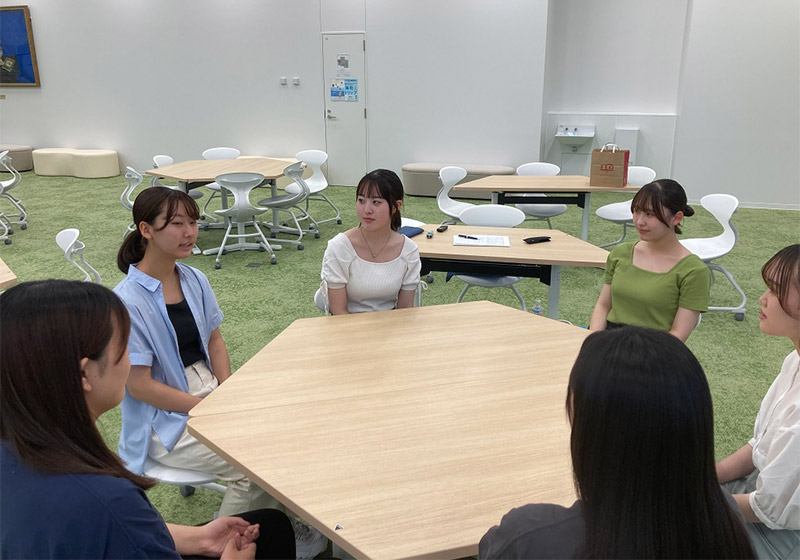
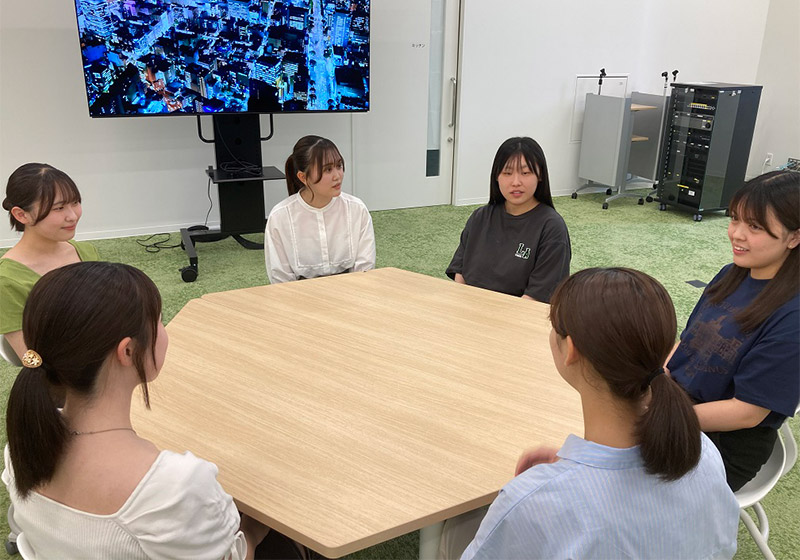
Q1. What were your reasons for wanting to Department of Policy Design?
- Sasaki-san:
- I have always wanted to work in a job that could revitalize local communities. When I learned about the new department that would allow me to study local communities through university brochures and other materials, I decided to apply to Department of Policy Design because I wanted to learn about local communities in depth.
- Akihira-san:
- I love my hometown and want to become a local government employee who can contribute to it, so I chose to Department of Policy Design where I could learn about that.
- Sanpei-san:
- I am interested in the SDGs (Sustainable Development Goals), and I applied to Department of Policy Design because I wanted to learn about the SDGs more broadly and deeply by taking "Introduction to SDGs," a course offered in the first year of the department, and various other subjects.
- Goto-san:
- I was drawn to Department of Policy Design because I learned that the curriculum consists of three areas (public administration, economy and industry, and civil society), and I was interested in the broad range of subjects offered. Also, like Ms. Sanpei, I studied SDGs in high school, and I wanted to learn more about SDGs in a broader and deeper way in Department of Policy Design, which is why I applied.
- Sekine-san:
- I learned about various regional issues through my high school research project, but I chose to apply to Department of Policy Design because I believe I can study regional issues that interest me, such as the declining birthrate, aging population, and gender issues, in depth.
- Takagi-san:
- In the future, I would like to be involved in community development. I chose to apply to Department of Policy Design because I believe that studying there will enable me to propose effective solutions. Another reason for my application is that I would like to participate in the various fieldwork classes offered by Department of Policy Design and engage closely with local people.
Q2. How was the group work on social issues in the "Basic Seminar"?
Note: "Basic Seminar" is a small-group class that all students enrolled in Department of Policy Design take in the first semester of their first year. Incidentally, this year's enrollment (first cohort) consists of 82 men and 71 women, for a total of 153 students.
- Sasaki-san:
- My group focused on the issue of "medical errors." By thoroughly investigating the current situation, we hypothesized that the deterioration of working conditions for healthcare professionals (stress, fatigue, etc.) is causing medical errors. Based on this hypothesis, we made policy recommendations from the perspective of healthcare professionals.
- Akihira-san:
- Our group focused on the issue of "declining birthrate and aging population" in our region. We concentrated on "childcare support" as a countermeasure, comparing and examining the initiatives in Iwate Prefecture and Tokyo. After clarifying the differences and similarities between the two municipalities' approaches, we made policy recommendations from a broad perspective.
- Sanpei-san:
- Our group tackled the issue of vacant houses. We specifically focused on the vacant house problem in Kurihara City, Miyagi Prefecture, and, drawing on measures taken in Sendai City, we devised appeal strategies to attract people from outside the city to live in vacant houses (communicating the livability and attractions of Kurihara City to people).
- Goto-san:
- Our group tackled the "refugee issue" from the perspective of multicultural coexistence. In class, we worked together with our classmates to thoroughly research the definition of refugees and their realities. Through this research, we learned that Japan has very strict refugee acceptance policies, and we organized information about the background and problems behind them.
- Sekine-san:
- Our group focused on the issue of "population decline due to a low birthrate." We examined the increasing rates of singlehood and later marriages as causes of the low birthrate, investigating the realities and causes of these trends in detail. Based on this, we summarized the problems with the "unconventional measures to combat the low birthrate" currently being implemented by the government.
- Takagi-san:
- Our group focused on the issue of "depopulation in regional cities." While researching various documents in the university library, we learned about the reality of many young people migrating from rural areas to urban areas due to reasons such as pursuing higher education. After thoroughly investigating the causes, we proposed the effects and challenges of the "relaxed-type relationship population" initiative as an opportunity to foster lasting connections with local communities, and suggested how to promote such initiatives.
Q3. What is the actual learning experience like in Department of Policy Design? (Aside from "Basic Seminar")
- Sekine-san:
- I was particularly impressed by the "Social Security Theory" class. In the class, the professor brought up the topic of baby hatches, which allowed me to think deeply about the pros and cons of baby hatches.
- Goto-san:
- In the "Introduction to SDGs" class I took, the professor showed us videos about gender discrimination, which allowed me to learn about the realities faced by people suffering from it.
- Akihira-san:
- I learned about leprosy in my "Contemporary Social Issues" class. I was deeply saddened by the reality of discrimination against people who have recovered from leprosy, but I was also greatly encouraged to learn that these survivors themselves are working to eliminate discrimination.
- Sanpei-san:
- I also learned about gender in my "Contemporary Social Issues" class. I hadn't been particularly interested in gender before, but after listening to the guest speaker, I learned the importance of respecting the diverse viewpoints that people hold.
Q4. What is something you would really like to work on during your four years of university?
- Sasaki-san:
- Since I haven't decided on my future career path yet, I'd like to try various things, such as volunteering. Previously, I was involved in the "Children's Fund" project in Natori City, Miyagi Prefecture, where I was able to hear the opinions of various children and adults, which was very inspiring. I would like to continue actively participating in extracurricular activities offered by local governments and universities.
- Akihira-san:
- I would like to actively participate in local projects. I previously participated in an activity called "City Camp," where I listened to people who have experienced the difficulties of childbirth and child-rearing. I hope to continue to have opportunities to interact with people directly affected by local issues, thereby gaining many insights and learning experiences.
- Sanpei-san:
- I would like to volunteer at a food bank. Food banks provide meals and offer various consultations to people who are struggling to get enough food on a daily basis, but I want to understand the essence of social issues by talking directly with people who are actually in need.
- Goto-san:
- I previously attended an information session for a career experience program in Miyagi Prefecture, where four business owners gave me valuable advice, saying, "It's good to deliberately do things you're not interested in right now. Also, it's good to actively go abroad while you're a student." I want to put that advice into practice and broaden my horizons even further.
- Sekine-san:
- I've loved local events like festivals since I was a child, and I often participated with my family. In the future, I'd like to contribute to the revitalization of the community by getting involved in the operation of local events.
- Takagi-san:
- During my high school research project, I tackled the issue of vacant houses, but I was unable to present a satisfactory solution, which I still regret. In the future, through various studies in Department of Policy Design, I hope to acquire the fundamental knowledge necessary for problem-solving, and at the same time, actively venture outside the university to directly hear the voices of local people and understand what is truly needed in the community.
Q5. Do you have any message for high school students who are interested in enrolling in Department of Policy Design?
- Sasaki-san:
- During high school, I was very anxious because I couldn't decide on my future path. I think there are high school students who feel the same way I did about their future. To all high school students considering taking entrance exams through comprehensive selection or school recommendation, please try not to be too nervous and calmly express your opinions. I'm sure your enthusiasm for wanting to get into the university will come across.
- Akihira-san:
- Department of Policy Design offers a wide range of learning opportunities, so even if you haven't decided what you want to do in the future yet, I believe you'll definitely find it during your time as a student. I would love to learn alongside all of you, so please do your best!
- Sanpei-san:
- Department of Policy Design offers the opportunity to learn in a variety of fields, so I encourage you to actively challenge yourself not only with subjects that interest you, but also with subjects that don't. Furthermore, I hope that your studies in Department of Policy Design will broaden your potential. Good luck!
- Goto-san:
- In Department of Policy Design, you'll receive notifications encouraging participation in various volunteer activities and local events, so I'm sure you'll find something you're passionate about. Good luck!
- Sekine-san:
- As we are the first graduating class, we don't have any seniors in our department yet, but next year we will be waiting for you as your seniors, so please feel confident in enrolling. Let's learn together!
- Takagi-san:
- When I was preparing for my university entrance exams, I received a great deal of support from my high school teachers, including my homeroom teacher and assistant homeroom teacher. I hope that all prospective students will be proactive and take initiative, and that they will continue their exam preparation without giving up until the very end. Also, I came to Sendai City from Iwate Prefecture, where I didn't know anyone, and I felt very anxious when I first enrolled. However, my classmates in Department of Policy Design are all bright and warm people, and now those anxieties have disappeared. I hope you all can enroll with peace of mind.
#02 - 1st Generation Member Interview 2
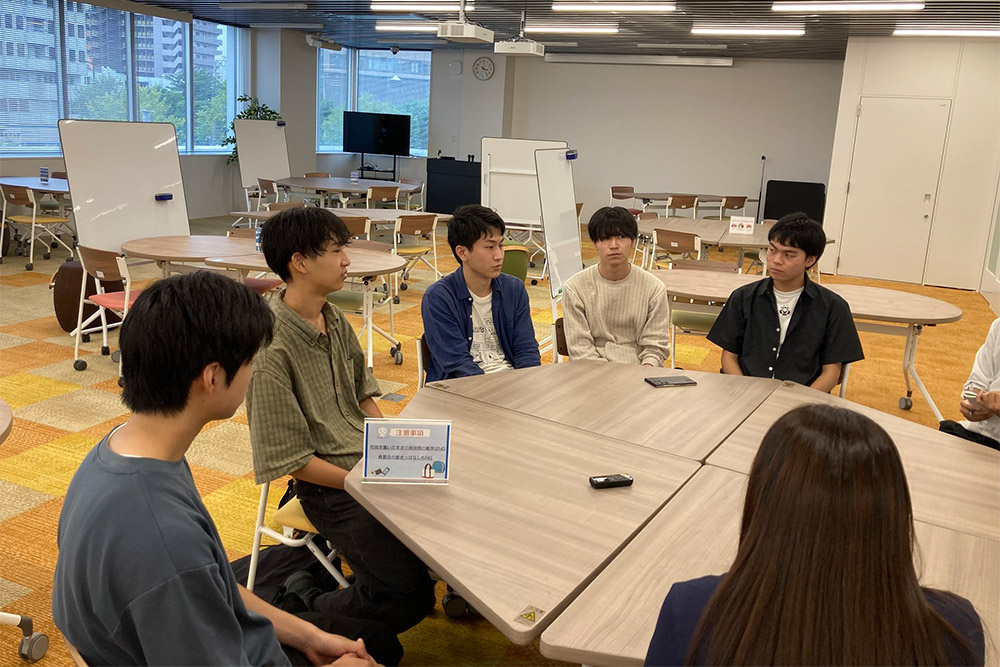
We interviewed second-year students in Department of Policy Design at the end of the first semester about what they had learned so far in Department of Policy Design and what they would like to work on in the future.
- Participants (Prefecture of Origin)
- Hitoshi Sasaki (Miyagi Prefecture) /
Shunri Yabuki (Fukushima Prefecture) /
Hideaki Sato (Miyagi Prefecture) /
Takuya Matsuda (Yamagata Prefecture) /
Hiroto Yamaki (Fukushima Prefecture)
Kaede Sasaki (Miyagi Prefecture) /
Riho Sanpei (Miyagi Prefecture)
Ichika Kawamura (Miyagi Prefecture)
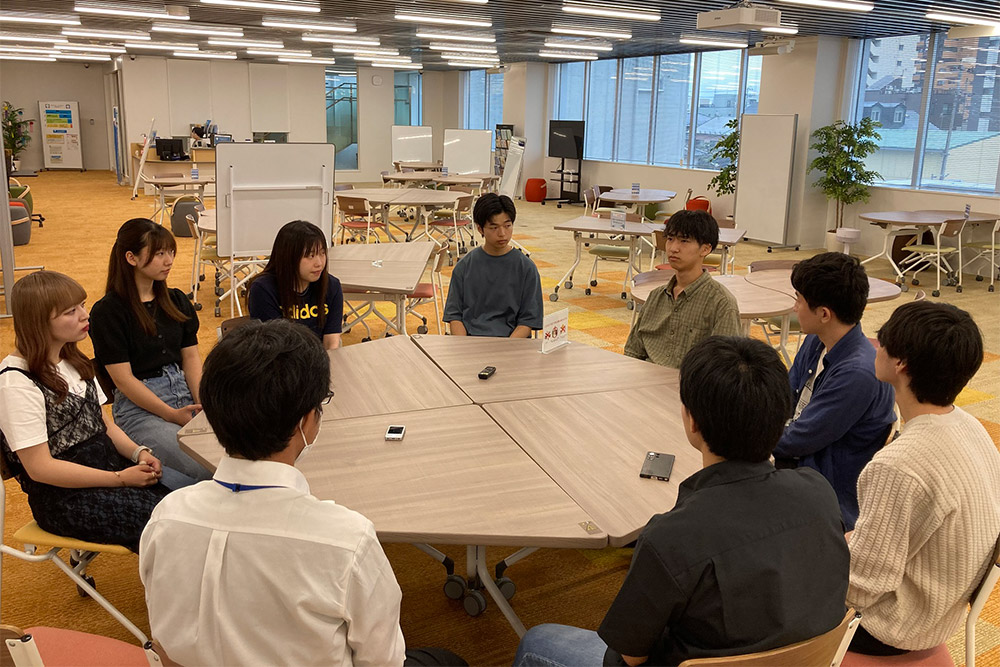
Q1. Please tell us why you chose to Department of Policy Design.
- Mr. Sasaki (Jin):
- I chose this university because I liked the opportunity to study a wide range of subjects. In particular, disaster prevention and relief, gender issues, and poverty issues were areas I had been interested in for a long time, so the fact that I could study those subjects was a major deciding factor.
- Yabuki-san:
- Since I hadn't decided what I wanted to study, I decided to learn a wide range of subjects and then explore what interested me.
- Sato-san:
- First, I chose it because of its unusual name. The name Department of Policy Design did n't tell me what the department was about, so I looked into it and found out that I could study various fields, which is why I decided to enroll.
*For those of you who have questions, we have prepared a list of frequently asked questions. Please pay particular attention to Q1 and Q3.
- Matsuda-san:
- I am interested in social issues such as regional challenges, rural depopulation and poverty, and the over-concentration of population in Tokyo. I aspire to become a social entrepreneur who can turn these issues into a business, and that is why I applied to study social issues, business administration, and entrepreneurship.
- Yamaki-san:
- I received help from civil servants when I was evacuated due to the damage caused by Typhoon Hagibis in 2019, which made me want to become a civil servant myself. Also, since I live in a sparsely populated area, I wanted to study the issues that sparsely populated areas face.
- Sasaki (Kaede):
- I hadn't decided what I wanted to do, so I chose this university because it offered a broad range of learning opportunities. Also, after listening to Professor Masaharu Wada and Professor Kyoko Sakuma speak at the open campus, I became interested in new things like SDGs and gender issues, so I decided to apply.
- Sanpei-san:
- When I was in high school, I didn't have a clear idea of what I wanted to do in the future, so I decided to go to university and learn various things before deciding. I wanted to study a wide range of subjects, which is why I chose to apply.
- Kawamura-san:
- When I was in high school, I hadn't decided on my future career, so I wanted to study a wide range of subjects and learn from various perspectives, such as those of a civil servant, entrepreneur, or citizen.
Q2. Were you able to learn what you had set as your goal after entering university?
- Mr. Sasaki (Jin):
- From my first year, I was able to choose my specialized subjects, which allowed me to study areas of interest such as gender studies in depth. Furthermore, in my second year, the number of subjects I could choose from increased, and I was glad that I was able to take lectures in a wider range of fields, including "Disaster Society Theory" (Professor Yasunori Saito), which I had wanted to study, as well as "Introduction to Labor Issues in the Global Age" (Professor Katsunori Miyaji).
- Yabuki-san:
- I believe I was able to learn a wide range of subjects. I took courses such as Economics (Professor Tadahiro Okuyama), "Everyday Life and Gender" (Professor Tomone Komiya), and "Contemporary Social Issues" (Professor Ai Kurosaka). Furthermore, I was able to take courses in the field of social welfare, which I am interested in, and a policy design practical training course related to it.
*Policy Design Practice: A course designed to provide opportunities for interaction with people from diverse social backgrounds, as well as to experience, research, and understand social activities in action. Please see the department's website for details on this unique course.
- Sato-san:
- In my first year, I was able to study a wide range of subjects, not just the areas I was interested in, such as "Introduction to SDGs" (Professor Kyoko Sakuma) and gender studies.
- Matsuda-san:
- As a second-year student, I've been able to research and present on local issues on my own, and I feel like I'm learning what I want to learn through practical learning such as "Policy Design Practice." I also appreciate that I can get a lot of information about off-campus events and connect with students, professors, business owners, investors, and others by participating in them.
*For example, Professor Hayasaka, a specially appointed professor at Tohoku University's Startup Business Development Center, will be invited as a lecturer for a program organized by Faculty of Regional Studies.
 There are programs such as introductory courses for entrepreneurs.
 - Yamaki-san:
- I was able to study life in evacuation centers and reconstruction in "Disaster Society Theory." I also studied the reasons for depopulation in "Aging Economics Theory" (Professor Yasuhito Sato [Faculty of Economics]), and I researched and presented on the issue of vacant houses, one of the problems of depopulation, in "Special Lecture" (Professor Itsuki Ichikawa). I feel that I have been able to learn what I wanted to learn. As for preparation for the civil service exam, I am taking an external civil service exam preparation course *.
- *Special Lectures: Public officials, business executives, and NPO members are invited to give lectures, and students then research and report on local issues based on the content of the lectures.
- *Civil Servant Courses: In cooperation with Tokyo Academy Sendai and the university cooperative, our university offers civil servant examination preparation courses for students aspiring to become civil servants. In addition, although this department is not specifically aimed at training civil servants, the curriculum is designed to prepare students for civil servant examinations and their second-stage examinations.
- Sasaki (Kaede):
- I was really glad that I was able to mainly study SDGs and gender studies in my first year. In my second year, I was able to learn about a wide range of fields that I hadn't been interested in before, such as disasters and global issues, and I developed new interests.
- Sanpei-san:
- Through courses in various fields such as "Contemporary Social Issues," "Gender Issues," and "Disaster Relief," I was able to narrow down my interests. Furthermore, through "Special Lectures" and "Policy Design Practice," I was able to hear from people active in diverse fields outside of the university, broadening my perspective and discovering areas of interest.
- Kawamura-san:
- Through various classes, I've been able to pick out things that interest me, and I think that's connected to my learning and is helping me to improve. Also, I've noticed that even in classes from different fields, there are similarities in the content covered, and the fundamental problems are often the same. I hope to delve deeper into these topics in more specialized areas during my third and fourth years.
Q3. Please tell us why you took "Policy Design Practice" and "Special Lectures," and what you learned from actually taking them.
- Mr. Sasaki (Jin):
- I participated in Professor Muto's "Policy Design Practice" course, which was related to the profession I aspire to, because I was already interested in the subject, and I wanted to learn about the local atmosphere and the genuine feelings of the people who live there—things you can only understand by going there directly. I also wanted to use the answers I received to the questions I was curious about as learning opportunities for the future and for my future career. Participating in the course made me realize that videos I had watched on the internet and elsewhere often presented one-sided perspectives and biased viewpoints. At the same time, I realized the importance of acquiring a multifaceted perspective, including understanding the government's way of thinking and the background of poverty.
* Professor Atsushi Muto 's Policy Design Workshop: Learning about poverty from Kamagasaki and Tobita Shinchi.
I'm sharing a little bit about my internship experience on Instagram. - Yabuki-san:
- I participated in Professor Muto's "Policy Design Workshop" because I wanted to understand the differences between research and reality regarding poverty, a topic covered in my classes, such as how those affected actually feel about it and how much they perceive it as a problem. When I actually went there, I didn't find the negative image portrayed on social media to be very strong, and I felt a sense of inclusivity. I appreciated the fact that people welcomed even unusual people and reached out to them. Also, there was what appeared to be a discriminated-against buraku nearby, and I saw how various issues are interconnected, not just poverty.
- Sato-san:
- I was curious about why people fall into poverty, why it takes so long to escape poverty, and why Tobita Shinchi isn't cracked down on, so I took Professor Muto's "Policy Design Practice" course. When you search for Nishinari Ward on social media or the internet, words like "dangerous" and "risky" come up as suggestions, but I realized after actually going there that this is biased information. In reality, there were kind people and people who spoke to me cheerfully. However, regarding Tobita Shinchi, I felt that it is necessary to create a society that can include the people who work there.
- Matsuda-san:
- I aspire to be a social entrepreneur and want to address poverty as a social issue. That's why I participated in this internship—to understand what people living in poverty want and what they think. For example, regarding poverty arising from the over-concentration of population in Tokyo, I considered whether poverty could be alleviated by relocating those living in poverty to rural areas. However, through the internship, I learned that local people value the connections and relationships they have in their communities, and that money is not the only important thing.
- Yamaki-san:
- I believe there are many areas where government, businesses, and civil society are in conflict, so I took the "Special Lecture" to learn how to strike a good balance between them. After attending the lecture, I felt that all the organizations—Sendai City Wakabayashi Ward *, Nakajo Construction *, and Food Bank Sendai *—share the same desire to improve their communities; they just have different methods. However, even so, conflicts can arise due to differences in their positions, and I realized that effective communication is necessary in such situations.
- *The "special lecture" given by the Wakabayashi Ward Community Development Promotion Department of Sendai City can be seen below.This is featured on our department's Instagram account.
- *The "special lecture" by President Yuki and Mr. Kikuchi of Nakajo Construction Co., Ltd. can be seen here.Here it is.
- *The "Special Lecture" by Mr. Kasahara of the NPO Food Bank Sendai can be seen here.Here it is.
- *The "special lecture" given by the Wakabayashi Ward Community Development Promotion Department of Sendai City can be seen below.
- Sasaki (Kaede):
- I believe there are many different challenges in the region, and I wanted to learn more about these issues from diverse perspectives, so I enrolled in the "Special Lecture" course. After listening to presentations from three different viewpoints (government, businesses, and NPOs), I realized that there are various problems from each perspective, and that we should all work together to improve the region. I also learned a lot, such as how to present research findings clearly to the speakers.
- Sanpei-san:
- I am taking a practical training course * at a children's center taught by Professor Komiya. My reasons for taking this course are my interest in the relationship between children and the local community, and my curiosity about the current state of children's centers. (I plan to complete the training in the future.)
*Policy Design Practice with Professor Tomone Komiya: Learn about the significance of social support for child-rearing through participant observation at child-rearing facilities.
- Kawamura-san:
- In my first year's introductory seminar, I researched reconstruction issues from an administrative perspective for a group presentation. I wanted to learn about reconstruction and disaster relief from a different viewpoint, and having experienced the Great East Japan Earthquake myself and received help from many volunteers, I became interested in volunteering and enrolled in Professor Saito's "Policy Design Practice" course. Through the practice, I learned about the difficulty of passing on disaster stories, the current state and challenges of volunteering, the necessity of public-private partnerships, and the importance of the connections between people that continue even after the disaster strikes, between victims and volunteers.
*Design practical lesson by Professor Yasunori Saito: How have non-profit organizations been involved in disaster recovery?
Q4. Please tell us about the areas of specialization you would like to deepen your knowledge in, the things you would like to learn, and the challenges you would like to take on during your university life.
- Mr. Sasaki (Jin):
- I've always been interested in disaster prevention and mitigation, and now that I'm a third-year student, I can study this field in Professor Yuki Sadaike 's "Regional Disaster Prevention and Mitigation Theory" course, so I definitely want to take the lectures and deepen my expertise. I also want to obtain qualifications such as a disaster prevention specialist certification and a kanji proficiency test certification. In addition, I want to actively participate in external events through my club activities.
- Yabuki-san:
- Over the past year or two, I've developed an interest in social welfare, so I'd like to deepen my knowledge in that area while simultaneously studying a wide range of subjects. I also intend to study diligently to obtain the qualification for appointment as a social welfare officer. Furthermore, to broaden my perspective, I'd like to participate in events and seminars offered by Department of Policy Design.
- Sato-san:
- I had been studying somewhat aimlessly, but my internship sparked my interest in poverty and social welfare. I hope to learn various things in the future, and ultimately, I'd like to study poverty in more depth. I also want to dedicate myself to extracurricular activities.
- Matsuda-san:
- Having learned about poverty this time, I would like to think about the problem of depopulated areas, such as the Kanto region, and how to move people from densely populated areas to rural areas. I also want to study business-related classes, such as those taught by Professor Masaharu Wada, as well as marketing and bookkeeping. Furthermore, I would like to actively participate in external events such as SIAC *.
*SIAC: Abbreviation for Social Innovation Accelerator College, a social entrepreneurship training program for university students organized by the city of Sendai.
- Sasaki (Kaede):
- I have been interested in gender since before entering university, and in my third year, I would like to take courses on gender in the civil society field to further deepen my expertise. Also, although I am not sure if it will be related to gender, I would like to study a field that can solve local problems. I would like to actively participate in seminars and lectures on these topics. In addition, I am currently volunteering at festivals outside of school, and I would like to continue to do my best in that area.
- Sanpei-san:
- I took the "Introduction to Labor Issues in the Global Age" class (Professor Katsunori Miyaji) and realized I was interested in global and labor issues, so I thought it would be good to take related courses. In addition, I would like to take courses in a wide range of fields to broaden my horizons. I also started volunteering for the Miyagi Pageant of Lights this year, and I would like to contribute to regional revitalization by spreading awareness of Miyagi Prefecture's events to areas such as Kanto and Kansai.
- Kawamura-san:
- Having observed both government responses and voluntary citizen activities in relation to disasters, I would like to consider what companies can do going forward. Through my internship, I also realized the importance of human connections and the significant influence of media, so I would like to study the psychological aspects of disaster response and the impact of media and information. Furthermore, I would like to actively participate in disaster prevention workshops held in my hometown to feel a closer connection to local issues and apply what I have learned.
Q5. What differences do you feel there are between high school life and university life?
- Mr. Sasaki (Jin):
- I think the degree of freedom is vastly different. As a university student, you can freely choose your courses, so your attendance time varies from day to day. However, with that freedom comes a greater sense of personal responsibility, so I think it's important not to live with the same mindset as a high school student.
- Yabuki-san:
- I think the main difference is that you're expected to take initiative. There are many opportunities for growth, but you need to make an effort to take initiative, such as reading books in the university library or asking professors questions about things you don't understand.
- Sato-san:
- The biggest difference is having more free time and fewer constraints. However, that also means you have to take responsibility for yourself. For example, if you do poorly on a test, you'll fail the course without any remedial classes. Also, you have to earn your own money and decide everything yourself. I feel like I have a lot more responsibilities now.
- Matsuda-san:
- I believe university students have a wide range of opportunities. There are opportunities to spend money, to learn, to participate in events, and so on. What's required in these situations is self-reliance; I feel that you can't take advantage of these opportunities unless you take action yourself.
- Sasaki (Kaede):
- At university, everything is decided by your own choices. In high school, you could graduate if you lived like everyone else, and it felt like you were being forced to study, but I think the biggest difference at university is that you act based on what you want to do.
- Sanpei-san:
- At university, if you take on various challenges, such as participating in events, you can gain experiences and qualifications that will be useful in the future. However, I think that if you just drift through your time doing nothing, you might graduate without gaining anything.
- Kawamura-san:
- I think it's essential to make your own informed decisions at university. When you have more disposable income and free time, all the decisions—whether this choice is truly right for you, whether you should pursue it now, whether you should study or not—are entirely up to you. I think the difference between high school and university is that you need to be constantly aware of these things.
Q6. Finally, do you have a message for high school students?
- Mr. Sasaki (Jin):
- As a university student, you'll have more time to dedicate to what you want to do, such as studying your chosen field or pursuing your career path, making it easier to take action. Of course, this comes with responsibility, so be mindful of that. However, I think enjoying the time you have to have fun will make your university life more meaningful. Good luck!
- Yabuki-san:
- I believe there are plenty of opportunities to deepen your thinking and grow as a person, and I'm glad I came here myself. By carefully considering the risks and rewards after taking action and taking initiative, you can deepen your thinking and grow. Good luck!
- Sato-san:
- I understand that some people may have been accepted to a university as a backup option, or enrolled out of necessity, and initially have no interest in it at all. In such cases, don't worry; just be confident and proactive, and you'll surely find something you want to do. Good luck with your exams!
- Matsuda-san:
- Since I had so much more free time, I got my motorcycle license and bought a motorcycle. With a motorcycle, I can go wherever I want, whenever I want. You should get your motorcycle license when you enroll.
- Sasaki (Kaede):
- I imagine that high school students who are currently worried about college entrance exams and other things like that are constantly thinking about their future and what they want to do next. But even so, if you know what you truly want to do and you really want to go to that university, I believe you can get in. Once you're enrolled, you'll have the freedom to spend your time as you please, and you'll meet all sorts of people at university. I hope you'll look forward to that and work hard with the goal of learning many different things.
- Sanpei-san:
- Even if you've already decided what you want to study at university, trying out different fields or areas you think you're not good at can change your perspective. Don't be afraid to try and gain a variety of experiences.
- Kawamura-san:
- Taking that first step can be quite scary, and you might feel anxious. But even so, cherish what you want to do and what interests you, and try to take that first step. There will be good and bad things, but they will all become part of your experience, so don't put too much pressure on yourself, believe in yourself, and keep walking in different directions.
That concludes my questions. Thank you for your time today.