
Lecture for students
Department of Policy Design holds lectures twice a year, inviting individuals who are working on various "challenges" in local communities. These lectures are an opportunity for students in Department of Policy Design to deepen their learning while also considering what they can do and what their future holds.
2026年度
The 7th Lecture for Students
- Date
- July 16, 2026 (Thursday) 15:00-16:30
- Venue
- Tohoku Gakuin University Tsuchitoi Campus
Building 8 Hall - Content
-
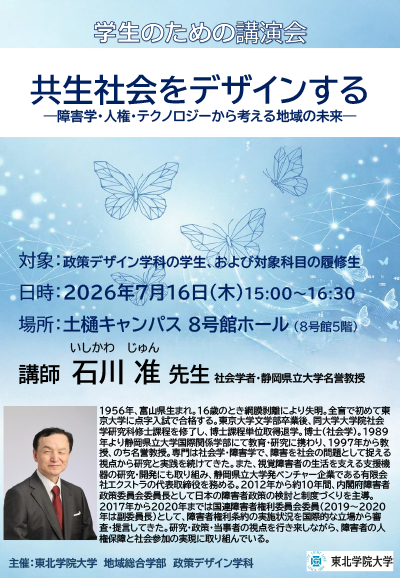
Designing a symbiotic society
—Considering the future of the region from the perspectives of disability studies, human rights, and technology—Lecturer Jun Ishikawa
(Sociologist, Professor Emeritus at Shizuoka Prefectural University)
Born in Toyama Prefecture in 1956, he lost his sight at the age of 16 due to retinal detachment. He was the first person to pass the entrance examination for the University of Tokyo using the Braille system despite being completely blind. After graduating Faculty of Letters, University of Tokyo, he completed his master's degree in sociology at the same Graduate Schools 's graduate school and withdrew from the doctoral program after completing the required coursework. He holds a PhD in Sociology. Since 1989, he has been involved in education and research at the Faculty of International Relations, Shizuoka Prefectural University, becoming a professor in 1997 and later a professor emeritus. His specialties are sociology and disability studies, and he has continued his research and practice from the perspective of viewing disability as a social problem. He has also worked on the research and development of assistive devices to support the lives of visually impaired people and serves as the representative director of Extra Co., Ltd., a venture company spun off from Shizuoka Prefectural University. For about 10 years from 2012, he led the examination and institutional development of disability policies in Japan as the chairperson of the Cabinet Office's Committee on Disability Policy. From 2017 to 2020, he served as a member of the UN Committee on the Rights of Persons with Disabilities (Vice-Chairperson from 2019 to 2020), where he reviewed and made recommendations on the implementation of the Convention on the Rights of Persons with Disabilities from an international standpoint. We are working to ensure the human rights of people with disabilities and realize their participation in society, moving between research, policy, and the perspectives of those directly affected.
Student impressions
- This lecture significantly changed my understanding of the word "disability." Previously, I believed that disability was solely due to an individual's physical or mental condition, and that the difficulties people with disabilities faced were solely their own. However, the lecture introduced the concept of the "social model of disability," teaching me that disability is not solely caused by the individual, but rather by the social environment, systems, and people's attitudes. I deeply resonated with the idea that disability can be minimized by changing social structures and environments. While I've often heard the phrase "supporting people with disabilities," I now realize that what's truly needed isn't support, but rather creating a society where everyone can live without hardship.
- Hearing about how creating systems actually helps people with disabilities around the world and how they utilize AI, I was inspired by their proactive approach to solving their own difficulties. I also learned that different perspectives on societal structures lead to completely different ways of responding. For example, the discussion about whether the inability to climb stairs is due to a leg disability or the stairs themselves was a new perspective for me.
Furthermore, I felt it is necessary to fully recognize those who have been oppressed or have refrained from speaking out or expressing their opinions in the past, as we respect diversity. I also learned that when implementing policies, various responses such as integration and separation will be necessary depending on the circumstances, that coordination is required between those who design the system and those who use it in order to create a system that is not one-sided, and that able-bodied people should not make policies based on their own arbitrary perspectives. I want to have a perspective that protects the human rights of people with disabilities, who are the people directly affected, while engaging with society. - Attending this lecture helped me understand that disability is not an individual problem but a societal one, and it made me realize that I myself am a person affected by it. Two points in particular stood out to me during the talk:
One topic was the difference between able-bodied people and people with disabilities. Professor Ishikawa described able-bodied people as those who are already given consideration, and people with disabilities as those who are not yet given sufficient consideration. He explained that just as there is no obstacle for a wheelchair user if there are no steps, disability is a product of societal design and environment. This interpretation had a profound impact on me. This is because, after hearing this, I realized for the first time that I had been living in an environment that was already accommodating. If there were no difficulties in living due to the environment, the difference between able-bodied people and people with disabilities would remain within the realm of individual differences. This talk, which made me realize that disability can be resolved by redesigning society with consideration, was a very impressive topic that greatly changed my way of thinking.
Another story that greatly influenced me was the idea that when redesigning a world where people with disabilities can live more easily, it's not about thinking from the perspective of people with disabilities themselves. People with disabilities understand best what challenges they face and what policies they need. Therefore, what's truly necessary when formulating laws and policies concerning people with disabilities is to involve them. When I understood this, I realized that I had subconsciously assumed that such things were the job of the government, and I learned that not only issues concerning people with disabilities, but also various discrimination issues should be addressed in collaboration with those directly affected. If I were a government official, my role would not be to formulate policies from the perspective of those directly affected, but rather to act as a point of contact connecting them to forums for considering laws and policies. This topic, too, was a memorable story that significantly changed my perspective.
Through many discussions, I was able to revise my perspective on policy design. I understood the importance of leveraging others' strengths, and I feel that from now on, I want to place greater importance on incorporating the opinions of experts and those directly involved. - The words, "Society is unlikely to change without people who riot," left a strong impression on me. Hearing the point that both people who speak up and take action, and people who work diligently on the ground to create systems are necessary, made me reflect on the fact that I am usually neither type, and that I am merely passively watching societal changes unfold. Even if I cannot raise my voice loudly, I want to make sure I don't overlook small inconsistencies when I notice them, and express my opinion in any way I can. Through this lecture, I relearned the importance of viewing disability not as an individual problem, but as an issue that society as a whole must address, and it gave me an opportunity to re-examine my own daily actions.
- I found Professor Ishikawa's programming skills and the software he created, EXTRA for Windows and JAWS for Windows, very interesting. Professor Ishikawa transforms what he cannot do into what he can do, and I was struck by the idea that this positive energy is what creates a good society and support system. What interested me most in this lecture was the way of distinguishing between able-bodied people and people with disabilities from the perspective of the social model, based on whether or not they are "already being accommodated." I feel that we have been making this distinction from a medical model perspective until now. When viewed from the social model, I realized that people who experience inconvenience are not necessarily limited to people with disabilities. I thought that by changing to meet the needs of society, we can create a society where everyone can live comfortably.
- Professor Ishikawa's positive attitude was very impressive. I imagine that he suffered significant emotional damage, especially since he wasn't born blind. I imagine he had to rely on others to survive and was completely preoccupied with his own struggles. Despite this, he decided to attend the University of Tokyo through an unprecedented braille entrance exam and studied abroad, demonstrating incredible drive that overwhelmed me from the very beginning of his lecture. "I can't read or write on my own" → "Then let's create software that allows blind people to read and write" → "Creating it from scratch is difficult, so let's adapt an existing overseas version into Japanese"—I was deeply impressed by his continuous actions and ideas, which were both for his own benefit and for the benefit of other blind people.
I was reminded once again of the importance of adjusting social structures and creating a society where everyone can live comfortably. I also realized the importance of understanding the opinions of those directly affected. - What impressed me most from this lecture was the societal perspective that disability is not an individual problem, but rather a barrier created by the structure and environment of society. In the future, it will be necessary not only to eliminate barriers, but also to utilize technology and create systems that make life easier. As a student in Department of Policy Design, I would like to think through my studies at university about how we can create a future where all people, regardless of disability, can live authentically. Professor Ishikawa, thank you very much for your valuable talk today.
- The question of whether the disability lies in the person in the wheelchair or the step itself, when faced with a step in front of them, was intriguing. A shift in perspective changes how we perceive disability and what is needed to solve it. Considering it from a social model perspective, I understood that disability is not an individual problem, but rather a barrier created by the structure and environment of society. Therefore, I felt that it is necessary to change the design and implementation of society.
- In the lecture, two perspectives, the "medical model" and the "social model," were presented using the example of a person with a leg disability. The medical model views the problem as an impairment of the individual's physical function, while the social model views the difficulty in living as a problem on the societal side. What I found particularly interesting was how, even with the same event, the very definition of "what the problem is" changes completely depending on the perspective from which you take it.
Furthermore, if the perception of a problem changes, the approach and solutions to it will also change. If the problem is perceived as being with the individual's body, then rehabilitation or prosthetic limbs become the solutions. However, if the problem is perceived as being with the environment, then the installation of ramps or elevators becomes the solutions.
I realized that the shift in perspective—specifically, "what is the problem?"—was the driving force behind the history of how university entrance exams in the 1990s were essentially a request-based system, and how the right of students with disabilities to study at higher education institutions is now being established, as well as the development of technologies like automatic braille translation software and AI generation. - Professor Ishikawa said, "The structure and environment of society create barriers, therefore we need to change the design and implementation of society." Through this statement, I learned that what we perceive as a problem, and what we focus on when considering solutions, differs depending on how we frame it. And this leads to the idea that "a change in perspective leads to a change in solution." (omitted) When we feel that "we can't find a solution," the problem may actually lie not in the solution itself, but in our "way of looking at things."
- From now on, I want to firmly remember and maintain the perspective that "the cause of disability lies not in the individual's body, but in society." I also want to constantly be aware of any barriers or inconveniences that I may be unconsciously creating in my own daily life and university life, and think about what I can do to make society easier for everyone to live in, and then take action. This lecture changed the way I saw the world. However, there is little we can do. I thought that it would be great if we could be more mindful of various things on a daily basis and create a world where everyone born into the world can live more easily.
- In Professor Ishikawa's lecture, I was particularly struck by his statement that "in a diverse and inclusive society, new categories constantly emerge, creating even more boundaries." While I feel that my understanding of people with disabilities has deepened, I also felt that new barriers are actually being created. I want to be more mindful of my own unconscious biases and my actions in everyday life.
- What stuck with me the most was the statement, "A 'healthy person' is someone who is already given consideration by society." I realized that the everyday life we take for granted is already a world that is thoughtfully designed and accommodated for us. I want to start by becoming aware that I am already in a supportive environment.
- What impressed me most in this lecture was the term "reasonable adjustment." Until now, I had understood "reasonable accommodation" as something that those around the person should be mindful of and continuously support for those who need accommodation. However, I heard that it is closer to the original meaning to rephrase it as "reasonable adjustment," which means creating an environment and systems that allow everyone to participate in society equally. This made me think that we should all reconsider our understanding of "reasonable accommodation," which is a concept that is consciously considered in all aspects of society, and take some kind of action, such as changing the content of accommodation as needed.
- This lecture made me reconsider what a truly inclusive society means. Technological advancements are leading to improvements in assistive devices and web accessibility. However, for diverse people to live together in local communities, I believe it is essential that each of us adopts a "street perspective"—that is, to use our imagination to understand the situations and difficulties others face and to remove barriers on the societal side. In the future, in the fields of local communities and policy design where I am studying, I want to continue to be mindful of the challenge of how to pick up the voices of those who are often left behind and reflect them in the design of systems and communities.
2025年度
The 6th Lecture for Students
- Date
- Thursday, December 4, 2025 15:00-16:30
- Venue
- Tohoku Gakuin University Tsuchitoi Campus
Room 601, 1st Floor, Building 6 - Content
-
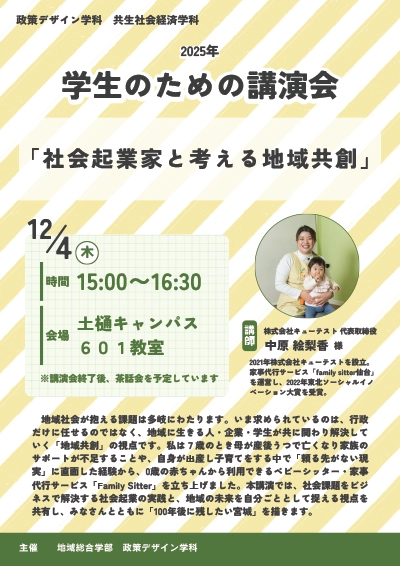
Community co-creation as envisioned by social entrepreneurs Instructor: Erika Nakahara
(Representative Director, CueTest Co., Ltd.)
The challenges facing local communities are diverse, ranging from isolation in child-rearing and a declining birthrate to an aging population, post-disaster recovery, and the increasingly serious problem of bears appearing in populated areas. These issues are often perceived as "not related to me," but in reality, they are deeply connected to the lifestyles and future choices of each and every one of us. What is needed now is not to leave it solely to the government, but to adopt a "community co-creation" perspective in which people, businesses, and students living in the community work together to solve these problems. When I was seven years old, my mother died from postpartum depression, and I experienced the pain of not having enough family support. Even after giving birth and raising my own child, I was once again confronted with the reality of "having no one to rely on." From there, I launched "Family Sitter," a babysitting and housekeeping service that can be used from the age of zero. We aim to create a society where working parents and children can live life to the fullest, by creating a system where child-rearing is not just a "family issue," but is supported by the community and businesses.
In this lecture, we will share the practice of social entrepreneurship that solves social issues through business, and a perspective that views the future of the region as our own responsibility, so that together we can envision "Miyagi that we want to leave for 100 years from now." Winner of the 2022 Tohoku Social Innovation Award.
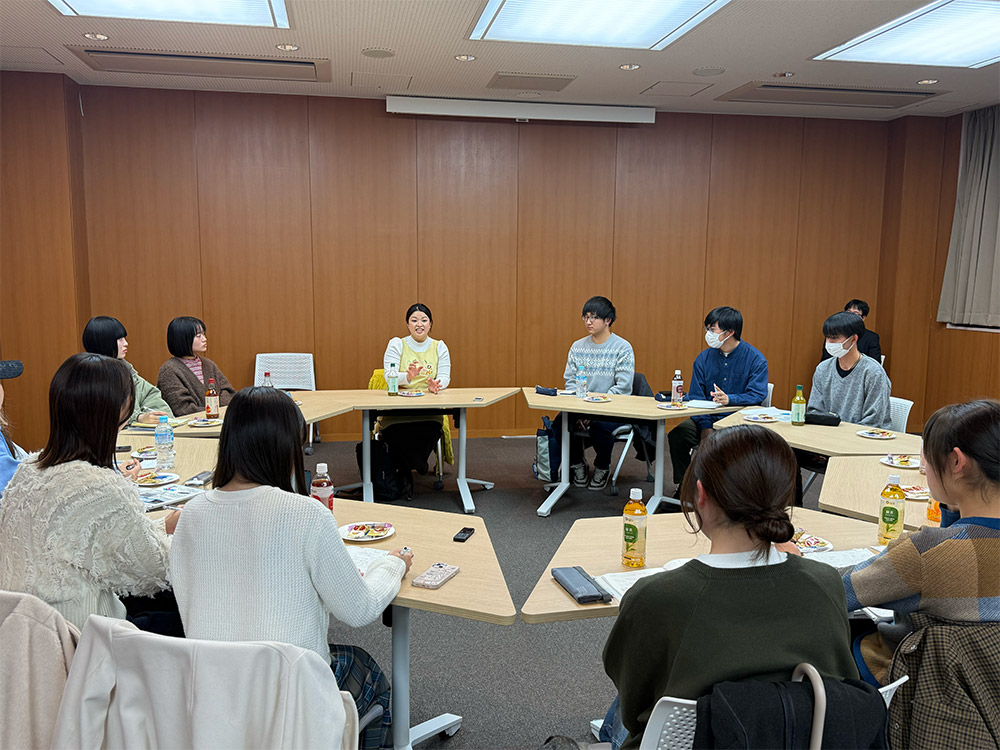
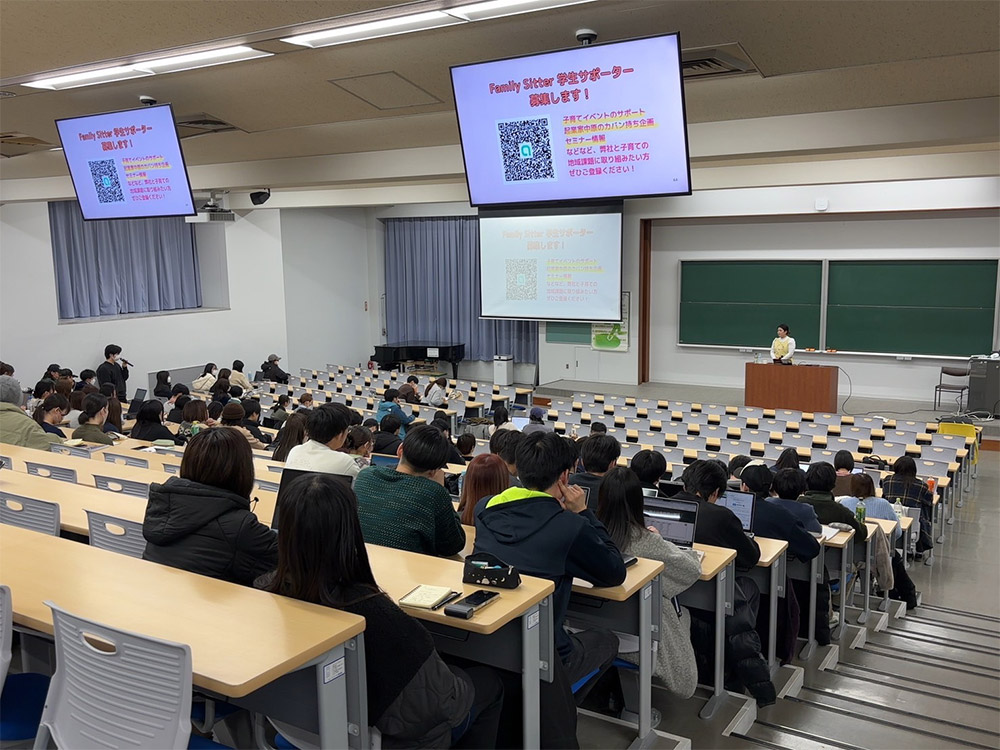
Student impressions
- As a member of society, I strongly felt that business models addressing social issues require those providing support to deeply understand their significance and actively engage in them. Hearing about examples of companies collaborating with government and local communities to find solutions to these issues, I reaffirmed the importance of the "company-government-citizen triangle" that I learned about in my studies.
- When tackling a social issue, many people go as far as identifying the problem. However, it's difficult to exert influence on stakeholders and move towards improvement. What's remarkable about her is that instead of being at odds with the business world, she's able to propose the economic benefits of creating a supportive environment for employees raising children within companies. I felt that this kind of attitude is something I should emulate when giving presentations.
- I found that this project is based on a clear "vision for social change." The vision of "aiming for a society where raising children while relying on others is the norm" is a contribution that directly relates to the sustainability of the local community, especially in Miyagi Prefecture, where nuclear families are becoming more common and the total fertility rate is particularly low. This attempt to change the culture of child-rearing itself, rather than simply providing a service, is a form of social innovation that transcends the boundaries of a for-profit company.
Furthermore, being selected for the "Social Impact Accelerator" program sponsored by the city of Sendai and being awarded the contract for the "Child-Rearing Household Visit Support Project" demonstrates a strong commitment to being a locally rooted company, as it has been publicly recognized by these institutions. Collaboration with the government not only enhances the credibility of our business but also builds a social network to ensure that support reaches families in need.
This time, we were able to hear Mr. Nakahara's story, which combines business strength and social responsibility from the perspectives of innovation and marketing. I will use this as a stepping stone for my future entrepreneurial endeavors. - This lecture allowed me to learn a great deal about community-based childcare support. I learned that providing services such as playing with children and doing housework as a business can contribute to the community by supporting child development. I was inspired by Ms. Nakahara's attitude of working not only for her own family but also to preserve the good qualities of those close to her, after experiencing postpartum depression herself. I was also shocked to learn that childbirth is as painful as a traffic accident that takes three months to heal. As a man, I cannot give birth to children, but after listening to the lecture, I thought about wanting to become a parent who can support mothers.
- After listening to this lecture, I strongly felt that the challenges faced by postpartum women and working parents are "societal problems" that cannot be solved by individual efforts alone. While support for pregnancy and preschool children is being put in place, I learned for the first time specifically that there is a lack of everyday support for children from elementary school age onward, as priority is given to addressing urgent issues such as the operation of children's centers, bullying, and truancy. Therefore, I realized that more continuous and accessible support is needed.
Furthermore, I felt that the initiatives of Kyutest Co., Ltd., which involve supplementing the lack of support in cooperation with local companies, are exactly the kind of activities that society needs right now. Through the lecture, I was reminded that for Japan to go forward, it is very important not to let the creation of an environment that makes it easier to raise children end as a temporary effort, but to continue it on a sustainable basis. - What impressed me most about Ms. Nakahara's story was how she didn't let her experiences end as mere events, but instead created new value from them. It was clear that her activities are rooted in a desire to support those currently in the same situation, stemming from her own understanding of the difficulties of the postpartum period, and this was incredibly compelling. I was particularly drawn to her approach of shaping her services to alleviate the burden of housework and childcare not as "task-by-task assistance," but as "support that is empathetic." Her willingness to adapt her approach to each individual user and to carefully record their experiences to improve future interactions suggests she has built a relationship of trust that goes beyond mere service. While I don't usually have much exposure to the realm of childcare, her story made me realize the invisible burdens within society and the importance of supporting those burdens. Ms. Nakahara's drive to transform her experiences and feelings into a truly needed form has been a great inspiration as I consider my own future path.
- Listening to Ms. Nakahara's lecture, I was impressed by her work, which focuses on addressing the issue of insufficient supply compared to demand. I understood that her business is not profit-driven, but rather focused on helping those in need and providing personalized support. This aligns perfectly with the ideal corporate model I learned about in public administration and regional business management courses. Furthermore, hearing a lecture from a senior entrepreneur who graduated from Department of Co-existing Society Studies changed my perspective on entrepreneurship. I had always felt that starting a business was a high hurdle, something unrelated to me, and something distant. However, hearing her speak increased my confidence that entrepreneurship is a realistic possibility for me. I now believe that entrepreneurship offers a higher chance of achieving what I truly want. I'm considering working locally, but haven't yet found a company that I'm satisfied with, and I was beginning to think that becoming a civil servant might be the best option. However, listening to this lecture allowed me to see the possibility of entrepreneurship as a viable option, expanding my future choices. Ms. Nakahara's entrepreneurship is strongly influenced by her thoughts, wishes, and passion for postpartum depression and childcare support, stemming from her own experiences, including her difficult past. Therefore, it is by no means easy to make a business that is recognized by society, and it is impossible to achieve without a strong will and goal, so starting a business is a tough idea for me right now. However, whether I start a business or not, I want to actively learn and work so that I can encounter a problem and a vision of society that I want to solve or realize. Mr. Nakahara's lecture helped me to think about what I really want to do.
- Despite the fact that many women face the risk of postpartum depression, awareness and concern about the issue throughout society are far from sufficient. Although the term "postpartum depression" has become more common, it is still often perceived as a "special case" or something that "only happens to a few people," and I felt a strong sense of unease about the current situation where it is not treated as a social issue. In reality, many mothers are isolated and unable to ask for help, but this situation remains invisible, and it is dismissed as a matter of individual effort.
The observation that child-rearing is often seen as "the parents' responsibility" or "a family matter," and that society is not adequately supporting it, resonated strongly with me. In Japan in particular, a cultural background where mothers bear the majority of child-rearing responsibilities, and a desire not to burden those around them, still creates a deeply rooted atmosphere where it is difficult to ask for help. As a result, many people do not receive the necessary support after childbirth, and as a result, many end up mentally overwhelmed. I felt that this is a serious problem that should be more widely known.
Furthermore, the idea that as children grow older and move beyond infancy, government and social support is prioritized for more urgent matters, and ongoing support for parents continuing to raise children becomes less available, was a perspective I had never considered before. Raising children is not something that ends in a few months or years, but a long-term endeavor, and there should be support available at each stage. Despite this, the current situation where support decreases once it is determined that the most burdensome period has passed makes me wonder if this is a cause of parents feeling isolated and anxious. - This lecture allowed me to gain a deeper understanding of the challenges facing Japan in childcare support, through actual data and Ms. Nakahara's own experiences. What particularly struck me was the structural problem of childcare being placed solely on the individual's responsibility. When I heard that "there are almost no childcare facilities in Miyagi Prefecture that accept children from the age of zero," I thought that many people might simply accept it as "that's understandable, they're so young." However, I realized anew that major social problems such as the increase in postpartum depression, child abuse, divorce, and the decline in women's participation in the workforce are all linked to these everyday inconveniences and burdens that are often overlooked. The social significance of the initiatives being undertaken by CueTest is enormous. On the other hand, if such activities are left to only a few companies, there will be a limit to the number of families that can be helped. I strongly felt the need to further expand the current collaborations with companies and partnerships with local governments, and to create a "system that supports childcare throughout society," starting with CueTest.
Of course, before pursuing scale, the most important thing is to protect children's lives and build a track record and trust so that parents can feel safe entrusting their children to us. In that respect, I was deeply impressed by the design of the app introduced in the lecture. The system, which is attentive to every detail and addresses the anxieties of users, truly feels like it will pave the way for the future of childcare support. I myself, though taking a different approach, will continue to explore ways to support families. - I learned for the first time that while support for pregnant women and preschool children is extensive, support for working mothers raising children is considered less urgent and is therefore inadequate. Recently, with the weakening of community ties, many people feel they don't have anyone easily to turn to when they're in trouble, and I myself feel anxious about the future. In that respect, having a place to consult with someone other than relatives after childbirth is necessary not only for physical support but also as a source of emotional support. Even though I feel this way, I tend to be passive, simply waiting for systems and society to change. However, I found Ms. Nakahara's proactive approach and commitment to making society better to be very admirable. It was a valuable opportunity to reaffirm my desire to adopt a perspective that addresses social problems.
- What resonated most strongly with me throughout this lecture was the desire to create a society where women can freely choose where they want to give birth and raise their children. I realized again through the lecture that childbirth is a tremendous experience for women, and raising children afterward is also extremely difficult because it is done with a body that has suffered great injuries. However, despite how difficult it is, I felt that the reality is that women sometimes have no choice and end up giving up. I felt that the role of babysitters, as implemented by CueTest, is wonderful in order to eliminate this. Furthermore, the aim is to create a system in which supporters can provide support regardless of language or experience, which I think will not only be able to cope with an increasingly globalized society, but will also become a system that everyone can use with peace of mind. When it comes to solving social issues, I would like to be able to approach problems that the government and other authorities have not been able to fully address by grasping where the challenges lie and their connections to the problems that arise from them.
- Listening to today's lecture, I was strongly impressed by the urgency of creating a system to support child-rearing in the community and by the way the speaker addressed social issues while listening to the voices of those directly affected. I felt that the possibility of protecting parents from "isolated child-rearing" by having private services such as babysitting and housekeeping services work in conjunction with the community is important. Also, the point that the participation rate of women in decision-making in Japan remains low made me think again about how closely child-rearing support and gender equality are actually intertwined. Overall, the lecture made me strongly feel the need to shift the perspective from just the government or just the family to "raising children as a whole community." From now on, I would like to find things that I, as a student, can do and work towards addressing social issues.
The 5th Lecture for Students
- Date
- Thursday, June 12, 2025 15:00-16:30
- Venue
- Oshikawa Memorial Hall, Itsutsubashi Campus, Tohoku Gakuin University
- Content
-
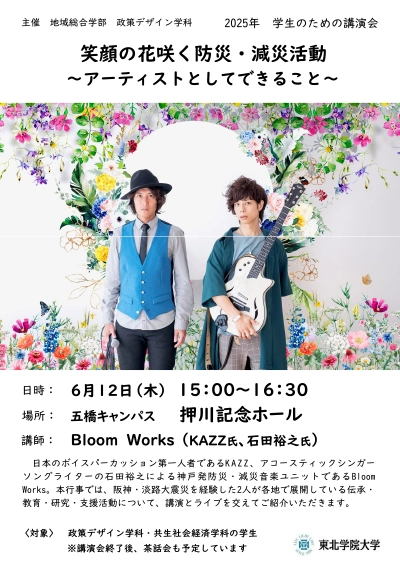
Disaster Prevention and Mitigation Activities that Blossom with Smiles: What Artists Can Do -Instructors: Bloom Works KAZZ and Hiroyuki Ishida
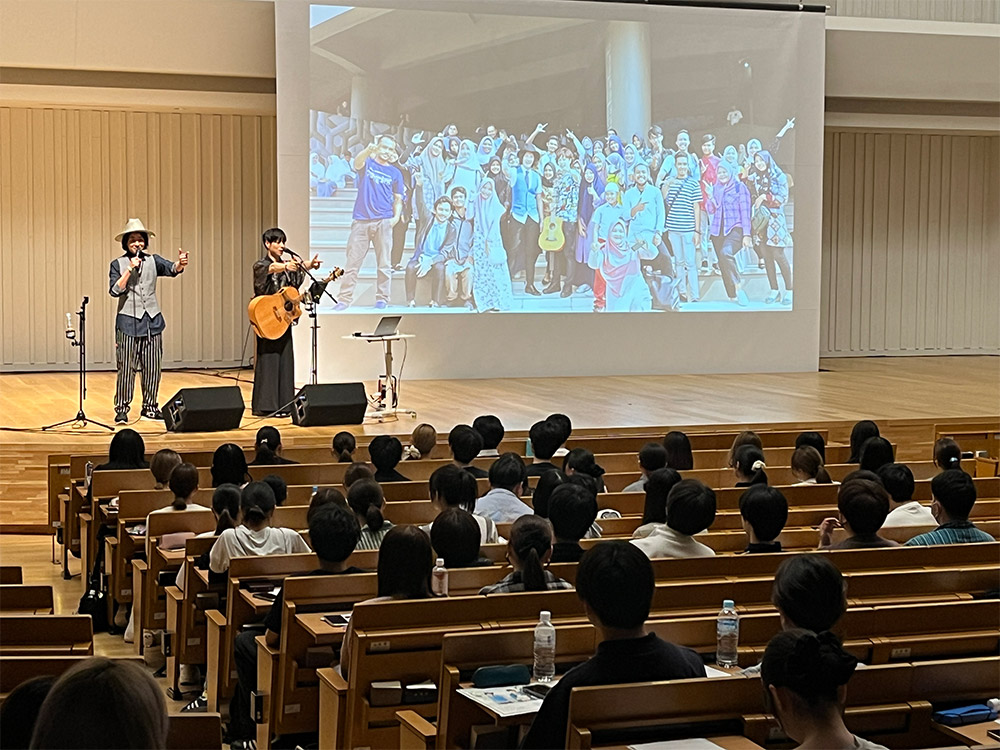
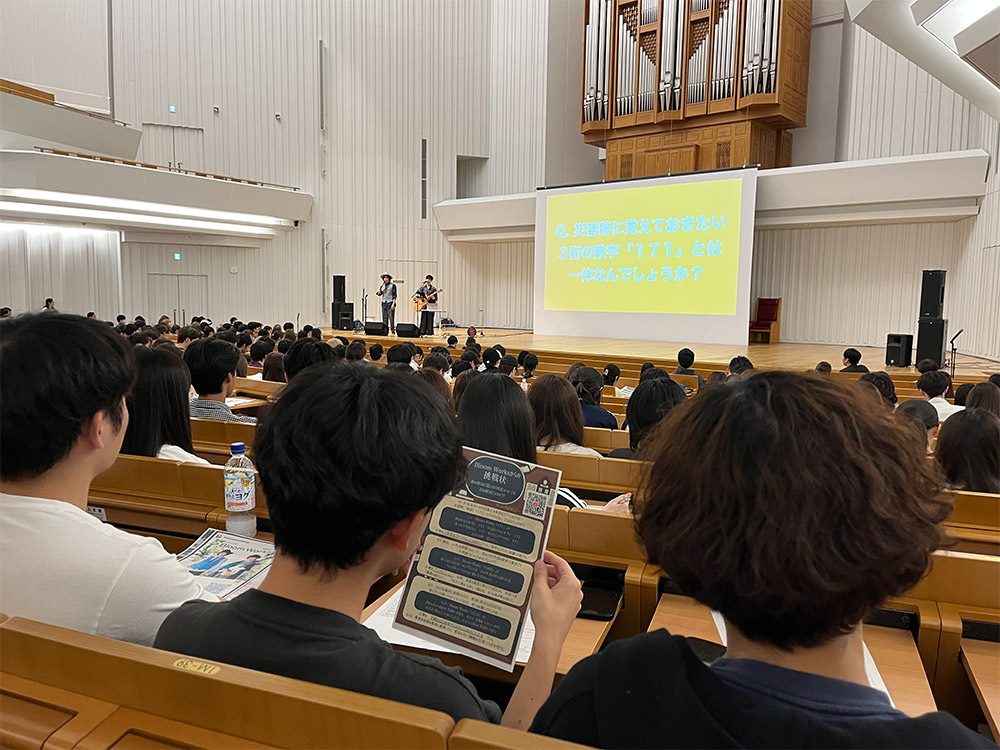
This lecture featured Bloom Works, a disaster prevention and mitigation music unit from Kobe, comprised of KAZZ, a leading figure in Japanese voice percussion, and Hiroyuki Ishida, an acoustic singer-songwriter. The lecture, which began with a live performance, provided an opportunity to learn about their experiences during the Great Hanshin-Awaji Earthquake, their activities in Ishinomaki City, and their disaster transmission, disaster prevention education, research, and support activities both domestically and internationally, through music and talk.
Furthermore, thanks to the support of Praise Station, we were able to improve the sound environment of the venue. As the talk and performance progressed, the atmosphere in the venue became more energetic, and during the encore, the students stood up and sang along, creating an atmosphere like a live concert.
Student impressions
- Listening to Bloom Works' lecture and performance at this event, I truly appreciated the wonderful way they use music to make disaster preparedness more accessible. I experienced evacuation during the Great East Japan Earthquake. Because of this, when I hear about disaster preparedness and related topics, even though they are important, I sometimes feel sad or gloomy. However, I think that by conveying disaster preparedness through music, as Bloom Works does, we can learn about it in a fun and positive way.
- Before attending this lecture, I had no idea what the relationship between "disaster prevention" and "music" would be. However, after the lecture, I was deeply moved and felt a warmth in my heart. To be honest, I shed tears during "Smile Flower." For some reason, "The Most Important Thing is You" really resonated with me and made me cry. I could feel the desire to spread smiles, which were the theme of the lecture, to as many people as possible. I learned so much through music and song.
- I felt that by combining two seemingly unrelated fields, such as music and disaster prevention, we can discover wonderful new ideas and uncover previously unseen challenges. I strongly believe that in the future, when I address local issues, it will be important to consider the integration of existing fields.
- I was impressed by the fact that the aim is to make disaster prevention and mitigation more approachable. Government and news appeals are often made in times of emergency and can be frightening, but using music to encourage people to think about disaster prevention and mitigation is different from the rigid approach we've had before and I thought it was very approachable. (omitted) I was able to see the wonderfulness of making people smile by making the most of one's own abilities. And it gave me an opportunity to think about what I can do.
- I thought that the activities of conveying energy and courage to disaster-stricken areas through song are very important. At the same time, hearing for the first time the feelings and struggles of those who are conveying the message made me realize how difficult and courageous these activities are. Also, even though I myself was affected by the Great East Japan Earthquake, listening to your stories made me realize that I had been neglecting my awareness of disaster prevention. Disasters in other regions tend to feel like someone else's problem, but this was an opportunity to reconsider my own disaster prevention, and I want to firmly remember that it could happen in the area where I live as well.
- I was particularly impressed by the fact that the lyrics of all the songs sung at the lecture included the word "smile," and by the speaker's words, "It's difficult to keep thinking about disaster prevention, but it's possible to leave a lasting impression on people's hearts as a culture through music. Disasters are recurring and cannot be eliminated entirely, but through disaster prevention, we can reunite with smiles on our faces." I believe that using music to communicate can make disaster prevention more accessible and easier to understand. I also felt that the venue was enveloped in a sense of unity through the music, with spontaneous applause breaking out during the lecture. I felt that creating this sense of unity is also a testament to the power of music.
- This was my first time listening to Bloom Works' music, and I was struck by how much they conveyed their feelings and disaster preparedness messages, stemming from their own experiences with disasters. It reaffirmed important aspects of disaster prevention and motivated me to raise my awareness of disaster preparedness on a daily basis. I had a very enjoyable time deciphering the disaster preparedness messages in the lyrics and clapping along to the music. Tsunamis and earthquakes will inevitably occur again somewhere, so I was reminded of the importance of each individual maintaining disaster preparedness awareness and of those who have experienced disasters passing on their messages to future generations. Furthermore, I felt that by making disaster preparedness messages into catchy phrases, many people will remember them in times of emergency, which could help reduce the number of casualties from disasters.
- I realized that there are many ways to communicate disaster preparedness besides music, and that we can explore these possibilities ourselves. I learned that disaster relief must be carried out in a way that takes into account the feelings of those affected, so I would like to think more deeply about how to do this in future classes.
- I realized that the act of "cheering someone up" shouldn't be one-sided. In his story about Indonesia, I felt the great power of music. I thought BloomWorks was amazing for not just thinking about it to himself, but taking action to spread cheer.
- This lecture made me realize that music can be connected to disaster prevention and mitigation. I had imagined that the songs would be about the feelings of those affected by disasters, but they were songs that incorporated humor into true stories, making them very approachable. Using an AED takes a lot of courage, but listening to pop songs like love songs encouraged me to not hesitate and to take action to save lives. When the Great East Japan Earthquake struck, it was the day before my kindergarten graduation ceremony. I experienced firsthand how disasters can take away people's lives and livelihoods in an instant. However, the reality is that it is fading from memory. Roads and buildings have been rebuilt, and the media only covers it on March 11th. I think there are many people who don't want to remember because it's painful. It is important to continue to tell the story so that no one in the future has to go through such painful experiences. At first glance, disaster prevention, mitigation, and music may seem to have nothing in common, but I thought it was a wonderful way to convey the message in an enjoyable and correct way.
- Listening to today's lecture, I found it easy to understand and remember the disaster preparedness actions to take before a disaster strikes, as they were conveyed through music. I learned for the first time that the number "171" is the disaster message dial, and I want to spread this information to my family and friends. Also, I realized that immediately after a disaster, a lot of baseless rumors and misinformation spread, so not only the victims but also everyone needs to think carefully about which information is correct and trustworthy before acting. Listening to the song "Love is an AED," I learned about the timing of chest compressions and what to do if someone collapses in front of you. I also thought that music is actually used to raise awareness of disaster preparedness overseas. I was amazed to learn that music can really save people. I want to be able to take action to help disaster victims in some way.
- I was only four years old when the Great East Japan Earthquake struck, and all I could do was hold my parents' hand and evacuate. At the time, all I could think was, "The ground suddenly shook, and then suddenly a strange life began," and I lived in an evacuation center without knowing what my parents were doing. Listening to today's lecture, I reaffirmed the desperation, chaos, and tragedy of a disaster, and felt the difficulty and hardship of healing from it. I realized that the reason I didn't feel fear at the time, and that I had almost no trauma despite being a victim of the disaster, was because of my parents' hard work, and I felt gratitude and true respect for them. I still have some memories of that time, but most people younger than me either have no memories or weren't even born yet. I myself know almost nothing about the Great Hanshin-Awaji Earthquake, the Miyagi Offshore Earthquake, or the Iwate-Miyagi Inland Earthquake. It's one thing if you've actually experienced it, but I think it's difficult for people who haven't experienced it to be constantly aware of disaster prevention. In that respect, I thought the attempt to deliver disaster prevention messages through catchy melodies and lyrics was quite good. I think it would be wonderful if we could raise awareness of disaster preparedness in everyday life without reopening someone's emotional wounds.
- The phrase "connections with people are also a form of disaster prevention" left a strong impression on me. In Ishida's story about performing a live concert at an evacuation center during the Great East Japan Earthquake, he mentioned a "concert centered around the victims." I don't think everyone was in a situation where they could wholeheartedly enjoy themselves. Nevertheless, the fact that everyone was able to sing together with their arms around each other's shoulders at the end, as shown in the final photo, I think is because Ishida focused not only on the music but also on the "people." The desire to "make disaster prevention a part of culture through music" and "leave a legacy for 100 years to come" came through strongly in the songs at the concert and in the stories shared by both of them. I think it's very difficult to keep the awareness and memory of disaster prevention alive and to remain conscious of it for a long time. I've come to think that disaster prevention is about using catchy, memorable pop songs heard in the lecture to inspire action. I have a dream of becoming a school teacher in the future. Although it's not my hometown, I also have a desire to work and live in Tohoku. If I become a teacher, I will have to tell my students about the Great East Japan Earthquake and tell them that they must protect their own lives. At that time, I would like to introduce Bloom Works' songs and become a teacher who can teach people that disaster preparedness is not just about knowing how to escape and preparing tools, but also about the importance of human connection.
2024年度
The 4th Lecture for Students
- Date
- Thursday, December 12, 2024 15:00-16:30
- Venue
- Tohoku Gakuin University Tsuchitoi Campus
Room 601, 1st Floor, Building 6 - Content
-
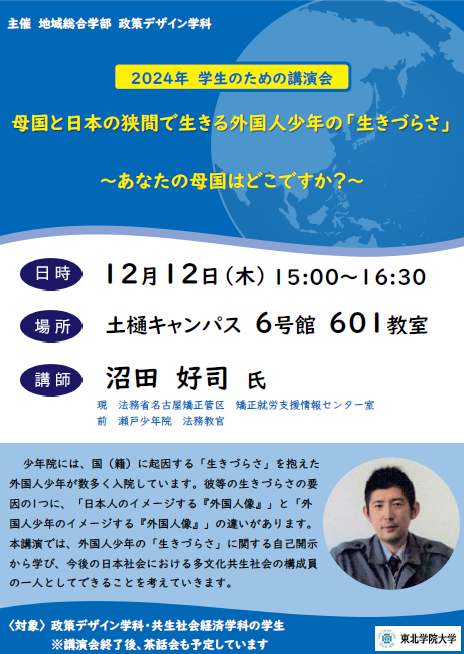
The "difficulty of living" for a foreign boy caught between his home country and Japan.
Where is your home country? Lecturer: Koji Numata
(Correctional Employment Support Information Center, Nagoya Regional Correctional District, Ministry of Justice)
Many foreign boys are admitted to juvenile detention centers because they face difficulties in life due to their nationality. One of the factors contributing to their difficulties is the difference between the image of foreigners held by Japanese people and the image of foreign boys held by these boys. In this lecture, we will learn from the self-disclosure of foreign boys regarding their difficulties in life and consider what we can do as members of a multicultural society in Japan in the future.
Student impressions
- I believe that a multicultural society is one that accepts each person's culture and roots. As a member of such a society, I want to stop making assumptions about people and instead be able to fully accept the thoughts and opinions of others.
- I realized that even without consciously thinking about it, I might have unconsciously labeled people based on their appearance or behavior. Assuming things like, "They have foreign features, so they must speak a foreign language," or "They're half-Japanese, so they don't understand Japanese culture," can cause distress to others. Such assumptions can weigh heavily on them, distorting what you truly think and what you want to resolve, sometimes leading to delinquency. I learned that understanding the root causes of delinquency can help prevent recidivism and delinquency in general.
- My general approach to interacting with foreigners was to treat them the same way I would normally if they understood Japanese. However, if it seemed they didn't understand Japanese at all, I would give a slight bow and quickly leave the scene. I feel like I might have inadvertently shown the common foreign perception that Japanese people are cold.
When interacting with people who are different from oneself, mutual understanding is essential for both oneself and the other person. As mentioned in the lecture, interpretations based on preconceived notions, such as the distinction between conscious and unconscious biases, can lead to discrepancies and conflict. Furthermore, conflicts can arise from the imposition of culture and common sense, with one side insisting, "This is how it is in our country, so you should do it this way," or "This is how it is in this country, so you should do it this way." Rather than trying to force one side to do things this way, it is important for both sides to shift their thinking outside the box of fixed ideas and to understand each other correctly. - I myself have never held discriminatory attitudes or treated foreigners in a discriminatory way. However, after hearing Ms. Numata's story, I realized that I was simply indifferent. As a Japanese person living in Japan, belonging to the overwhelming majority, I realized that there are problems that I cannot perceive.
- A multicultural society is one where one's strengths are utilized, one can live authentically, and all members of that society are respected equally. To achieve this, I want to change my mindset and do what I can, such as valuing a willingness to compromise.
- Up until now, when I interacted with foreigners, I had assumed they couldn't speak Japanese. After hearing this story, I realized that being treated as someone who can't speak Japanese without my consent might be perceived as discrimination. Also, regarding the story about the juvenile detention center, I had also assumed it was a dangerous place and that rehabilitation would be difficult. However, even after making a mistake, there is still room for rehabilitation, and I want to start by stopping making assumptions.
- A multicultural society is one in which diverse cultures and values are respected and people live together. First, it is important to set aside preconceptions at an individual level and listen sincerely to what others have to say. If we increase the opportunities for foreign boys and Japanese boys to learn together, I believe that Japanese people will also deepen their understanding of diversity. Changing one's way of thinking is difficult, but I believe that maintaining an attitude of trying to understand is a step towards multicultural coexistence. I felt that by changing my own way of thinking, I could start to change the awareness of those around me as well.
- I want to continue learning to ensure that our activities for a multicultural society do not become condescending, merely about understanding different cultures. Instead, we always engage newcomers and established members alike on an equal footing, creating a society where no one is left behind.
- I felt there was a considerable distance between Japanese people and foreigners, as foreigners in Japanese society are often seen as something unique. I realized that resolving the "difficulties of living" that foreigners experience when living in Japan will bring us closer to realizing multicultural coexistence, but I believe there are several hurdles that must be overcome to achieve that.
- Up until now, when I've thought about multicultural coexistence, I've focused on how Japanese people can approach creating an environment where foreigners can live and work comfortably in Japanese society. I resonated with what Ms. Numata said this time, when I heard her say that she sees multicultural coexistence as a place where one can move between wanting to be a foreigner and wanting to blend into Japanese society.
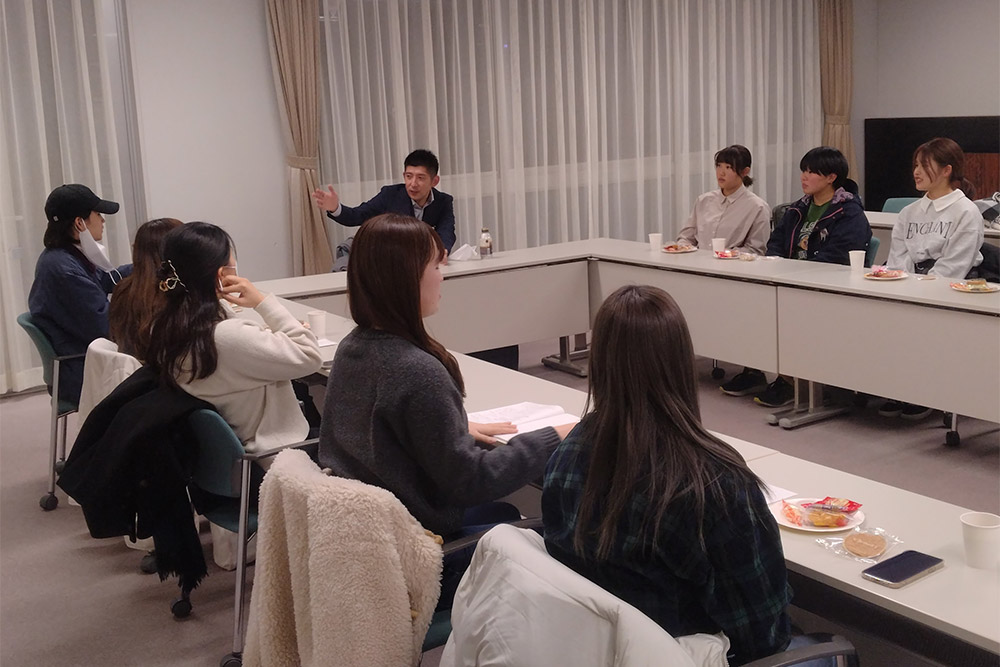
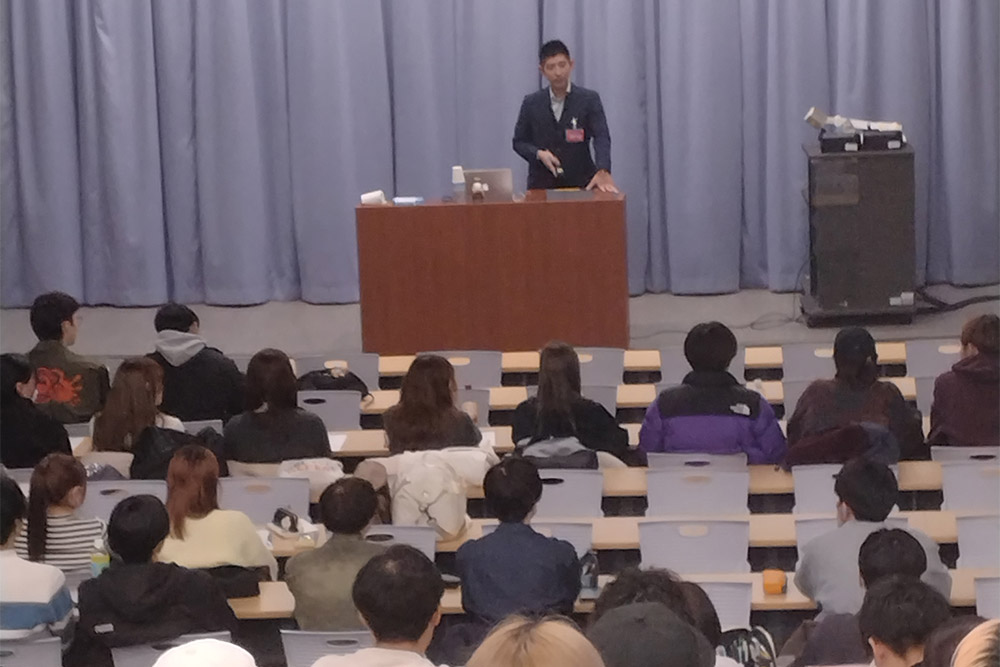
The 3rd Lecture for Students
- Date
- Thursday, June 27, 2024 15:00-16:30
- Venue
- Tohoku Gakuin University Tsuchitoi Campus
Room 601, 1st Floor, Building 6 - Content
-
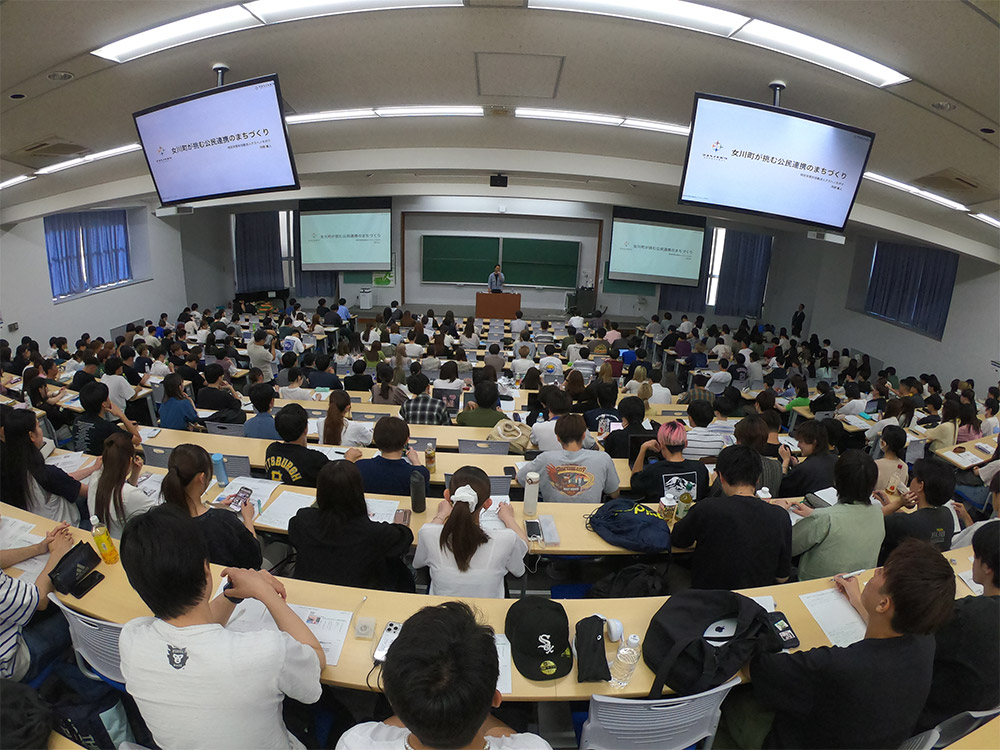
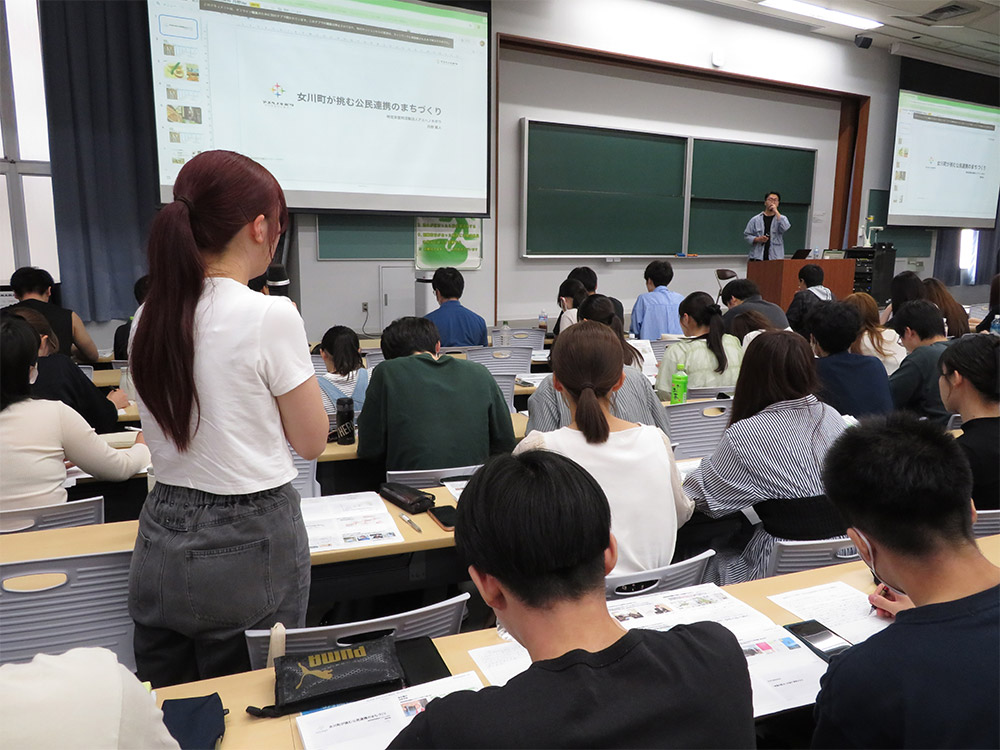
Onagawa Town's Public-Private Partnership in Community Development Lecturer: Masato Tanno
(NPO Asuheno Kibou)
Onagawa, a small port town located in eastern Miyagi Prefecture, is known as a "leading runner in recovery" among the areas affected by the Great East Japan Earthquake. In this presentation, we will discuss town development in Onagawa, focusing on the keywords "public-private partnership" and "active population."
Student impressions
- My family is from Onagawa, and I lived in Ishinomaki before the earthquake, so the content was very familiar and easy to understand. I was greatly shocked by the fact that Onagawa is currently undergoing significant development, perhaps due to my preconceived notions... (omitted)... I'm still afraid of the sea and haven't been able to go, but after hearing this story, I feel like I want to visit Onagawa again.
- What impressed me most in this lecture was the statement, "Those over 60 refrained from interfering, acting as a shield and entrusting the town to the next generation." It is estimated that it will take at least 20 years to complete the soft and hard reconstruction, and I believe that the mayor at the time's decision to entrust the town's development to young people, stating that he could not take responsibility for it after the reconstruction, and ensuring its long-term sustainability, is being put to good use in Onagawa's town development today. ... (omitted) ... I believe that two points will be important for the town to survive from now on: "town development centered on young people" and "increasing the active population." Regarding town development centered on young people, I think that, like Onagawa, if young people take the lead, with the older generation supporting them working together, taking the initiative to do new things, and increasing their involvement with the town, it will lead to an increase in the active population.
- When I consider that so many people, united by the desire to make Onagawa a better town, have come together as public, private, and even outside Onagawa, and that they are all connected by the existence of Asuheno Kibou, I realize just how amazing what Asuheno Kibou is doing is, and I am deeply moved.
- I found Asuheno Kibou's efforts as a public-private partnership intermediary to be innovative, particularly their ideas and perspectives on creating a compact and livable town, and on further developing Onagawa Town by increasing not only the population but also the active population. Having experienced the earthquake, I felt the need for a rapid recovery, preparation for unforeseen circumstances, and the understanding of limitations while taking measures tailored to the specific region. Furthermore, I was impressed by their emphasis on word-of-mouth and referrals in their relocation program, especially in an era dominated by social media. I believe this approach allows people to experience the charm of Onagawa Town firsthand and makes it easier for them to visit.
- The entire process, from creating a tenant-based shopping street to embodying sustainable urban development, appealing to both locals and the public, thereby branding the area and involving more people in its revitalization, was very interesting.
- What impressed me most at this lecture was the section on the project to promote the creation of active populations. I found it appealing that people can get involved in a way that they enjoy most, not just through relocation or starting a business. I also felt that the effectiveness of community development by young people was being demonstrated very well. My hometown is in a similar situation, but there may be a big difference in how we start new community development. I would like to explore ways to improve things that suit the current situation and characteristics of my region, while referencing the public-private partnership community development of Onagawa Town and Asuheno Kibou.
- My hometown has also seen a recent increase in new commercial facilities, but there are many concerns about whether they can continue operating given the declining population. I was impressed by Onagawa Town's compact city development and its shopping district with tenants, which I see as forward-looking urban planning.
Until now, even when I heard the term "public-private partnership," it was difficult to imagine concrete examples of such initiatives. This time, learning about the Onagawa case study, along with the activities of Asuheno Kibou, has increased my interest and awareness. - Previously, it was thought that social issues should be solved by the government, but in modern Japan, many problems have arisen that are difficult for the government alone to solve. Therefore, I felt that collaboration between the government and private companies, citizens, and NPOs is essential in the coming era. I was also impressed by the Reconstruction Liaison Council's talk about private sector reconstruction programs. I think that by focusing on compact cities, people will gather in one place, which could be a catalyst for restoring vibrancy.
- I thought it was a good idea to create a public-private partnership office at the Onagawa town hall and include private sector personnel, which allows for a good combination of administrative and private sector perspectives. Rather than clearly separating administration and the private sector, I felt that creating a bridge between them is very important in public-private partnerships, and I intend to keep this in mind when considering solutions to local issues in the future.
- I felt a strong determination to create a sustainable town for Onagawa, with the younger generation taking the lead in community development. Instead of proceeding alone, the voices of the townspeople were incorporated at every step, providing a valuable lesson in public-private partnerships. While many municipalities seem to focus on increasing their population, Onagawa's approach of increasing the number of people involved with the town—in other words, increasing the "related population"—felt realistic and practical.
- What impressed me most at this lecture was the talk about the mayor of Onagawa. I was impressed by how he approaches his work seriously, yet maintains a close relationship with the residents, and how both the residents and the mayor enjoy their interactions. When it comes to regional revitalization and solving local issues, we tend to approach them with a serious attitude, but I learned that wonderful ideas can be born when we work in a fun atmosphere, and I want to cherish that as well.
2023年度
2nd Lecture for Students
- Date
- Thursday, November 16, 2023 15:00-16:30
- Venue
- Tohoku Gakuin University Tsuchitoi Campus
Building 8, Room 842 - Content
-
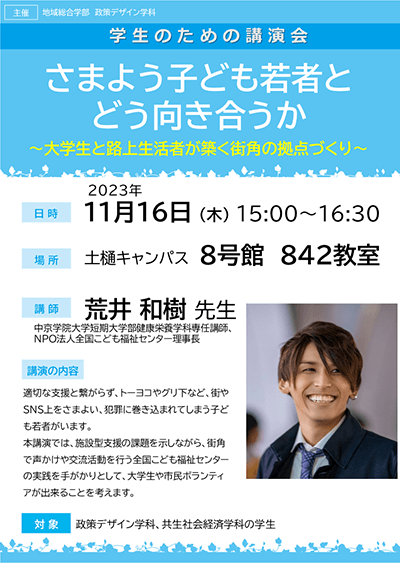
How to deal with wandering children and young people: Building community hubs on street corners through collaboration between university students and homeless individuals. Instructor: Kazuki Arai
(Full-time Lecturer, Department of Health and Nutrition, Chukyo Gakuin University Junior College; Chairperson, National Children's Welfare Center, a non-profit organization)
There are children and young people who, without access to appropriate support, wander the streets and social media, including places like Toyoko and Gurishita, and end up becoming involved in crime.
This lecture will highlight the challenges of facility-based support and, using the practices of the National Children's Welfare Center, which engages in outreach and interaction activities on the streets, as a starting point, we will consider what university students and citizen volunteers can do.
Student impressions
- What struck me most was the mismatch between the support provided by the adults mediating the various forms of assistance and the support being received by the children. I felt that we need to think more deeply about providing support that is essential and more effective, rather than just providing support unilaterally.
- I felt that Professor Arai's organization is able to inspire many people to think, "Next time, I want to do it for someone else!" because there are people there who understand the pain and suffering in people's hearts. (omitted) I strongly felt that I want to become someone who cherishes encounters and connections, respects others, doesn't impose their views, and can create an environment where we can protect others and live together.
- What particularly struck me after listening to Mr. Arai's talk at the lecture was the point that there are negative aspects to providing support.
I was shocked to learn that the anger of children in children's homes is not being voiced, and that they are being placed in a controlling and domineering environment in exchange for support. I also heard that when it comes to children who have run away from home, being controlled unilaterally is coercive and only makes them distance themselves further, and I felt that this was absolutely true. - The phrase, "The child who was reached out to will eventually become the one who reaches out to others," left a strong impression on me. This means that, more than just expanding the circle of support and increasing the number of people providing support, it gives those receiving support a sense of security knowing that they are being supported by someone who understands their feelings. The hardships each person has experienced may be different, but I believe that having gone through painful experiences allows one to empathize with others. I felt that this message was conveyed to those receiving support, which is why the circle of activity has expanded.
- What particularly impressed me was Mr. Arai's concluding remark about "continuing to engage without trying to eliminate differences." I found that to be a very interesting idea. Indeed, if we become too preoccupied with "support," we end up ignoring the feelings and wishes of children and tying them down with adult opinions. This would cease to be true support, so I think it's an important perspective.
- After listening to Professor Arai's lecture, I realized the need to create a reciprocal support system. I understood that if the supporters proceed with things unilaterally, without listening to the opinions of those being supported, a mismatch will occur. The number one reason why children and young people cannot ask for help is apparently "shame and stigma." It would be ineffective to simply set up a "consultation service" without adults understanding the feelings of shame and pride that children have. I think we should create a reciprocal support system that incorporates the opinions of children.
- While working in the red-light district can sometimes be illegal, the high pay and the feeling of being able to live independently, combined with a distorted sense of money, can lead to a vicious cycle where people return to such work even after finding other jobs, or they may feel that there is no point in working. It's easy to imagine that once you start working at night, engaging in prostitution, or engaging in sugar dating, your senses become numb, you start to think you can earn unlimited money, and options like welfare or daytime jobs disappear from your mind.
Therefore, I thought that Professor Arai's approach of speaking directly to people up close was very effective, unlike those who call out from afar as if it were someone else's problem. - The best thing about this lecture was that it helped me overcome my own prejudice against welfare recipients. If I ever become eligible for support myself, I want to use it confidently and without shame.
- After listening to this lecture, I felt that my own view of the current support system had completely changed. There is a deeply ingrained societal idea that those who receive support must be controlled and managed because they are receiving support, and there are almost no opportunities to build collaborative relationships. Therefore, I felt that Ms. Arai's activities, which involve group activities for those receiving support that emphasize communication, can be said to be true welfare, as they can change the view that those who receive support are socially vulnerable.
- Even among the support currently being provided that is considered good, there may be some that are linked to suffering for the children. That is why it is necessary to re-examine the way support is provided based on Ms. Arai's ideas. (omitted) Having learned about these facts myself, I thought that I should take some action instead of thinking of it as someone else's problem.
Commemorative Lecture for the Establishment Department of Policy Design (1st Lecture for Students)
- Date
- Thursday, June 22, 2023 13:30-15:10
- Venue
- Tohoku Gakuin University Tsuchitoi Campus
Hoy Memorial Hall (Underground) Multipurpose Hall - Application method
- Free admission, no registration required.
*Everyone is welcome to attend. - Content
-
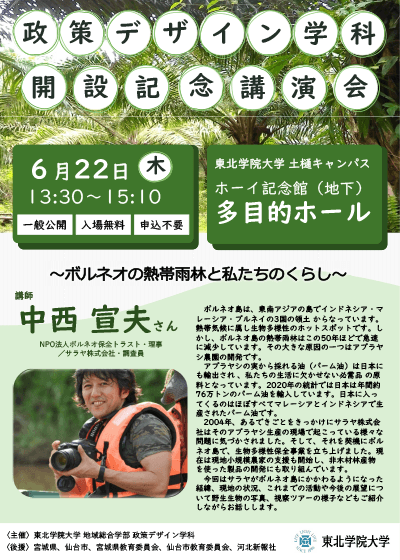
The rainforests of Borneo and our way of life: Lecturer Nobuo Nakanishi (Director, Borneo Conservation Trust NPO / Researcher, Saraya Co., Ltd.)
Borneo is an island in Southeast Asia, comprising the territories of Indonesia, Malaysia, and Brunei. It has a tropical climate and is a biodiversity hotspot. However, Borneo's rainforests have been rapidly declining over the past 50 years. One of the major causes is the development of oil palm plantations.
Palm oil, extracted from the fruit of the oil palm tree, is exported to Japan and is an essential ingredient in many necessities of our lives. According to 2020 statistics, Japan imports approximately 760,000 tons of palm oil annually. Almost all of the palm oil imported into Japan is produced in Malaysia and Indonesia.
In 2004, an incident prompted Saraya Co., Ltd. to become aware of the various problems occurring in oil palm production. This led them to launch a biodiversity conservation project on Borneo. Currently, they have also begun supporting local small-scale farmers and are working on developing products using non-timber forest products.
In this presentation, we will discuss how Saraya became involved with Borneo, the current situation there, our past activities, and our future prospects, while also sharing photos of wildlife and scenes from our inspection tours.
- Organizer
- Tohoku Gakuin University
Department of Policy Design Faculty of Regional Studies - Sponsorship
- Miyagi Prefecture, Sendai City, Miyagi Prefectural Board of Education, Sendai City Board of Education, Kahoku Shimpo Newspaper
Student impressions
- I use salad oil, but I thought palm oil wasn't really relevant to me. However, after listening to the lecture, I realized that palm oil is widely used around us and that we benefit from it. At the same time, I learned that oil palm cultivation is carried out to produce palm oil for our use, and that the development for cultivation threatens the lives of the original inhabitants and animals.
- Listening to the speaker, I was shocked to learn that the decline of rainforests is so advanced that it's easily visible to the naked eye. I was also saddened to learn that forest development is leading to social problems beyond environmental issues, such as wildfires and child labor.
Furthermore, in order to solve these problems, measures such as RSPO and the idea of coexisting with elephants are being considered worldwide to address the decline in biodiversity and the vast areas of plantations. I realized how little I knew about these issues and regretted using palm oil. In the future, I would like to put into practice solutions that I can implement as an individual, such as checking product labels. - The video of the elephants that I saw in this story left a strong impression on me. I was deeply saddened to learn that friction had arisen between humans and Borneo elephants over oil palm, which is the raw material for the detergents we use every day.
- Until I entered university, I knew absolutely nothing about Borneo—where it was, what it was like, etc. But through today's lecture, I've begun to develop an interest in Borneo and other cultures I've never encountered before.
- Regarding environmental issues, I learned that the use of highly toxic pesticides leads to problems such as water pollution and skin irritation. I also learned about labor issues, including child labor and the existence of workers under harsh quotas. From this, I realized that various sacrifices are made to produce palm oil, something I use casually every day.
- After listening to this lecture, I was impressed to learn that palm oil, which is produced on the majority of plantations in Borneo, is actually very close to us. <...> I learned that improvements are currently being made through the cooperation of many people, and it reinforced my understanding that even when problems exist, it is important to cooperate and work steadily towards their resolution. I felt inspired to get involved in such activities myself.
- The problems happening around the world are not unrelated to Japan. It's possible that we are unknowingly contributing to them in our daily lives, so I realized that "ignorance" is indeed the scariest thing.
- I felt a sense of empathy when I heard that Ms. Nakanishi, the lecturer, is now dedicating herself to Saraya, but that she once couldn't find what she wanted to do. <...> I'm currently aiming to become a civil servant, but my thoughts might change due to something small in the future. Therefore, I want to broaden my horizons by jumping into things that interest me or taking action on a whim.
- I realized that the cooperation of many people is essential to bring about change. <...> The lecture was a good experience because I learned not only about environmental issues but also things that could be applied to my daily life.