
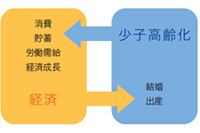
"Aging Economics" is a course that analyzes the relationship between the declining birthrate, aging population, and the economy and society using economic methods. Specifically, it analyzes the impact of demographic changes, known as a declining birthrate and aging population, on the "economy," such as consumption, savings, labor supply and demand, and economic growth, and conversely, the impact of current economic and social systems (such as tax systems, social security systems, and employment practices in companies) on people's lifestyles, such as marriage and birth behavior, using economic methods. Based on this, it considers how to design a fiscal and social security system appropriate for a society with a declining birthrate and aging population.
Japan is experiencing an unprecedented rate of population aging and a declining birthrate. "Aging Economics" examines this phenomenon from an economic perspective. Aging Economics explores aging societies from multiple angles. For example, it investigates how a declining birthrate and aging population affect labor supply and demand and economic growth. Conversely, it explores how economic and social structures influence people's marriage and birth behavior.