
Department of Co-existing Society Studies implements its own unique career development initiatives to help students achieve their desired career paths. Here are some examples of these initiatives.
Activities in the Comprehensive Seminar (Required for 1st Year Students)
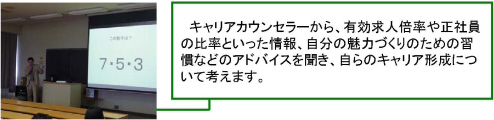
Impressions from 2010
- This lecture helped me understand what I should do to prepare for my career after graduation. It was a good opportunity to think about what kind of person companies truly need and what I can do to become that kind of person.
- After listening to this lecture, I realized I need to think carefully about what I can offer as a strength and what I truly want to do. I want to approach my university life with enthusiasm and a sense of purpose, and start planning my job search schedule now.
Impressions from 2011
- I still have a long way to go in terms of both knowledge and social etiquette. I want to take my time and slowly refine my individuality at this university. That's what I felt after the lecture. (Ms. M)
- I haven't yet decided on a clear dream for the future. However, I believe I'll have many more encounters with people and jobs in the future, and I hope to use those experiences to find my dream. And I want to be able to make that dream a reality. I'm competitive and don't want to have any regrets, so I want to approach everything with curiosity and gain many experiences. I'm looking forward to the future. (A)
- I realized there are many things I need to do now, such as developing skills to promote myself and improving my communication abilities. I believe that getting a job offer isn't the goal; what's important is being able to continue working, so I want to research and find a job that suits me. (H)
- Tohoku Gakuin University has a disaster volunteer station and offers a variety of activities, so I wanted to use these activities to interact with people more and improve my basic academic skills as well as my essential social skills. (K)
- I haven't yet decided what I want to do or what my future path should be, so I thought I'd try to figure those things out during my first year and think carefully about my future. I also want to thoroughly examine my inner self so that I can answer questions about myself properly when asked to introduce myself in an interview. (Y)
- I want to develop habits of learning and reading newspapers from now on. I also want to figure out what kind of work I'm interested in, what I need to do to achieve that, and do what I can before things get busy. Through part-time jobs and volunteer work, I want to interact with various people, listen to their stories, and learn about society, so that I can identify what I'm lacking and live my university life with career development in mind. (C)
- After listening to this lecture, I realized that job hunting isn't something you start in your third or fourth year, but rather an opportunity to showcase the achievements you've accumulated since your first year. From now on, I want to dedicate 100% of my effort to everything I do and work towards my future. (R)
- I realized once again that it's necessary to seriously consider what kind of job you want to pursue, even from your first year of university. (Y)
- The most valuable thing I learned was about the kind of people companies are looking for. When I start my own job search, I'll do my best to put what I learned in this lecture into practice. (H)
Career development (3 years, elective)
Career development is a subject designed to help students think about what kind of job they want to do after graduating from university, what they need to do to achieve that, and to acquire practical knowledge. They will also learn specific methods for getting their desired job, such as how to improve their self-expression skills, including written communication and presentations, and how to gather information.

The aim is to acquire practical knowledge such as business etiquette and document processing skills.
Career development image
Career development is offered in the third year. It is taught by an external lecturer specializing in career development. The course aims to support career choices by providing students with practical knowledge such as business etiquette and document processing skills, as well as an opportunity to consider their own aptitudes. It also aims to develop communication and information processing skills that are necessary not only in the workplace but also in daily life.
Activities in Exercise I (3rd year)
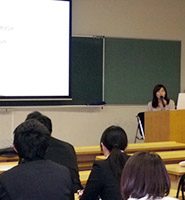
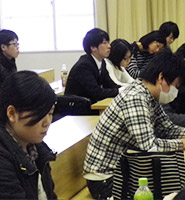
In January 2014, the Sato Yasuhito Seminar and the Kumazawa Seminar jointly held a "Job Hunting Advice Session." A fourth-year student, who had never been rejected at the application stage and had received a job offer from his first-choice company in March of his third year, shared his experiences and gave advice on key points for application forms and interviews. The third-year students, who had just started their job hunting, listened attentively to the fourth-year student's talk, taking many notes.
Student impressions
- It was incredibly helpful to receive direct advice from someone who had received a job offer from a top company. They provided detailed information on key points for job fairs, how to write application essays, and the types of questions asked in interviews, which was extremely valuable.
- Listening to seniors' stories and learning tips for information sessions, application forms, and interviews helped me understand what I need to do now and what I'm lacking. It's not that I was taking job hunting lightly, but there's still a lot to do, and I've come to realize again how insufficient my preparation is. However, realizing these things at this stage is a positive thing for me, and I think it will be beneficial for my future job hunting. I will do my best to make the most of what I learned today.
- Listening to the fourth-year students' presentations today gave me a much better understanding of how to differentiate myself from other students in application forms and interviews. Their clear explanations during the information sessions, application forms, and interviews helped me consider what actions I should take going forward. I intend to make full use of what I learned today as I begin my job search in earnest.
- Hearing this job-hunting advice has motivated me more than ever before. I realized how naive my approach to job hunting had been, as I had only been vaguely going about it. From now on, I want to put the advice I received into practice and have a satisfying job-hunting experience. It was a very valuable time for self-reflection.
- Attending this job-hunting advice session was a great opportunity to address my anxieties about finding a job. I received a lot of helpful and insightful advice, which I will put into practice at future information sessions and when I prepare my application forms.
- I knew that this time of year is very difficult for job hunting, but I was confused because I didn't really know what I should be doing. Thanks to my seniors, I was able to find what I needed to do right now. I'm sure I wasn't the only one who found it so helpful.
- The senior student shared specific details of what they actually did, and also shared anecdotes about how other people approached job hunting, such as experiences with friends and interviews, which made it easy to visualize. The discussion about application essays and interviews was the most interesting, and there were some things I'd like to try myself. I plan to put more effort into preparation and practice beforehand.