
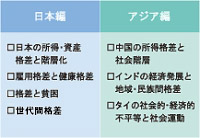
Examples of themes
The course on inequality addresses various inequality issues found in Japan and Asia. Through an omnibus format with lectures by multiple instructors (7 in total), students can gain a multifaceted and deeper understanding of inequality issues.
Student impressions
About the whole
- I thought it was a very unique lecture, typical of Department of Co-existing Society Studies. I would definitely recommend it to younger students.
- My biggest surprise was discovering that Japan is a more unfair society than I had imagined among developed countries.
- Each professor lectured on topics specific to their research, making each lecture feel fresh and engaging. While the word "inequality" has become more common in recent years, I had never truly considered the problems it creates, the specific types of inequality that exist, or even why inequality arose in the first place. This past year, learning about the numerous inequality issues prevalent around the world has provided an excellent opportunity to delve deeper into the problem. The lectures were interesting and thought-provoking.
- As a student in Department of Co-existing Society Studies, I strongly felt through my inequality studies class that I want to contribute to the realization of a society free from inequality and injustice by confronting the many disparities that exist in society and seeking solutions.
Japan (1) Income and wealth inequality and stratification in Japan
- I liked this lecture the most. I was impressed by how the lecturer didn't just lecture unilaterally, but instead asked for students' opinions and actually used calculators to calculate the Gini coefficient.
Japan (2) Employment disparities and health disparities
- I was able to learn about the disparity between regular and non-regular workers, which is a major concern for me right now. As I will be entering the workforce in the future, knowing the reality of the situation makes a big difference, and I feel that the lesson content was very beneficial for me. Also, I had never learned about "health disparities" before, so I found it very interesting, and I learned a lot of new things.
Japan (3) Inequality and Poverty
- The detailed explanation of the welfare system, from application to receiving benefits, was very clear and easy to understand. I was surprised to hear about cases of people who were not approved for welfare benefits, and I also learned that there are many cases of fraudulent claims.
Japan (4) Intergenerational inequality
- After attending the lecture, I learned that intergenerational inequality in Japan is serious. I learned that unemployment rates are higher with each passing generation, wage increases are unlikely, and the gap will not narrow unless additional burdens are borne. I realized that some generation must bear the financial burden.
- I knew that resolving intergenerational inequality would inevitably lead to conflicts of interest between generations, but I didn't expect such a huge difference between young people and the elderly. While it might seem that the elderly' burden won't increase as their benefits decrease, I think that the reduction in benefits will actually increase their burdens, such as making their lives more difficult. I realized that resolving intergenerational inequality is difficult.
Asia (1) Income Inequality and Social Stratification in China
- Learning about inequality in China, in conjunction with my Asian economics class, was a valuable learning experience.
Asia (2) India's Economic Development and Regional and Ethnic Disparities
- The section on literacy rates was particularly striking. I was surprised to learn that some regions have high literacy rates but low GDP per capita.
Asia (3) Unequal Development and Social Movements in Contemporary Thailand
- The most memorable story was about Thailand. Until then, I knew almost nothing about Thailand. This lecture allowed me to learn about what kind of country it is. Behind the glamorous facade of rapid development, there are various problems, such as the enormous regional disparity between urban and rural areas, and environmental and resource issues that require clearing forests to develop land. This experience has made me want to take an interest in Thailand myself.