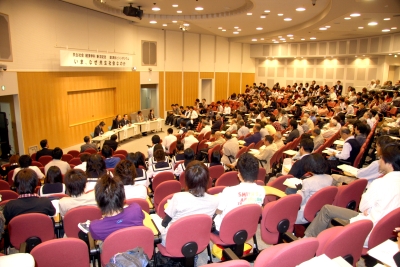
First-year students of Department of Co-existing Society Studies participated in a lecture and symposium held on June 13th to commemorate the establishment of the new Department of Department of Co-existing Society Studies. How did the students feel about the passionate presentation on "Why an Inclusive Society Now?" by Professor Masaru Kaneko of Keio University, Vice Chairman of the Editorial Board of Kahoku Shimpo, Associate Professor Tadashi Masuko of Tohoku Gakuin University, and Associate Professor Yumi Kumazawa of Tohoku Gakuin University? Here are some of their impressions.
What surprised me most was the severity of the structural reform issues and regional disparities. I enrolled in this university hoping to learn about inequality and the working poor. However, I realized just how narrow my perspective had been. I had always been very interested in income inequality. But I learned that income inequality is intricately intertwined with so many other issues that it cannot be viewed in isolation. This lecture and symposium made me realize once again how little I know, and that I need a broader perspective to understand what I want to learn. (K-kun)
After listening to the lectures and symposium, I realized how essential "coexistence" is to society today. Given the current situation with regional disparities and a once-in-a-century recession, it's crucial that all citizens consider what risks Japan faces and what needs to be done, with a sense of "coexistence." This ability is what's needed. My desire to study diligently in Department of Co-existing Society Studies has grown stronger, and this has been incredibly helpful for my future studies. (N)
What interested me most at the lecture was the scarcity of hospitals in rural areas. I learned that the decline in hospitals means that "without the minimum facilities necessary for human survival, people will no longer be able to live," which is a critical situation for rural areas. I believe that an instability in the foundation of daily life will lead to disparities among individuals. I want to learn about how to create an inclusive society and think about measures to make society a place where people can live with peace of mind. (E)
After listening to the lecture, I feel like I've gained a general understanding of what economics really is. I also realized there are tons of interesting issues to discuss, such as the Lehman Shock, the working poor, and the future of new industries. (I-kun)
When I try to organize my thoughts on the question, "Why a symbiotic society now?", I think it's because a new approach—a "symbiotic society"—is necessary to solve the problems of modern society, and because "community" is required. I used to think that "symbiotic society" and "community" were the same thing, but as I listened to the discussion, I came to understand the meaning of these two words much better. "Community" is one of the things we must consider for a "symbiotic society," and I believe that only by deeply recognizing "community" and thinking about how it should be can we truly create a "symbiotic society." This lecture and symposium made me even more interested in a "symbiotic society," and I feel it will be something that will connect to my future. I want to continue to make it a habit to question various things and accumulate knowledge. (I-kun)
Details of the commemorative lecture and symposium for the establishment of the new department were featured in the newspaper.
Updated July 13, 2009
Details of the commemorative lecture and symposium "Why a Coexistent Society Now?" held on Saturday, June 13th, to mark the establishment of Department of Co-existing Society Studies, were featured in the Kahoku Shimpo newspaper on July 8th.
In his lecture, Professor Masaru Kaneko of Keio University explained in detail the background behind the need for a symbiotic society. Furthermore, he proposed that "'environment' and 'safety' should be utilized in industrial creation" as a strategy and challenge for the future.
At the subsequent symposium, opinions were exchanged on the theme of exploring sustainable regional economies. Mr. Motoo Suzuki, Vice Chairman of the Editorial Board of the Kahoku Shimpo, shared his views on the emotional support during the recovery from the Iwate-Miyagi Inland Earthquake. Mr. Tadashi Masuko, Associate Professor Department of Regional Design Faculty of Liberal Arts Tohoku Gakuin University, said that market involvement is key, citing Yubari City and Sendai City as examples. Ms. Yumi Kumazawa, Associate Professor Department of Co-existing Society Studies Faculty of Economics Tohoku Gakuin University, said that she would like to pay attention to national policies that support regional reconstruction. Mr. Masaru Kaneko pointed out that even in coexistence created out of necessity, having financial resources and guarantees can lead to the creation of new systems.
I hope that through this lecture and symposium, you have come to understand the importance of building a symbiotic society for Japan's future, and that while building such a society may sound like a daunting task, the key to achieving it lies in our local communities.
Related Information
- Kahoku Shimpo article published (PDF: 2MB)
- Advertisement published in Kahoku Shimpo (PDF: 316KB)