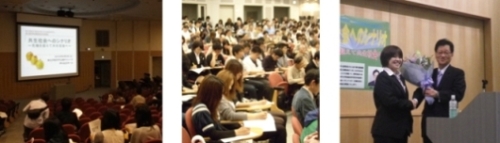
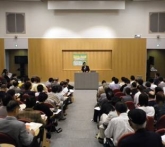
On June 5, 2010, we held the second lecture commemorating the opening of Department of Co-existing Society Studies, titled "Scenarios for an Inclusive Society: Overcoming Crisis, Towards an Inclusive Society," with Professor Emeritus Naohiko Kanno of the University of Tokyo and Chairman of the Local Government Finance Council as the lecturer. Many students from Department of Co-existing Society Studies, along with members of the general public, participated in the lecture. Some of the comments from the participating students are included below.
- I believe Professor Kanno's lecture gave our generation, who will be supporting not only the future labor market but the country itself, hints about Japan's past failures and what we should do going forward. I found it very informative and truly felt it was a wonderful lecture that significantly changed my understanding of economics. If there is another opportunity like this, I would definitely like to participate and change my own values. This lecture also made me realize that accumulating such experiences is what leads to my own growth.
(K, 2nd year student) - I learned so much from this lecture. At the same time, I felt like I found hope for overcoming these difficult times.
(2nd year student I) - As we are the people who will shape Japan's future, we must understand the current situation in Japan (politics, welfare, international relations, etc.). I wanted to look at the concept of a symbiotic society from various perspectives and connect them to different aspects of life.
(S, 1st year student) - During this lecture, I heard the Swedish words "omsøri" and "lagom" for the first time. When I heard the meaning of these words, I felt I understood what kind of thinking is necessary for coexistence in Japan and around the world.
(S, 1st year student) - In today's challenging world, what is most needed? I believe, as Professor Kanno also said, is for everyone to live not in isolation, but to share time together, cooperate, and support one another. Through this lecture, I was once again strongly reminded of the necessity of a symbiotic society. First and foremost, we, as students of Department of Co-existing Society Studies, must take the lead in seriously addressing the issue of a symbiotic society, and we must study and strive every day to ensure that Japan in the future becomes a society where everyone can live comfortably.
(Y, 1st year student) - In his lecture, Professor Kanno stated that compulsory education is not about developing the ability to make money, but about people from different backgrounds and upbringings gathering in the same classroom, learning together, learning to be members of the same society, and becoming a member of a community. I had never really thought about what compulsory education is before, so I was surprised to learn that we were already learning about coexistence at that stage.
(Ms. M, 2nd year student) - I was interested in the idea that providing services is more important than providing cash payments as a way to eliminate inequality and create an inclusive society. I had only considered giving money to people in financial difficulty, so it was good to learn about a new way to solve the problem. In particular, I think Japan should implement more retraining and re-education programs for the unemployed.
(1st year student A) - I was very pleased to attend Mr. Kanno's lecture and to hear from someone who is thinking about the future of Japan. I consider it a very valuable experience. What I realized is that in order to change the present and create something new, it is important to look back and re-examine the past. Rather than talking about ideals, I think the first thing we should do is to look with our own eyes at and understand past mistakes, discrimination, and failures in political systems.
(1st year student I) - Poverty and inequality are spreading throughout society. To overcome this crisis, it is essential that society as a whole shares the "pain" of difficult times and the "happiness" of overcoming them. It is important to propose concrete ways of society where everyone can work and live with dignity. However, in Japanese society, the happiness that should be "shared" is seen as something that is "taken away." We need to re-examine how we interact with each other. I believe that if we re-examine this and move closer to "sharing," we can create a better future.
(H, 1st year student) - Listening to this lecture, I was reminded once again of the importance and difficulty of coexistence. The meaning of "coexistence" is incredibly broad, even though it's a single word. Everything that can exist in the world lives together. There is indeed "coexistence" there. I feel that the essence of coexistence lies there. Simply "living together" is not coexistence. What is important is that we support each other, connect deeply, and walk together.
(1st year student K) - What I realized after attending this lecture was that Japan's current situation is more critical than I had previously thought. Comparing Japan's current fiscal situation and social security system with those of other countries made me realize its shortcomings. On top of that, it gave me an opportunity to reconsider the relationship between the economy and a harmonious society, and why building such a society is necessary.
(T, 1st year student) - Listening to Ms. Kanno's lecture this time, I was able to learn about the seriousness of the current state of society. Something must be done about Japan, which is facing a declining birthrate and an aging population. I also think that we cannot understand Japan's current situation by only looking at our own country, so we must find solutions after learning about the situation in other countries as well. I was reminded that in order to make our city a safe and comfortable place to live, it is important for each and every one of us to properly understand the current situation and cooperate with each other.
(T, 1st year student) - I realized how narrow my perspective on society had been until now. I used to think of child allowances as mere handouts, but I learned that these allowances and social security benefits, which may seem wasteful, protect the lives of each individual and are important for transforming society into one where we can live with peace of mind. Listening to the lecture, I felt that now is a major turning point in overcoming the economic crisis and transitioning to a "symbiotic society."
(T, 2nd year student) - Professor Kanno's lecture this time offered a broad perspective on what society should be like. As I live through this "age of crisis," the two words "Omsori" and "Lagom" that he taught me will serve as my guide. I think it would be wonderful if not only Japan, but the whole world, aimed for the knowledge society that Professor Kanno spoke of and moved forward with the spirit of "Omsori" and "Lagom."
(Second-year student I)