
Held on November 27, 2010
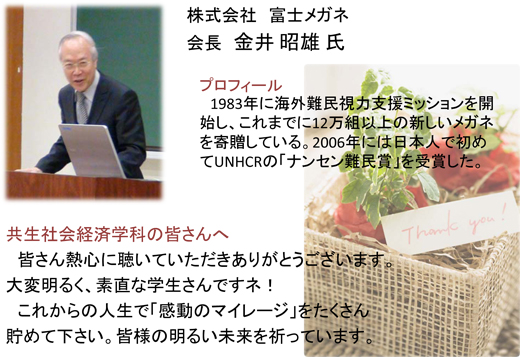
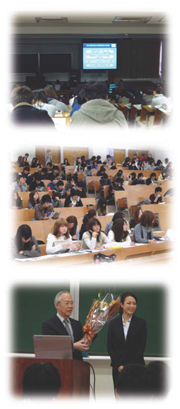
- I believe this initiative has continued this long because people who resonated with it connected with each other and dedicated themselves to making it a success. People from all over the world shared the same ideals and joined hands towards that goal. I felt there was some kind of unknown potential that I can't put into words. Things that are impossible alone become possible when everyone works together. I think that the essence of unlocking that "possibility" is "empathy."
(H, 1st year student) - I felt that this activity was made possible through the cooperation of many different people. And I was deeply impressed by the people connected through this collaborative relationship.
(H, 1st year student) - I was deeply impressed by today's lecture. I often find it difficult to act on things I want to do and end up giving up, but I was reminded of the importance of "just trying it." I also learned that one person's determined action can actually move many people, which I thought was truly wonderful.
(S, 1st year student) - When we talk about refugee support activities, it seems like a lot of it is indirect aid, such as providing food and clothing to the people on the ground. I think Fuji Megane is a pioneer in "face-to-face" support activities, which are something that Japanese people are not very good at. It is a job that gives people eyesight and hope for the future, and I am very proud of it, and I would like to do a job like that, where I can see as many smiles as possible.
(T, 1st year student) - Listening to Ms. Kanai's story, I realized that there are many different forms of refugee support. I had thought that food aid was the main activity, so I was surprised to learn about the project to donate eyeglasses. As I listened to her story, I came to understand how much joy and inspiration helping refugees regain their lost eyesight brings them, and I realized that it is a very meaningful activity.
(2nd year student A) - The many smiling faces wearing glasses were the most heartwarming I have ever seen. Grateful for the environment that allows me to witness these smiles, I too want to use the chain of happiness I received through Mr. Kanai to help others through my activities and way of life. Thanks to Mr. Kanai and his colleagues' wonderful work, I feel I was able to share the joy of sight with the refugees.
(2nd year student A) - I was also drawn to Ms. Kanai's personality, as she doesn't talk about how difficult and wonderful what she has accomplished was. Her work must have involved many obstacles and worries that we don't know about. I was deeply moved by how Ms. Kanai spoke about all of these aspects with a smile.
(2nd year student E)
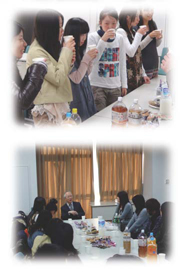
- If Ms. Kanai hadn't studied abroad, this activity might not have happened. You never know when or where you'll have such an experience, so I want to actively participate in various activities from now on.
(2nd year student E) - I strongly felt that the overseas refugee vision support mission is more than just volunteer work. The desire to give refugees the joy of seeing, and the feeling that "by enabling them to see, we can help their lives," was palpable, and it made me reconsider the concept and significance of coexistence.
(2nd year student F) - I have poor eyesight and have worn glasses since I was little. I thought this was perfectly normal and never considered myself particularly fortunate. But I realized I need to remember that there are people in the world who have poor eyesight but cannot afford glasses.
(K, 2nd year student) - I was deeply moved by how the staff members greeted me with smiles. It made me realize that in the future, I too want to take pride in my work and be of service to many people.
(Y, 2nd year student) - Through this lecture, I was reminded of the importance of sharing my happiness with others. Furthermore, my interest in volunteering has deepened, and I would like to utilize the fieldwork I will be taking in my third year to fully experience both the challenges and the rewards of volunteer work.
(Y, 2nd year student)