
Held on November 26, 2011

Student impressions
- During the Q&A session, listening to the story of the person selling Big Issue made me realize how prejudiced I had been towards homeless people. Homeless people are not simply people who live on the streets and live in poverty; they are people who have lost their jobs due to unavoidable circumstances such as being laid off, or who are having difficulty finding work due to the difficulty of finding employment. Many of them are working hard to be able to live a "normal life." It is inappropriate to have prejudices against people who are making an effort. In order to support the social reintegration of homeless people, I think the first thing is for us to change our own way of thinking. (K)
- Listening to Professor Sano's talk and the stories of those who sell Big Issue has lessened my preconceived notions about the homeless. I think that people like me who have preconceived notions about the homeless would also change if they had the opportunity to hear lectures like this. However, such opportunities are far too few. I believe that increasing the number of such lectures and providing more opportunities to learn about the homeless and those who sell Big Issue is the first step in breaking down the four major obstacles and seven barriers that Big Issue faces. (E)
- Seeing the salesperson desperately selling magazines on DVD, I strongly resolved that even though I know it's a tough and unpleasant job, when I do get a job, I will work with all my might. I haven't found a job yet, but I believe that any job will always be useful to people, so I was reminded that I must never forget to be grateful for having a job. And with that gratitude in mind, I will work my hardest, thinking of it as giving back to society. (T)
- Until now, I thought that giving homeless people "things" like food and money was the most appreciated thing we could do. Of course, that's also appreciated, but I've learned that "support that leads to a better tomorrow" is the most important thing. Even something as small as giving them "work" can be the first step towards independence. (K)
- Attending this lecture made me realize once again how important human connections are. I also learned about one possible solution to the homeless problem, and I'm truly glad I attended. I had never properly confronted the issue of homelessness before, so this lecture has given me a chance to do so. (Y)
- Apparently, 58 people have become independent through The Big Issue. There are still many homeless people out there, but the fact that there is an environment where they can become independent is a chance. I thought it was a wonderful thing that can tell homeless people that there is still hope. (S)
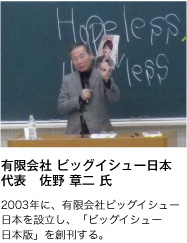
- Apparently, homeless people become "HOMELESS" because they are "HOPELESS." I was deeply moved by how the employees of Big Issue work so hard every day to figure out how to help them reintegrate into society. (I)
- The most desirable state for a company is one that contributes to society while also generating profits. (Mr. S)
- What impressed me most at this lecture was Mr. Sano's statement that "homeless people are not objects of pity, but business partners." (Ms. I)
- This is the point I resonated with the most: since the Great East Japan Earthquake, it seems that phrases like "Let's do our best, keep going" have been used as slogans. As Mr. Sano also mentioned, when you think about it, offering words like "together" and "it's going to be alright" instead of "keep going" to people who are already doing their best is essentially what Big Issue's activities are all about. As I pursue the idea of a "symbiotic society," I want to keep these points in mind and strive for a society where everyone can live without discrimination. I also want to create a society where we can support people in need, rather than forcing them to keep going with "keep going, keep going." (U)
- A week after the lecture, I went to Hashimoto's place to buy the latest issue of Big Issue. Hashimoto greeted me with the same smile as at the lecture, saying, "Welcome." It was my first time buying Big Issue, but all the articles were very interesting. Next time, I'm thinking of buying back issues along with the latest one. I want to take action, even if it's just a small step, as someone directly involved. (S)
- Later, I was walking down the stairs in front of Sendai Station with two friends when one of them exclaimed, "Oh! The person who came to my lecture is selling Big Issue!" Another friend suggested, "Should we buy one?" and so the three of us bought Big Issue for the first time. The man selling it had a very kind expression and said, "Thank you!" Seeing his face, I realized that I was the one who had been closing myself off. Apparently, there was a woman who had been consulting with him, and I could understand why. What made me happy that day was that not only I, but my friends also bought one, and we were able to share this feeling. (A)