
Held on June 15, 2013
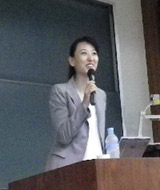
Certified NPO Bridge for Smile
representative Keiko Hayashi Mr.
After graduating from university, she joined the staffing company Pasona, where she worked as an executive secretary, in sales, and in human resources. In 2003, she encountered children's welfare facilities through an English language training program she participated in with the aim of studying for an MBA. In December 2004, she founded Bridge for Smile.
To all students studying in Department of Co-existing Society Studies
We tend to consider what we know and what we have experienced as "normal."
But in reality, no two people grow up in the exact same environment.
Everyone's home, school, and work environment is different.
Aren't we becoming too trapped by the concepts of "normal" and "common sense," creating a stifling society?
I hope we can all work together to create a society where we respect each other, accepting that differences are natural and perfectly acceptable.
By all means, cultivate your empathy skills.
Student impressions
- I was deeply moved by Ms. Hayashi's strong determination to balance work and raising children. I believe that being a woman and having children is a significant handicap in society. I thought it was wonderful that she is engaged in such activities despite the discrimination and prejudice. I also hope to live with the same strong will as Ms. Hayashi, live a life without regrets, and find work that allows me to support others. I also want to make an effort to live my life with an interest in the issues that are happening today. <Ms. M>
- Listening to Mr. Hayashi’s lecture this time, I realized anew that the general public still has very little knowledge or understanding of care facilities and the like. I believe Mr. Hayashi is working to bridge the gap between the general public’s perceptions and those of the facilities, but after hearing this lecture, I, too—having become aware of that gap—felt a sense of mission that perhaps we, as well, must take some kind of action.<S>
- What I realized after attending this lecture is that issues like prejudice and discrimination cannot be resolved solely within the confines of these facilities. Society as a whole must consider these issues with a supportive attitude. As a student studying in Department of Co-existing Society Studies, I want to consider these issues from both economic and social perspectives. <Ms. M>
- At this lecture, I learned about the challenges of living on my own and the importance of having someone to rely on.<S>
- This lecture was very educational; I learned so much about children's welfare facilities that I didn't know before. I was already interested in the topic, so I want to learn even more. It was also good to learn that there are people who provide support. I may not be able to do the same level of work as them yet. I may not be able to see the results of my efforts or see any tangible benefits, but I want to find something I can do. And one day, I hope to be able to support many people like Ms. Hayashi and her colleagues. <K>
- At the end of this lecture, we watched a video of a speech contest, and the people giving speeches looked incredibly radiant. They had lived in facilities and must have faced far more difficulties than us, yet they were so vibrant. We are supposed to be the ones providing support, but instead, I was the one who received energy, and it gave me the courage to try again something I had given up on for a long time. When I am able to work as a working adult, I would like to pay close attention to the children in care facilities and proactively support them. <W>
- I’m truly glad I had the opportunity to attend this lecture. I had never given much thought to children’s homes before, but when I heard about the hardships faced by those who grew up in them, I realized this is not an issue we can simply ignore. What surprised me most while listening to the lecture was Ms. Hayashi’s determination and drive. Even after getting married and having children—a situation where it would be perfectly normal to become a stay-at-home mom—she acted on her strong desire to “work.” I realized that while this might seem simple, it’s actually incredibly difficult. It may seem like hindsight, but by deciding to work and taking action, she encountered a children’s home while studying abroad and was able to share so many insights with us students through this lecture. I truly envied a life like hers. Of course, I’m sure Ms. Hayashi’s success was the result of her behind-the-scenes efforts, but learning that taking action can lead to such success gave me a little more confidence in myself. I believe that children from children’s homes are no different from other students. I think the goal of this NPO, Bridge for Smiles, is to ensure that these same children do not feel the gap between the facility and society, or the gaps between different facilities. Honestly, I think it’s an endlessly difficult problem, but seeing Ms. Hayashi’s attitude toward the children made me feel that it might actually be possible. I respect not only Mr. Hayashi but also everyone involved with the NPO. Thank you so much for showing me how the support of so many people can become a source of hope for these children’s futures. I’d love to attend another lecture.<S>