
Held on December 6, 2014
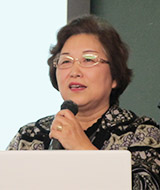
Instructor: Mikiko Orihara
Director of the special nursing home "Parcia"
I joined the Catholic Children's Welfare Association, a social welfare corporation, and gained experience as a life counselor, administrative supervisor, and office manager.
To all students studying in Department of Co-existing Society Studies
I am truly grateful that so many students listened attentively, even though it was a Saturday afternoon. It was a very meaningful time to have the opportunity to think together with young students about the past, present, and future of elderly care.
We are now facing a super-aging society, and the number of elderly people who develop dementia and require long-term care is increasing dramatically. While efforts are being made to address this societal change through reforms to the long-term care insurance system, numerous challenges remain. We are born as human beings, grow, work, raise children, and grow old. We are required to deeply consider how to understand and support these life changes that everyone experiences, not as something distant, but as something that concerns us all.
All elderly people desire to be needed unconditionally and to feel that they are valuable. When they require care, I realize every day in my work as a caregiver the importance of providing not only physical care but also spiritual care tailored to each individual.
I believe that a mature society where the elderly can enjoy a happy later life is similar to a society where all generations can live comfortably. I hope that young students will explore what they can do to build such a society and consider what it means to be a part of it.
Student impressions
-
Today's lecture provided valuable insights from Professor Oribara, who is at the forefront of addressing the aging of Japanese society and the treatment of the elderly, issues we study daily in this department. I believe this will help us to incorporate more concrete images into our daily learning. In fact, the case of a parent of a disabled child who killed their own child, which was the catalyst for Professor Oribara to take his first step into the field of social welfare, was just discussed in a recent lecture on civic activism.
I was able to listen to the talk with interest from beginning to end. Personally, I was deeply struck by what Professor Orihara said at the beginning of the lecture: "Getting old means losing the strength you cultivated when you were young. It's something you can't get back no matter how hard you try."
This lecture has inspired me to take action towards my grandmother and other elderly people in my community, respecting the elderly's desire to be treated as their number one priority and cherished above all else. I would like to express my gratitude to Professor Oribara for giving me this opportunity to think in this way. (A)
-
Listening to Professor Orihara's talk deepened my understanding of the activities at Parcia and the realities of elderly care. I also learned a lot about the history of elderly care. Elderly care will become an even more important field in society in the future, and it's a crucial job that directly supports people. I've become interested in it as a future career. I want to broaden my horizons and think carefully about my future. (T)
-
What I realized after attending this lecture is that future welfare services will require collaboration not only from those working in facilities, but from everyone living in the community. The increasing number of elderly people and the shortage of personnel involved in welfare are also accelerating the trend towards community welfare, but it also has the advantage of creating connections between people, so I think it is good to support the elderly in cooperation with local residents. I would like to apply what I learned from this lecture to the social welfare theory and community welfare theory I am currently studying, and I would also like to thank Professor Orihara for giving such a meaningful lecture. (S)
-
The lecture provided a more detailed explanation of elderly care, a topic we learn about in class, incorporating insights from those working in the field. I was particularly interested in the section on supporting independent living at home. I realized that with the aging population, health management for the elderly and preventative care to avoid the need for long-term care are crucial. (W)
-
I had learned about the history of welfare in lectures until now, but being able to hear from people involved in welfare at this lecture allowed me to understand the process more concretely. I realized for the first time after listening to the lecture that I had only seen the shift from a system of government-mandated services to a contract system from the perspective of the service users. The change to a contract system that allows people to choose facilities was a major transformation. I was glad I listened to the lecture because I was able to learn not only from the perspective of the service users but also from the perspective of the facilities. (S)
-
Shifting the national policy to prioritize social security should lead to a better life. As the baby boomer generation ages, the current problems will only intensify. I felt that Mr. Orihara's appeal, considering this foresight, was wonderful. We can support the elderly by realizing a dignified life that improves both internal quality of life for self-realization and external quality of life for society, and by coexisting with them. I learned that this is a problem that involves not only the elderly but also younger generations. (S)
-
I was very interested in the topic of welfare, and I'm glad I was able to learn a lot from hearing about special nursing homes for the elderly, as well as the current state and future of welfare.
This time, we learned about Parcia's fundamental philosophy. There were some words that made me feel a little sad, such as "preparing for heaven," but I realized that these words convey the meaning of the existence of a nursing home. And the word that left the biggest impression on me after hearing the philosophy was "pursuit of happiness." It means that everyone has the right to be happy, and I think there are many people in nursing homes who are comforted by this and are living happy lives. (Ms. M)
-
I was able to learn a great deal about the realities of elderly care. This experience allowed me to reflect on what I should do going forward and what the future holds for Japan. Hearing such valuable insights was very educational. (K)
-
I was very interested in this lecture because it was about long-term care, a topic I had studied in my second and third years. The lecture covered a wide range of topics related to long-term care, including its history, revisions to the long-term care insurance system, the personnel who support long-term care, and the types of personnel that are needed.
This lecture was a very valuable opportunity for me to learn about modern caregiving and to think about caregiving and welfare in my own way. I believe that if we, the younger generation, gain a deeper understanding of caregiving and become interested in related matters, Japan's future will be brighter and more vibrant. (K)