
Held on May 9, 2015
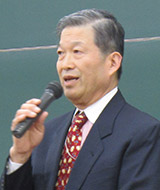
Lecturer: Hajime Kitamura
Freelance journalist
After working in news reporting at TV Asahi, she is currently a freelance journalist, supporting victims of the long-term effects of Agent Orange used in the Vietnam War.
Young people around the world
Have you read the United Nations Population Fund's (UNFPA) "State of World Population 2014"? It has the headline, "The Power of 1.8 Billion: Young People Transforming the Future." It says that there will never be another era with such great potential for economic and social progress. We are living in an age with the largest number of young people in human history...
However, Japanese society presents a challenging future for young people. That is precisely why young people with a clear vision for the future are needed to drive change.
For society, young people are hope and the engine.
There is a poem by Takayama Chogyu, a literary giant born in the Tohoku region.
"Sing, my friend, sing loudly. Sing of ideals, love of humanity, believe in progress, and advance endlessly—this is the calling of a poet like you."
Become aware of the great mission you have to live in the present and follow the path of coexistence.
Further developing empathy: A message from Hajime Kitamura (March 2016)
Student impressions
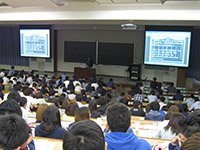
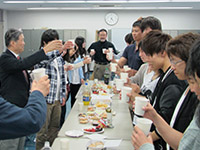
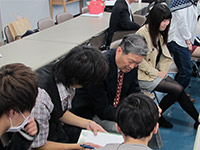
- I am shy and introverted. Since coming to Sendai, I have found it harder to find things interesting. However, none of the five actions for improving happiness discussed in this lecture—connecting with others, being active, being interested in things, continuing to learn, and giving—applied to me. Trusting others leads to a longer life, and being active is a way to break free from negativity. This lecture made me want to improve my university life going forward. (Y)
- There's something Mr. Kitamura said that left a lasting impression on me. It was that the Vietnam War isn't just something you read about in history textbooks. I think there are probably many people like me who are unaware of the Vietnam War and other tragic events of the past. In order to create a society of coexistence and a world without war, it's necessary to feel and reflect on these events as if we were directly involved. (S)
- This world is full of mysteries, and many things remain unexplained. I believe that having an interest in these areas and learning about the structure of this world will lead to happiness. Furthermore, I think it is very important to take an interest in others. By taking an interest in others, you open your heart to them, become a more likeable person, and I believe that this leads to happiness. I have learned that having an interest in things is very important for my future life, so from now on I will try to take an interest in various events. (I)
- Japan, where we live, is the only country in the world to have suffered atomic bombings, but it has become so peaceful that there is hardly any trace of that past, and it feels as though the horrors of war have faded from memory. Sometimes I even wonder if Japan really did wage war in the past. However, after hearing Mr. Kitamura's words that we must not let the horrors of war fade away in order to avoid repeating the foolish act of war, I felt that we must accept the reality that we did wage war. For that reason, I think it is necessary for us young people to take more interest in war and pass it on to the next generation. (K)
- To help people suffering in Vietnam and elsewhere, I believe that while medical care is important, it's also crucial to listen to them, alleviate their sadness, suffering, and anxiety, and ease their burden. Countries with high social capital, or communication skills, tend to have higher life expectancies. Therefore, I believe it's essential that young people go to those who are suffering and literally "put their hands together" with them. (T)
- What was most shocking was the sight of the victims. The Vietnam War resulted in millions of casualties. The toxins that entered their bodies were passed down not only to them but also to their children and grandchildren. It is estimated that there are as many as 200,000 such second and third-generation victims. The Vietnam War is not a thing of the past; it continues to this day.
Why wage war, even at the cost of so many lives? There is no justice or justification in war. Nothing is gained from war; all that remains are countless casualties and the despair of those left behind.
The memory of war must never fade. It is our duty as modern people to bear the sorrow of the victims and ensure that such a tragedy never happens again. (Ms. M) - This lecture was about the "damage caused by Agent Orange," a specific aspect of the Vietnam War, and it contained shocking facts that I had never heard in class.
After listening to this lecture, I've gained more things I want to learn and find out about at university, such as what kinds of people exist not only in Japan but around the world, and what kind of lives they lead.
The Vietnam War resulted in over 3 million deaths in Vietnam, 50,000 in the US, and 521 in Australia. However, the number of suicides afterward—100,000 in the US and over 1,500 in Australia—is overwhelmingly higher than the number of deaths. Despite these facts, why do wars continue to be waged around the world? I wanted to discuss this with many people. Listening to this lecture has broadened my perspective. (S.) - This lecture taught me about the horrors of chemical weapons. After listening to Mr. Kitamura's talk, I had to revise my understanding of war, realizing that it is far more dangerous and cruel than I had previously perceived. The effects and horrors of Agent Orange, in particular, left a lasting impression on me. The American military, through a temporary operation, caused the destruction of tropical rainforest ecosystems for generations to come, as well as inflicting tragic damage such as carcinogenicity and teratogenicity to fetuses. I was terrified to think that humans would resort to such cruel methods, even in order to win a war.
Having learned about this war in depth, I truly appreciate the preciousness and importance of the peace we have today, and I hope this peace will continue. However, I often hear that conflicts are still ongoing somewhere in the world. I don't want to think of these wars as something unrelated to us, and I want to broaden my knowledge and understanding of war over the next four years. (S)