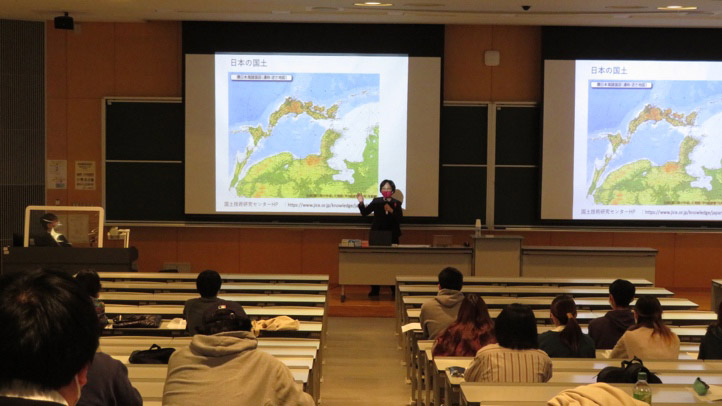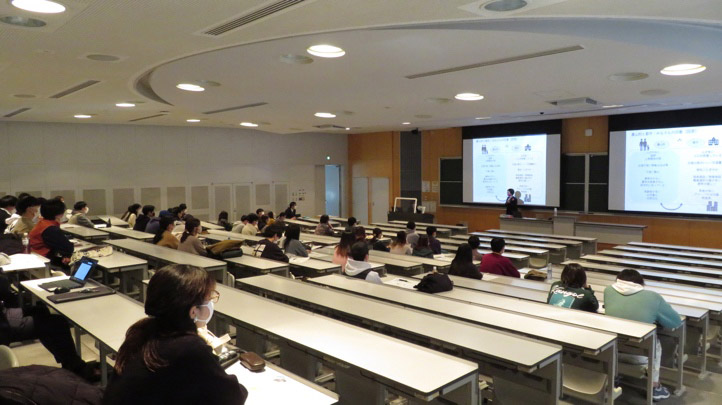
Held on Saturday, November 26, 2022
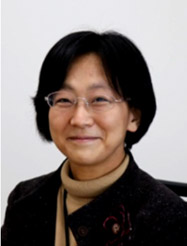
Instructor: Namiko Numao
(Professor, Faculty of International Studies, Toyo University)
He completed the second-term doctoral program at Keio University (Graduate Schools Graduate School of Economics). After serving as a research assistant at Keio University (Faculty of Economics) and as a researcher at the Tokyo Municipal Policy Research Institute (a public interest incorporated foundation), he became a professor at Nihon University (Faculty of Economics) in 2008. Since 2017, he has been a professor in the Department of International and Regional Studies at Toyo University (Faculty of International Studies). His areas of expertise are public finance and local public finance.
Lecture content
In an era where diversity is valued, where and how do you want to work and live? This time, together with you, we will consider the possibilities of cities and rural areas in the coming era, while also keeping in mind the diversification of work styles and lifestyles in the post-COVID era. The world's population has reached 8 billion, and there are predictions that water, energy, and food shortages will become more serious globally. We would like to reconsider the value of rural areas and think about cooperation and exchange between cities and rural areas, as well as the form of a region that resonates with you, and the way of living and working there.
Message to students
I've been thinking about the diverse regions in Japan and the various lifestyle and work options available. Each of us has a unique personality. I encourage you to think about where you want to live, how you want to live, and how you want to work, while keeping your own values in mind.
During this lecture, I was asked, "Why do you live in Tokyo?", which made me think about it again. I think I'm attracted to Tokyo because of the lifestyle of living in a traditional row house in the old downtown area, the relationships with neighbors, the comfort of a highly functional and convenient environment, and the opportunity to meet and discuss with people who have interesting ideas and technologies. However, with the advancement of digitalization, exciting rural areas are also emerging all over the country, offering access points to encounters with wonderful people.
I pray that you will all be able to connect with various regions and jobs and find a "place" and "relationship" that aligns with you.
Student impressions
- Things I had arbitrarily assumed were impossible in rural areas become possible thanks to technological advancements and people's ingenuity. Even cities, which I had the impression were convenient and full of possibilities, have their own difficulties in daily life. Up until now, I had made assumptions about whether I lived in a city, rural area, or the countryside, but I realized there's no need to make assumptions; possibilities are everywhere, and how you live your life is up to you.
- What left a lasting impression on me was the realization that rural areas have so much potential. Until now, I had thought that many rural areas were depopulated and that agriculture, forestry, and fisheries were the main sources of income. However, after hearing about concrete initiatives in places like Kawakami Village in Nara Prefecture and Ama Town in Shimane Prefecture, I was surprised to see that the options are truly expanding. There was a discussion about "appreciating that things are produced in the place where you live," and this is something that can be said about my own place of residence as well, so from now on I want to be a little more conscious of that appreciation in my daily life.
- I learned about a new perspective on cities and rural areas. Knowing that young people are increasingly migrating to these areas because they are expected to become more livable in the future completely changed my view of cities and rural areas.
- The section about identifying areas of personal connection was particularly helpful. I also want to incorporate areas of connection into my self-analysis and choose the work and lifestyle options that best suit me from among the diverse choices available.
- I was very surprised to see data that included figures showing more than half of the population is concentrated in the three major metropolitan areas, as I had never seen anything like it before. I think this will allow me to approach job hunting from a wider range of perspectives than before. I think I'll try researching companies again. The town revitalization policies were very interesting and piqued my interest. Therefore, this time I would like to research various town revitalization policies in addition to those of the town I heard about.
- I felt like my anxieties were being stirred up. I learned that reflecting on the space, the rich nature, the scenery, the events, and the things in a place is also a form of "empathy." Before attending the lecture, my goal was to decide whether to live in Sendai or the Kanto region, or in a city or a rural area, but after listening to the talk, I felt like "I could have fun anywhere in Japan!!!" and thinking about the future changed from a burden to an ease.
- In the future, Japan will face a declining birthrate and an aging population, which will change the structure of society. Within this context, even more diverse lifestyles and work styles will emerge in both urban and rural areas. Through this lecture, I realized the importance of not being fixated on a single place or job, but rather approaching society with a flexible mindset and a broad perspective.
- The talk about "Our 'Empathy' and 'Points of Empathy'" left the biggest impression on me. As the professor mentioned, when I became a third-year university student, I registered with "Rikunabi" and "Mynavi," and started receiving invitations for internships and other opportunities from all sorts of companies. For me, who didn't have a clear idea of "I want to work for this company or in this industry," these invitations only made me anxious, and until attending today's lecture, I felt anxious and impatient about job hunting. However, I realized that instead of focusing on "industries," it's necessary to change my "perspective" and think about things like "where I can empathize" and "what kind of workplace I can empathize with," such as whether to value "connections between people" or "space" such as "a team/workplace with a comfortable distance."
- I feel like my perception of cities and rural areas has been completely changed.
- What impressed me most this time was the effort being made to revitalize and preserve the region by making the most of the unique strengths of each rural area. I had resigned myself to the fact that small towns and villages have few opportunities to be seen and are only going to decline. Therefore, I felt that the best way to revitalize my hometown was to contribute indirectly to my hometown by revitalizing Fukushima Prefecture as a whole through Koriyama City. However, after listening to today's talk, I realized how narrow my perspective had been. I was deeply moved by the efforts being made to make the most of the unique strengths of the land, even in municipalities with populations the same as or even smaller than my own town. I was also excited to listen to the talk from beginning to end. I was able to reaffirm the reason why I have always dreamed of becoming a local government official. I want to look into more rural and urban initiatives that I am unaware of. By seeing various places and areas, I would like to convey the charm and things I love about my hometown to the fullest extent.
- I learned a great deal from this lecture. I realized that Japan, compared to the rest of the world, has a wide variety of regions and a diverse range of choices. Until now, I had thought that Japan was a country with few choices. I vaguely assumed that after graduating from junior high school, going on to high school, one would either go on to university or get a job. I learned that Japan has a wide variety of lifestyles depending on the region, and my perception of Japan has changed as I realized this aspect of the country.
- I had always dreamed of living in Tokyo, but this lecture changed my perception of the city, so I'm glad I learned about the situation there beforehand. I've decided to think carefully about what kind of person I am and work hard on my job search, taking into account what's important in rural and urban life.