
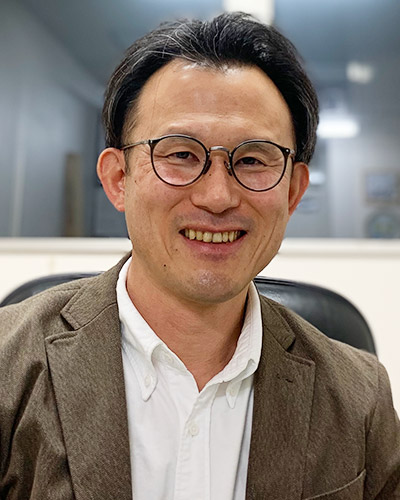
MUTO, Atsushi Associate Professor
Specialized fields
- social welfare science
Research Keywords
- Single-mother households, poverty issues, mother-child support facilities
Courses taught
- Social Welfare Theory, Public Assistance Theory, Fundamentals of Fieldwork, Fieldwork Ib, Basic Seminar, Seminar I & II
Representative works
- "Mother-Child Support Facilities and Social Policy," in Keiko Miyashita and Yachiyo Sudo (eds.), *A Gaze Towards the Future of Mothers and Children: 25 Years of Casa de Santa Maria, a Mother-Child Support Facility*, Heureka, 2021.
- "The Current Situation and Challenges of Mother and Child Support Facilities," Mirai, 2020.
- "Workfare or Income Security? – Considering Poverty in Single-Mother Households from the Perspective of Female Workers' Issues," in *The Aspirations of Social Welfare Research*, supervised by Nobukatsu Otomo, edited by Soon-ho Kwon, Yoshie Funamoto, and Noriharu Unuma, Horitsu Bunka Sha, 2017.
Message from the teacher
My specialty is social welfare studies. Social welfare has always aimed to address the living problems of citizens and guarantee a minimum standard of living. However, even now, many citizens live below the minimum standard of living. Among these issues, I have continued my research on the poverty problem of single-mother households and the ideal form of support facilities for single-mother households that protect and support single-mother households that are unable to live in their communities due to poverty. I focused on single-mother households when researching poverty because poverty problems among child-rearing households were particularly pronounced in single-parent households, especially single-mother households.
Unraveling the root causes of poverty among single-mother households and considering solutions will not only address the problems currently faced by single-mother households but also contribute to solving problems for all families raising children. Solving the intergenerational cycle of poverty, often referred to as child poverty, is crucial for considering Japan's future. By examining our present situation and imagining the future, we want to identify the shortcomings of this country's systems and policies and think together with you about what this country should be like.